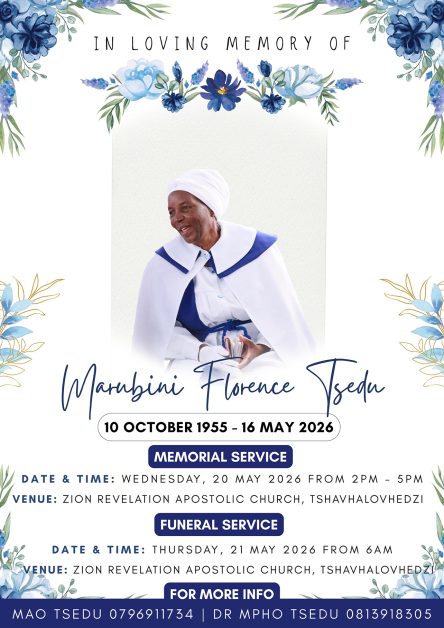
THERE are people whose names never make headlines, whose faces are never splashed across newspapers or television screens, but whose lives hold together families, communities, and even history itself. My aunt, Flora Marubini Tsedu, was one of those people.
I have struggled to write this tribute because she was not someone who demanded attention. She was quiet. Gentle. Reserved. In many ways, she and I were alike; we have our own subtle way of making our presence felt and not through loud words, but through kindness, consistency, and strength. You always knew she was there.
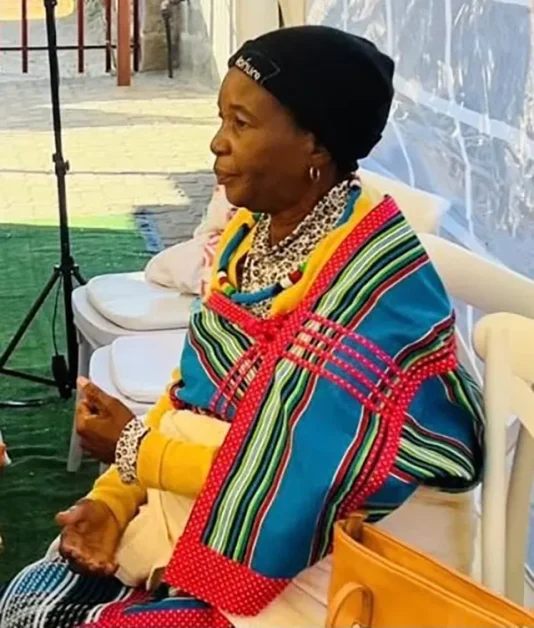
At home and in our village of Tshavhalovhedzi, in Venda, Limpopo, she was simply known as “Mme a Mpho”.
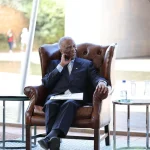
Many people know my uncle, Mathatha Tsedu, for his work in the media and politics. But for those of us who watched closely, we knew there was no Mathatha without Flora. I still struggle to speak about her in the past tense because, in my mind, they have always existed as one.
History often remembers the names of men who stood on stages, wrote articles, gave speeches, and led movements. But behind many of those men were women who carried burdens nobody saw. Women who held homes together while the world outside was falling apart.
Just like Nelson had Winnie, Steve had Ntsiki, and Chris had Limpho, Mathatha had Flora.
She was there when apartheid security police kicked down doors at their house in the early hours of the morning. She was the one left to comfort the children and family when her husband was detained. She was the one who moved from prison to prison searching for him while authorities refused to tell her where he was being held. She was the one making tea in the kitchen while comrades filled the house discussing politics, freedom, and resistance late into the night.
And yet she never asked for recognition.
Recently, while watching a documentary about Winnie Mandela, my wife asked me whether Nelson Mandela’s legacy would have survived prison in the same way without Winnie keeping his name alive outside. We both agreed it would have been difficult. In the same way, I do not believe Mathatha Tsedu would have become the man many people know today without “Mme a Mpho” beside him. She carried more than her share of the struggle.
But beyond politics and history, she was our teacher in the most literal sense.
Most children in Tshavhalovhedzi probably learned their first English words from her. She taught English at Sendedza Primary School for some time, and many of us still remember her handwriting and her simple signature on our homework books. There was nothing fancy about it. Just neat, quiet, and dignified. Exactly like her.
What hurts the most is that people like her often leave silently, but the emptiness they leave behind is loud.
Now “Mme a Mpho” is no more.
Mathatha has lost his Flora. Her children have lost their mother. The grandchildren have lost the grandmother whose home was always filled with warmth, laughter, and comfort. As Tshivenda says so beautifully, “Makhulu ndi tshiulu ri tamba ri tshi gonya.” A grandmother is the mountain we climb and play on without fear. For the grandchildren, that mountain now rests.
Our lives will never be the same again.
Marubini Flora Tsedu will be laid to rest this Thursday in her beloved village of Tshavhalovhedzi.
May your soul rest in eternal peace, Mme a Mpho.
Muya wa vho u edele nga mulalo.
*Tendani Tsedu is the Head of Corporate and Marketing Communications at the South African Medical Research Council. He writes in his personal capacity.