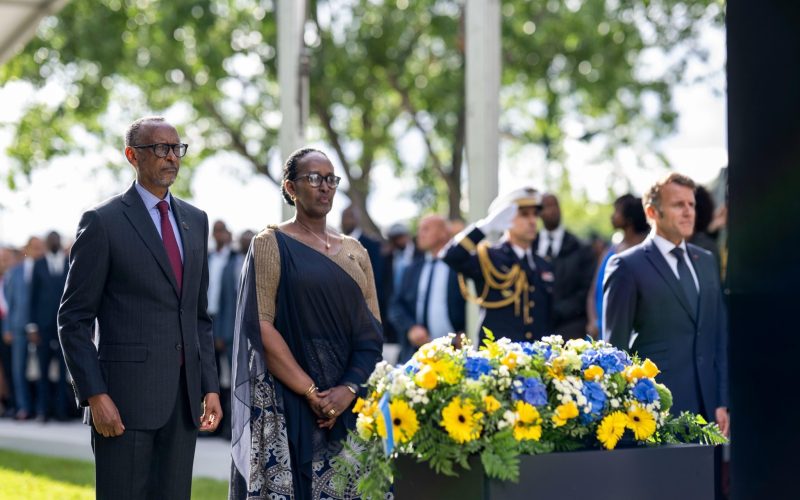
ON a June afternoon in Paris, before an audience that included heads of state, diplomats, historians and survivors, a monument was unveiled in France’s capital to honour the approximately 800,000 Tutsi massacred in Rwanda in 100 days of 1994. The ceremony was more than an act of commemoration. It was, in the words of President Paul Kagame, a moment of truth — and truth, he reminded France and the world, is more valuable than any formal apology.
President Kagame and First Lady Jeannette Kagame joined French President Emmanuel Macron, senior government officials, members of the diplomatic corps, academics, researchers and friends of Rwanda for the inauguration. The event, hosted in the French capital under the authority of the City of Paris, was a convergence of historical weight and diplomatic renewal — and it carried within it the unfinished grammar of thirty years of reckoning.
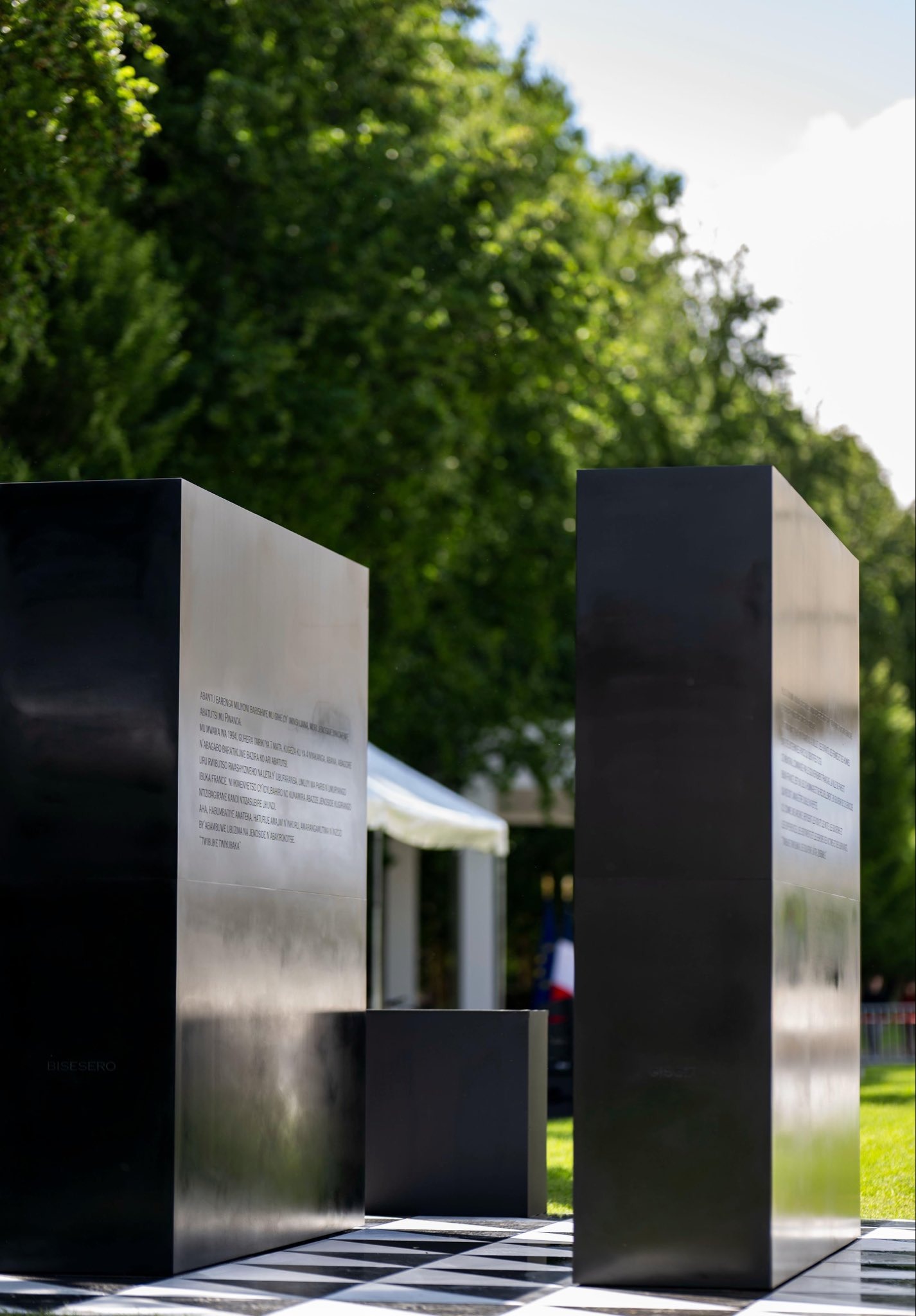
THE MONUMENT: TRUTH CAST IN PERMANENCE
The monument, described by Paris city official Guillaume Bontemps as an archive in stone where the voices and words, memories and experiences, feelings and hopes of victims and survivors are preserved, is designed to shelter testimony from the erasure of time. Its inauguration is the physical culmination of a diplomatic journey that began tentatively under President Nicolas Sarkozy and gathered decisive momentum under President Macron.
For Rwanda, the monument carries a significance that transcends symbolism. It is the inscription, in the most public and permanent form possible, of a truth that survivors have long carried alone. Speaking at the inauguration, President Kagame placed the monument within that larger context of testimony and dignity:
“The memorial before us is powerful, because it sets the truth in stone and protects it from the heartlessness of time, by instructing the living. It is not a validation, because none is needed. But it will stand as a mark of respect for the dignity of Rwandans and our history.”
President Paul Kagame | Inauguration of Monument, Paris, 3 June 2026
The phrase “it is not a validation, because none is needed” is characteristic of the register Kagame has long maintained when engaging France on the genocide. Rwanda’s history, his words insist, is not contingent on external endorsement. The monument does not confer truth; it reflects it. For survivors and the Rwandan state alike, this distinction is not semantic — it is the difference between a nation receiving permission to grieve and a nation asserting its own memory before the world.
FRANCE’S RECKONING: COURAGE, NOT COMFORT
The path to this monument has been neither short nor easy. For years, France’s relationship to the 1994 genocide was defined by denial, defensiveness and diplomatic silence. French military and political figures were implicated in providing arms, training and political cover to the Hutu Power regime that orchestrated the killings. Paris, which had intervened militarily under Operation Turquoise in June 1994, was accused by Kigali of having shielded perpetrators and delayed international response.
The relationship between Rwanda and France fractured entirely in 2006 when a French judge issued arrest warrants for nine members of President Kagame’s inner circle. Rwanda broke off diplomatic relations. Years of cold hostility followed.
The thaw began in 2010 under Sarkozy, who visited Kigali and acknowledged France’s political responsibility for not stopping the genocide. Kagame’s speech in Paris today extended explicit recognition to that opening:
“This door was first opened by President Nicolas Sarkozy, and I wish to commend him today.”
President Paul Kagame | Paris, 3 June 2026
But it was under Emmanuel Macron that France’s reckoning reached its most substantive expression. In May 2021, Macron travelled to Kigali and formally acknowledged that France bore heavy and overwhelming responsibility for the genocide by not stopping it. Speaking in Paris on Tuesday, Kagame made explicit the political courage that such an acknowledgement requires:
“Confronting historical responsibilities requires real courage, because it generates fierce opposition by those with a case to answer. You need a strong sense of humanity to see it through. President Macron, I want to commend you on both counts: courage and humanity. You acknowledged that France could have stopped the genocide, but did not. In response, I described your words as something more valuable than an apology: namely, the truth.”
President Paul Kagame | Paris, 3 June 2026
By commending Macron for courage and humanity, Kagame validates France’s journey in terms of the moral framework Rwanda has maintained throughout — one that foregrounds the human cost of political cowardice, and acknowledges bravery when it appears.
FORESEEABLE. FORESEEN. FAILED.
In his most historically significant passage, Kagame addressed directly the nature of France’s proximity to the genocide — and the gap between knowledge and action that cost nearly a million lives:
“The Genocide against the Tutsi was foreseeable, and in fact foreseen, and France was in a unique position to observe and to act. It took too long for France to come to terms with its role, causing additional pain.”
President Paul Kagame | Paris, 3 June 2026
This is the crux of Rwanda’s grievance with France — and with the international community more broadly. The genocide was not an ambush of history. It was preceded by years of anti-Tutsi propaganda, lists drawn up, weapons distributed, and rehearsal massacres carried out. French officials, intelligence services and military advisers were embedded in Rwanda during this period. The Duclert Commission, established by Macron in 2019, concluded from France’s own archives that France bore heavy and overwhelming responsibility. The French National Assembly’s 2021 report found that France had been blind to genocide preparations.
Kagame does not say France committed genocide. He says France was in a unique position to observe and act — and did not. That is its own verdict.
UNFINISHED BUSINESS: WHERE CONSENSUS HAS NOT BEEN FOUND
Kagame’s speech was not a declaration of closure. He acknowledged explicitly that the two countries have not reached full consensus on the historical record, and that the legitimate anguish of survivors and genocide advocates who remain dissatisfied has not been extinguished:
“And on some points, we still have not found consensus. I fully understand the feelings of those survivors and advocates, who remain dissatisfied with the official record. But I believe that our common work has initiated a journey towards truth, which is irreversible.”
President Paul Kagame | Paris, 3 June 2026
This is a moment of political honesty. Survivor organisations, including Ibuka — Rwanda’s largest genocide survivors’ association — have repeatedly stated that France has not gone far enough in prosecuting those who committed genocide on French soil, and that a formal apology remains outstanding. Kagame’s acknowledgement of their dissatisfaction, delivered on French soil in French diplomatic company, holds France to the trajectory it has chosen while leaving room for the further steps — judicial, archival, reparative — that survivors continue to demand.
FRANCE AMONG NATIONS: A RELATIVE STANDARD
In one of the most diplomatically significant passages of his address, Kagame broadened the lens to hold France’s reckoning against the wider failure of the international community in 1994:
“And France was not alone in falling short, far from it. Many other countries did so as well, but none has gone as far as France in setting the record straight and accepting its part in the tragedy.”
President Paul Kagame | Paris, 3 June 2026
The United States avoided using the word genocide during the killings, fearing legal obligations to act. The United Nations failed to act on General Roméo Dallaire’s urgent warnings from the ground. Belgium, Rwanda’s former colonial administrator, withdrew its peacekeepers entirely after the killing of Belgian soldiers in the genocide’s opening days.
None of these powers has matched France’s public acknowledgement. Kagame’s words are at once a recognition of France’s relative courage — and an implicit indictment of those who have not taken even the steps France has.
A NEW CHAPTER: PARTNERSHIP GROUNDED IN TRUST
The inauguration was followed by a state dinner at the Palais de l’Elysee, hosted by President Macron and First Lady Brigitte Macron. It was a setting that would have been unimaginable during the years of rupture. What was being transacted was not just diplomacy — it was the operationalisation of reconciliation.
Kagame’s closing words at the inauguration gave precise shape to Rwanda’s vision for what this relationship can now become:
“This has been a day of great meaning and promise. Rwanda appreciates the steps you have taken. We have chosen to look forward and write a new chapter together, and that choice is already bearing fruit. The ambition is there on both sides. But what matters most is the renewal of trust. Today, France is an important partner for Rwanda in investment, technology, climate, and many other common priorities. Rwanda looks forward to working with France to deepen our collaboration and expand the possibilities between our two countries.”
President Paul Kagame | Paris, 3 June 2026
The language of investment, technology and climate is deliberate. Rwanda under Kagame has pursued a development model emphasising high-value sectors — fintech, tourism, health innovation, climate resilience — and France, with its development finance reach across Francophone Africa, is a natural partner. The diplomatic normalisation initiated in 2021 has already translated into concrete agreements. The monument, in this sense, is not only an act of memory — it is a foundation for commerce, cooperation and shared continental leadership.
WHAT THIS MOMENT MEANS FOR AFRICA
The Rwanda-France reconciliation carries implications that extend beyond the bilateral. It is one of the most consequential post-colonial accountability processes in African diplomatic history — a case study in whether a European power can honestly confront its role in African suffering and build a new relationship on that honest foundation.
It also arrives at a moment of significant continental pressure on inherited frameworks of French influence. France has faced expulsions from Mali, Burkina Faso and Niger — countries where its post-colonial relationships have collapsed under the weight of unresolved grievances. The contrast with Rwanda is instructive: where France has acknowledged its failures and pursued a relationship built on mutual respect and on Rwanda’s terms, the partnership has deepened. Where France has not, the relationship has fractured.
For the African Union, for pan-African diplomacy, and for a continent that continues to seek reparative justice from its former colonial powers, the Paris monument offers both a model and a benchmark. It is not the endpoint. Kagame has been clear on that. But it is, as he put it, an irreversible journey — and the stone in which that truth has now been cast will not be easily moved.