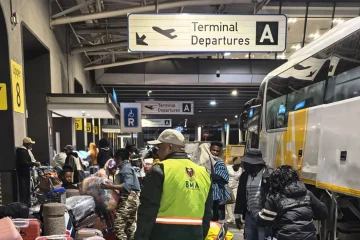
SHE came in on United Airlines flight UA 996, wheels down at Kotoka International Airport at approximately 9:01 a.m. on Tuesday. For Sedina Tamakloe-Attionu, former Chief Executive of Ghana’s Microfinance and Small Loans Centre (MASLOC), the landing ended five years of freedom — and began what ought to be a decade behind bars.
Officers of the Ghana Police Service and the Ghana Prisons Service were waiting. The woman who had used a court-sanctioned medical trip to the United States in 2021 as a one-way exit from Ghanaian justice was received, debriefed, and subjected to medical examination before being taken into custody. The machinery of the state — the same state whose coffers she had been convicted of looting — now had her firmly in its grip.
“She had used a court-sanctioned medical trip to the United States as a one-way exit from Ghanaian justice. Five years later, there was nowhere left to go.”
THE CRIME: NINETY-THREE MILLION REASONS TO FLEE
MASLOC — the Microfinance and Small Loans Centre — exists, in theory, to place credit in the hands of Ghana’s most economically marginalised citizens. Between 2013 and 2016, while Tamakloe-Attionu served as its chief executive under the first Mahama administration, the institution became instead a vehicle for one of the most brazen acts of public theft in Ghana’s recent history.
The Accra High Court found her guilty on more than 70 corruption-related charges, including causing financial loss to the state and stealing. The total haemorrhage: GH¢93 million — equivalent to more than $6 million in public funds — diverted, misappropriated, gone. Among those defrauded were the victims of the Kantamanto market fire outbreak, people who had lost their livelihoods to disaster and turned to MASLOC for recovery support. They received nothing.
That this money has not been recovered — that GH¢93 million of public funds remains unaccounted for — is not a secondary detail. It is the central fact. Tamakloe-Attionu’s incarceration, while necessary, does not return a single cedi to the state. The criminal process and the recovery process are two separate battles, and Ghana has so far won only one.
THE ESCAPE: A MEDICAL TRIP THAT BECAME AN EXILE
In 2021, while her trial was still active, Tamakloe-Attionu applied to the Accra High Court for permission to travel to the United States for medical treatment. The court granted it. It was a decision that would cost Ghana three further years of judicial process and an international extradition effort spanning two continents.
She did not return. The trial continued in her absence. In April 2024, the Accra High Court convicted and sentenced her in absentia, imposing ten years of imprisonment for her crimes. It was a statement of judicial resolve, but also an admission of powerlessness: Ghana had the verdict but could not touch her.
Three months later, in July 2024, the Government of Ghana submitted a formal extradition request to the United States. What followed was a painstaking legal process: a US District Court in the State of Nevada reviewed Ghana’s application, examined the supporting documentation, and ultimately certified the extradition. US authorities notified Ghana of the surrender in January 2026.
THE RETURN: A LANDMARK IN EXTRADITION HISTORY
Her arrival on Tuesday is not merely significant in the Tamakloe-Attionu case. It is, by the account of Ghanaian authorities, the first successful extradition from the United States to Ghana since 2009 — a gap of 17 years. That alone speaks to the rarity and the difficulty of this kind of international legal cooperation.
The United States Embassy in Accra confirmed the extradition, noting that Tamakloe-Attionu was being surrendered to serve the sentence imposed by the Accra High Court. The bilateral mechanics — the diplomatic notes, the Nevada federal court proceedings, the logistics of a transatlantic transfer — represent months of sustained government-to-government effort that is often invisible to the public until the moment a plane lands.
There is more to come. Ghana’s Attorney-General is scheduled to meet counterparts at the United States Department of Justice for bilateral discussions on all pending extradition requests between the two countries — a meeting that will, no doubt, be coloured by the momentum of Tuesday’s transfer.
THE POLITICAL QUESTION: WILL SHE ACTUALLY SERVE?
This is where the hard political question intrudes — and it must be asked without flinching. Sedina Tamakloe-Attionu served as MASLOC chief executive during the first Mahama administration, 2013–2016. John Mahama is now President again, returned to office in January 2025 on a platform that included a commitment to an Office of the Receiver for Assets and Liabilities (ORAL) — a mechanism intended, among other purposes, to claw back stolen public funds.
The extradition itself happened under this government’s watch. The Attorney-General’s office pursued it. That is credit where credit is due. But the history of Ghanaian anti-corruption enforcement is also a history of high-profile convictions that dissolve quietly — pardons, nolle prosequi entries, sentences suspended on grounds that never quite bear scrutiny. The public is entitled to be sceptical, and that scepticism is not partisanship: it is memory.
“The extradition is a milestone. Whether it produces justice — or merely spectacle — will depend entirely on what the Mahama government does next. And Ghana is watching.”
Ghana’s anti-corruption community has welcomed Tuesday’s development as proof that flight does not guarantee freedom. Anti-corruption advocates have cited the case as a major test of Ghana’s ability to pursue and secure the return of convicted public officials who flee while facing criminal proceedings — a test, they argue, the country has just passed.
But passing the extradition test is the beginning, not the end. The sentence must be served. The assets must be identified and seized. The GH¢93 million — or whatever portion of it remains traceable — must be pursued through every legal avenue available. ORAL was a promise made to the Ghanaian people. The Kantamanto fire victims, and the millions of ordinary citizens whom MASLOC was meant to serve, are part of the constituency to whom the promise was made to.
ANALYSIS: WHAT THIS MOMENT MEANS FOR AFRICAN ACCOUNTABILITY
Across the continent, one of the most pernicious features of elite corruption has been the ease with which its perpetrators have accessed international sanctuary. The wealthier the crime, the wider the escape routes. Western capitals — London, Washington, Dubai — have long served as unofficial retirement destinations for Africa’s convicted and accused, their legal systems moving slowly enough that extraditions become negotiations and negotiations become oblivion.
The MASLOC extradition chips at that assumption. It demonstrates that the US-Ghana extradition treaty — dormant for a decade and a half — can be activated, that a US federal court will certify such a request, and that the process, though gruelling, produces results. It sends a signal that other fugitives across the continent should absorb carefully: the runway is not endless.
For Ghana specifically, the case tests the narrative of a government that came to power on accountability rhetoric. Mahama’s second term began with considerable goodwill on anti-corruption issues. The decision to vigorously pursue this extradition — even knowing the political proximity of the accused to the NDC era — suggests the government understands it cannot selectively enforce convictions without destroying its own credibility. Tuesday’s result is the dividend of that understanding.
For now, UA 996 has delivered a verdict that five years of evasion could not overturn. Sedina Tamakloe-Attionu is in Ghanaian custody. The Kantamanto victims are still waiting for their GH¢93 million. And Ghana is watching.
KEY FACTS: THE MASLOC SCANDAL — A TIMELINE
2013–2016 — Tamakloe-Attionu serves as MASLOC CEO; alleged embezzlement of GH¢93m (≈$6m) occurs, including diversion of funds meant for Kantamanto fire victims.
2021 — High Court grants her leave to travel to the US for medical treatment while standing trial. She does not return.
April 2024 — Accra High Court convicts and sentences her in absentia to 10 years on more than 70 charges, including causing financial loss to the state and stealing.
July 2024 — Government of Ghana submits formal extradition request to the United States.
January 2026 — US authorities notify Ghana of her impending surrender following certification by the Nevada federal court.
9 June 2026 — Tamakloe-Attionu arrives at Kotoka International Airport on UA 996 at 9:01 a.m. Taken into custody. First US-Ghana extradition since 2009.