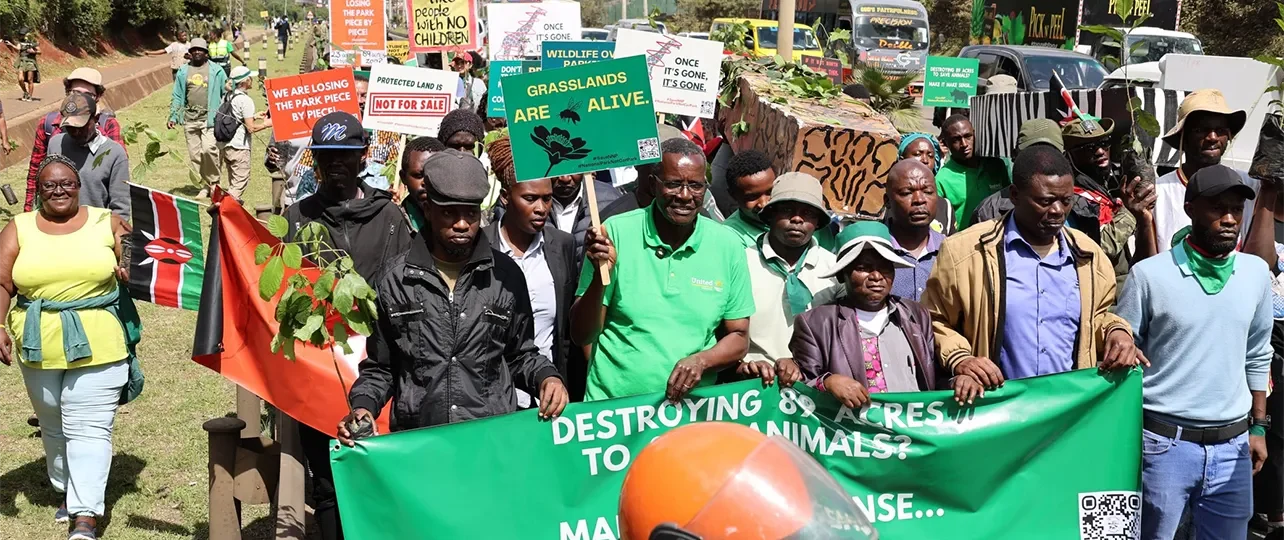

THE scene at the edge of Nairobi National Park on Monday morning was one of those that writes its own history. A man in a green T-shirt – the same shade worn by the activists around him – stood his ground as police moved in. He was not just any protester. He was David Maraga: former Chief Justice of the Republic of Kenya, constitutional champion of judicial independence, and the man who nullified a presidential election and survived the fury that followed. And now, at the park boundary on Lang’ata Road, he was being bundled into a police lorry alongside environmental activists who have been trying for months to stop the destruction of one of Africa’s most extraordinary urban wildernesses.
He was detained at Lang’ata Police Station. He was then released. And then – in the gesture that elevated the moment from a protest arrest to a statement of principle – he refused to leave.
“I will not leave this station until all those detained are released.”
Former Chief Justice David Maraga, Lang’ata Police Station, June 8, 2026
Eight of his fellow activists remained in custody when those words were spoken. Maraga, a man who spent his career interpreting the law from the highest bench in the land, chose to interpret his own freedom as meaningless if it came at the expense of solidarity with those who had none. It was a small act. It was also a profound one.
A PARK UNDER SIEGE
Nairobi National Park is unlike anything else on the planet. Located barely seven kilometres from the central business district of a capital city of five million people, it is a 117-square-kilometre sanctuary where lions still move through grasslands within sight of corporate towers. It is the city’s oxygen, its identity, and – for an increasingly urbanised and climate-anxious generation of Kenyans – its conscience.
It is also, apparently, in the way of progress. The Kenya Wildlife Service, operating under a licence issued by the National Environment Management Authority on December 3, 2025 – details of which only became publicly known in February 2026 – has begun clearing trees to make way for an expansion of the Bomas of Kenya International Convention Centre. The project carries a price tag of Sh41.9 billion. Central to the controversy is the proposed excision of 76 acres of protected parkland, including indigenous forest, to accommodate a 1,300-vehicle parking facility and a pedestrian overpass connecting the convention complex to the relocated Nairobi Animal Orphanage, which has stood on its current site for 62 years.
Tree-clearing operations began in March 2026. By the time protesters were arrested on Monday, the construction machinery had been at work for three months. What the government describes as a modernisation project and a boost to Kenya’s capacity to host major international events, conservationists describe as the beginning of the end of the park’s ecological integrity.
“Nairobi National Park is not for sale. Our public spaces, our environment, and our rights cannot be traded away behind closed doors.”
Friends of Nairobi National Park, Kituo cha Sheria, and Friends of Karura Forest have petitioned the Senate and filed High Court cases citing irregular procurement and inadequate public participation. Environmental groups – including the Green Belt Movement, founded by the late Nobel Peace Prize laureate Wangari Maathai – have called for the immediate suspension of all construction activities, full public disclosure of the Environmental Impact Assessment, and an independent review. One lobby group has warned that up to 100 acres of upland forest could ultimately be at risk if the precedent of the current excision is permitted to stand.
Members of the National Assembly Tourism and Wildlife Committee have themselves raised alarm over the cost of the Bomas International Convention Centre project and the legitimacy of the procurement process. Critics argue that the scale of the planned parking facility – 1,300 bays – far exceeds what would be required for an orphanage relocation and is primarily intended to serve the convention centre’s commercial ambitions.
THE LAW, THE MAN, AND THE MOMENT
There is something deliberately symbolic about David Maraga being among those arrested at this protest. In 2017, as Chief Justice, Maraga led the Supreme Court bench that nullified the presidential election of Uhuru Kenyatta – a decision that shook the continent and was celebrated across Africa as proof that judicial institutions could hold. He retired from the bench in January 2021 and has since emerged, in the words of one Kenyan commentator, as a ‘roving conscience of the republic’ — joining demonstrations, lending his name and his presence to causes that he believes threaten Kenya’s constitutional order.
On Monday, Maraga wrote on X — the platform formerly known as Twitter — that he had been arrested while en route to present a petition to the Kenya Wildlife Service. ‘Our national heritage and environment must be safeguarded from greed and unnecessary destruction without public participation,’ he wrote. The police did not immediately issue a statement explaining the basis for the arrests.
The footage circulating on social media told its own story: a former Chief Justice, dressed like the activists around him, trying to take cover from a police sweep near the park’s main entrance, and then being escorted without ceremony into a police vehicle. Civil society organisations described the protest as entirely peaceful. The arrests, they said, represented a growing threat to civic space and democratic participation in Kenya.
“Protecting the country’s natural heritage should not be treated as a criminal act.”
Maraga’s decision to remain at the police station after his own release is the detail that will endure. It is the kind of gesture that costs a person nothing materially and everything reputationally — because it subordinates the powerful person’s freedom to the principle that justice is not justice if it is selective. In a country where former officeholders routinely exchange one form of privilege for another, Maraga planted himself on a bench in a police station and waited.
WHOSE PARK? WHOSE CITY?
The battle over Nairobi National Park is, at its core, a battle over who gets to decide what a city is for. Kenya is one of Africa’s fastest-urbanising countries. Nairobi is expanding in every direction, consuming agricultural land, wetlands, and green corridors with an appetite that reflects both genuine development pressure and, its critics say, the unchecked ambitions of a construction-and-procurement complex that is deeply embedded in the state.
In that context, the park is more than an ecological resource. It is a line. Every excision, however small, however justified by the bureaucratic vocabulary of ‘modernisation’ and ‘public benefit,’ moves that line. Environmental lawyers have long argued that once the logic of excision is accepted — that protected land can be repurposed if the project is sufficiently prestigious — no conservation boundary is safe. The 76 acres being cleared today become the template for the next 76, and the next.
The Bomas project has its defenders. Supporters argue that Kenya needs world-class conference infrastructure to compete with South Africa and Rwanda for the continent’s high-value meetings diplomacy. They maintain that environmental safeguards have been factored into the planning. They note that the project was licensed by the relevant regulatory authority. These are not trivial arguments. But they are arguments that, in the view of both the courts and the conservation movement, were never put to the Kenyan public in the manner that the law requires.
The NEMA licence was issued in December 2025. Its existence was disclosed to the public only in February 2026 — two months later. Tree-clearing began in March. Protests intensified through April and May. By Monday, the situation had escalated to the point where a former Chief Justice and nine other citizens were being driven away from a wildlife boundary in a police truck. At no point in this sequence did the government convene the kind of open, substantive public participation process that Kenya’s constitution and environmental legislation demand.
“Every tree cleared inside that park is a verdict on what kind of country Kenya has chosen to become.”
THE CONTINENTAL STAKES
For readers beyond Kenya’s borders, it is worth pausing on what is at stake in continental terms. Africa is home to the world’s greatest concentrations of terrestrial wildlife. It is also the continent most acutely threatened by the infrastructure demands of rapid urbanisation and the climate pressures that follow land-use change. The argument that protected areas are negotiable when a sufficiently large development project requires them is not a Kenyan argument alone — it is made in Dar es Salaam, in Abuja, in Accra, in Kinshasa. And every time it succeeds, the template is strengthened.
Nairobi National Park’s singular character — a wild ecosystem embedded in a capital city, sustained across decades of explosive urban growth through the will of successive governments and the advocacy of generations of conservationists — makes it one of Africa’s most important arguments for the possibility of sustainable urbanisation. To excise it in pieces for convention centre parking is to forfeit that argument. It is to tell the continent that when commerce and conservation conflict, commerce wins.
The protesters who gathered on Monday — and the former Chief Justice who stood among them — understand this. They are not opposed to development. They are opposed to development that circumvents public participation, that treats protected designation as a bureaucratic inconvenience rather than a constitutional obligation, and that erases irreplaceable natural heritage for infrastructure that could, with imagination and political will, be built elsewhere.
WHAT COMES NEXT
By Monday evening, eight of the nine protesters arrested alongside Maraga had not yet been released. High Court petitions are pending. The Senate has received representations from conservation groups. The National Assembly committee has raised questions about procurement. And David Maraga sat in Lang’ata Police Station, waiting.
The government’s next moves will be revealing. If it releases the remaining activists without charge and suspends construction pending proper public participation, it will signal a willingness to course-correct. If it proceeds — if it charges the protesters, clears the injunctions, and presses on with the Bomas expansion — it will have made a choice about Kenya’s character that will not easily be unmade.
What is certain is that the arrest of a former Chief Justice at an environmental protest has drawn international attention to a controversy that the state might have preferred to resolve quietly. The footage of Maraga being escorted into a police vehicle has circulated globally. The image of him refusing to leave a police station until his colleagues were free has circulated further. These images do not fade. They become part of the record of a country’s choices at a particular moment in its history.
“A man who once nullified an election in defence of the constitution now finds himself defending trees. The through-line is the same: the law must mean what it says.”
David Maraga’s political ambitions — he has indicated interest in the 2027 presidential contest — mean that his presence at the protest is not without calculation. But calculation and conviction are not mutually exclusive. He was there. He wore the green shirt. He sat in the police station. Whatever his motivations, the act is the act, and it will be judged on its terms.
Nairobi National Park will survive this week. Whether it survives the decade is a question that Monday’s events have made more urgent, and more visible, than at any point in its history. The lions in the grassland, indifferent to the drama at the park boundary, are not waiting for an answer. But the city around them — and the continent watching from beyond it — is.