
NASSER Hospital in Khan Younis is the last major medical facility continuing to operate in the southern Gaza Strip. Over more than two and a half years, The New Humanitarian has reported on how the facility and its staff have struggled to continue providing healthcare amidst the Israeli military campaign that has laid waste to Gaza and the blockade that has choked off essential supplies. The hospital has been besieged and raided, then hurriedly reopened: The staff has been working under immense strain.
Recently, The New Humanitarian revisited the hospital and spoke with staff members who were interviewed in previous articles to better understand the challenges the facility continues to face during the current so-called ceasefire as well as how Israel’s genocidal war has affected the frontline workers who have been trying throughout to provide healthcare to Gaza’s population.
Nasser Hospital director Atef al-Hout described the facility as “a heap of compounding crises, down to the simplest things”. He said there has been no meaningful improvement in conditions despite last October’s ceasefire agreement between Israel and Hamas.
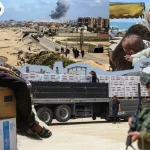
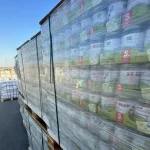
The frequency of attacks has reduced, but Israel continues to carry out strikes and target Palestinians. Over 980 people have been killed, and nearly 3,100 have been injured since the ceasefire agreement came into effect, according to Gaza’s health ministry. Israel has also continued to restrict the entry of aid, medical supplies, fuel, generators, and equipment needed to keep health facilities functioning at even a minimum level.
Desperately needed reconstruction efforts have failed to materialise as global attention has shifted elsewhere, and Israeli leaders are once again openly discussing plans to take over at least 70% of the enclave and expel the vast majority of Palestinians from the territory.
Al-Hout described the situation in Nasser Hospital as “catastrophic”. Nearly 50% of medications are entirely out of stock, and there are shortages of many others. The hospital’s oxygen station, which should produce oxygen at 95% purity, now operates at 80%. Laboratory culture materials needed to test for bone infections before surgery have been unavailable for over a year and a half because Israel has refused their entry.
“No medical equipment of any kind has been permitted in,” al-Hout said. The ban extends to maintenance parts for existing machines, electricity generators, their fuel and oil, and spare parts.
“Every single thing in the complex is a crisis,” he said. “A shortage of just one item halts surgeries. Sometimes it is gauze. Another time it is anaesthesia drugs. Then antibiotics. It moves from one crisis to the next.”
Patients suffer and even die from illnesses, wounds, and complications that would be easily treatable or preventable if the necessary supplies were allowed in, according to medical workers.
Before the beginning of the war in October 2023, Nasser had 342 beds. That number was increased to 600 during the conflict. At its peak, more than 1,100 patients filled the facility, half of them without beds. Currently, around 440 patients are admitted. The hospital, which previously served roughly 350,000 people, now covers more than double that figure due to Israel pushing Palestinians out of much of southern and eastern Gaza.
Some 2,700 medical staff work at the complex, including personnel absorbed from hospitals in Rafah and or other parts of Khan Younis that were destroyed or that are behind the so-called yellow line demarcating over 60% of Gaza currently controlled by Israeli forces, which the vast majority of Palestinians are barred from entering.
The radiologist, Mohamed Abu Mousa
Mohamed Abu Mousa, 45, has been working at Nasser Hospital since 2009. When The New Humanitarian visited recently, he was positioning an elderly patient on the CT scanner, pushing the gurney manually into the machine, then circling back to the control room. He adjusted settings on a primary monitor and several auxiliary screens, conferred with a colleague on imaging angles, and then began the scan. It was an ordinary sequence in extraordinary circumstances.
The CT scanner Abu Mousa operates is the only one functioning in all of southern Gaza. Before the war, Khan Younis governorate had six hospitals, and each had a CT scanner. The other scanners were destroyed or rendered inoperable during successive Israeli military operations, along with many of the other medical facilities.
“This means a medical, moral, and national responsibility falls on us to make sure nothing fails,” said Abu Mousa.
The New Humanitarian first spoke to Abu Mousa in October 2023, the devastating first month of Israel’s military campaign. At the time, he recounted the story of finding his seven-year-old son Youssef’s body in the hospital’s morgue following an Israeli airstrike on his family’s home. “We don’t have the luxury of pausing to grieve,” Abu Mousa said back then. “The heartache is immense, but the wounds are endless. We have to keep going.”
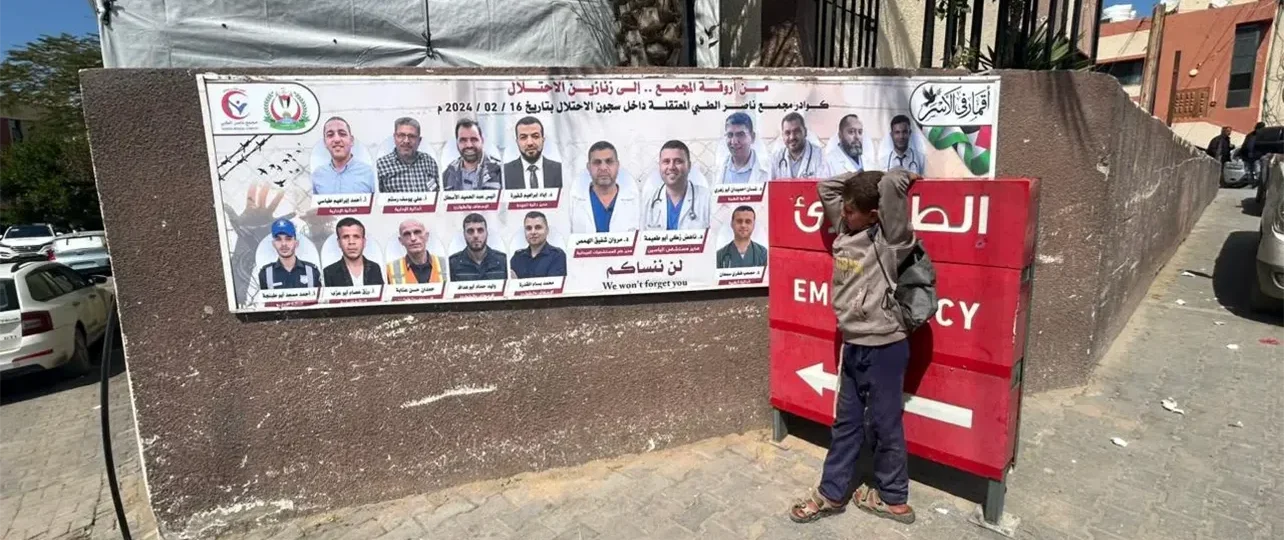
Now, he is trying to reassemble a professional life from fragments. On 15 February 2024, Abu Mousa was one of the staff members Israeli forces detained when they raided the hospital. He was held in Israeli prison – where Palestinians are systematically subjected to inhumane living conditions, abuse, and torture – for 20 months before being released on 13 October last year as part of the ceasefire agreement between Israel and Hamas.
When he returned to the radiology department he had worked in for 15 years, he found it almost gutted. Equipment had been severely damaged during two military incursions in February and March 2024. A mass grave containing 284 bodies was discovered on the grounds of the hospital following the raids.
To keep operating, the staff had to improvise, repurposing parts from broken machines to keep others running.
“Even the simplest things are enormously difficult to obtain,” Abu Mousa said. “But everyone understands we are facing a massive challenge and we cannot surrender to reality.”
When he recalled the moment he found Youssef’s body in the morgue, his sentences broke apart, his face tightening against tears. He asked to pause, to wash his face, and compose himself.
“I am undergoing psychological treatment with a specialist, but I have not achieved satisfactory results,” he said. “I cannot move past the moments of the hospital raid and the detention, and before all of that, the killing of my little boy, with whom I had a special bond.”
His wife, who holds Egyptian citizenship along with their two surviving children, has refused to leave Gaza. “She says, ‘I do not want to leave Gaza and leave my son behind,’” Abu Mousa said. “She is talking about his grave. Imagine these feelings. How do we move past them?”
The chief paramedic, Ahmed Taher
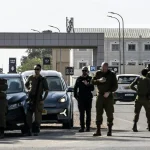
Ahmed Taher, 45, is the acting head of the ambulance centre at Nasser. He took over the role after his predecessor, the director of emergency services for all of southern Gaza, was detained by Israeli forces in December 2023. The director had been on a World Health Organization-coordinated mission to transfer wounded patients from northern Gaza to the south using an Israeli-designated route. Despite completing the same trip five times before, he was detained at the Netzarim checkpoint dividing northern and southern Gaza. Over two years later, he is still in detention.
The New Humanitarian spoke to Taher shortly after his predecessor’s detention began. He hadn’t seen his family in weeks, after moving them to al-Mawasi, the strip of coast in southern Gaza where Israel was ordering people to evacuate to. The constant deluge of casualties flooding into the hospital and Israeli strikes made it difficult for him to leave.
“It has been tough, very tough,” Taher said at the time. “We’re trapped here. There’s constant shelling and road closures. The buildings around us are being targeted one by one.”
Over two and a half years later, Taher is trying to keep Nasser’s paramedic service running. The ambulance unit originally had 12 vehicles. Six have been destroyed or seized by the Israeli military: three were confiscated at a checkpoint between north and south Gaza; one was struck near the Rafah crossing; and two were destroyed during the raids on the complex.
The remaining six have been supplemented by four ambulances from hospitals that went out of service after Israeli forces entered Rafah and parts of Khan Younis. But four of those 10 vehicles run on gasoline, which is unavailable, leaving only six that run on diesel fuel operational.
“The ambulance service depends on three things: personnel, vehicles, and their fuel and maintenance needs,” Taher said. “All three have been directly targeted. If the bombing had not subsided, the ambulance system would have collapsed entirely, because fuel is scarce, there are no spare parts, and no replacement vehicles.”
Staff have resorted to salvaging tyres, batteries, and components from bombed-out ambulances. On the first day of the war, an Israeli airstrike hit an ambulance inside the Nasser compound. Three paramedics were killed that same day: Marwan Abu Rida, who worked at Nasser, and Tariq Ashour and Mahmoud Abu Mashayekh in northern Gaza. Since then, more than 1,700 healthcare workers have been killed.
Before the February 2024 raid on Nasser, when the hospital was under siege and food supplies inside were running out, Taher and a group of paramedics smuggled food into the complex using a donkey-drawn cart. In a separate operation, they evacuated 50 patients and their companions over three days using four ambulances, without coordination with the Israeli military because they were afraid coordination would increase the likelihood of an attack.
“It was a deadly gamble, but it was our humanitarian duty and we will never abandon it regardless of the risks,” he said. “I led the ambulance convoy at the front and everyone insisted on joining, even though they knew they were facing a real possibility of death.”
Taher said the danger he faces in his work has strained his family. “With every bombing, they know I will rush to rescue the wounded,” he said.
He and his colleagues live as displaced people in tattered tents about seven kilometres from the hospital. Their homes have been destroyed and, like everyone else, they struggle to find food, water, and medicine.
“Despite all the responsibilities placed on paramedics, my colleagues and I are living in the same conditions as the rest of the Palestinian people,” he added.
The director, Atef al-Hout
Al-Hout was on a trip to Germany in October 2023 when the war began. He returned to Gaza the following month. He said the most painful moment of his career was the day he was released by Israeli soldiers after a two-hour interrogation inside the complex during the February 2024 raid, and walked into another building to find his colleagues bound, blindfolded, and stripped of their clothing.
“Ninety-five of the hospital’s workers, I found them shackled, humiliated, naked, being beaten for any movement,” he said, tears filling his eyes. “The Israeli army had told me days before that it would not storm the complex.”
He recalled another moment during the siege, when a colleague from the radiology department pleaded with him to send an ambulance to retrieve her injured children from outside the hospital entrance. He could not. The army was preventing all movement and firing on anyone who tried.
“That threat was carried out,” he said. “Many times we had to triage among the wounded, and they died in front of us, even though saving them would have been possible if we had some medical devices and resources, like intensive care rooms.”
“Fathers were screaming in front of us, holding their injured children, and we were helpless,” he added.
Since the signing of the ceasefire agreement, the hospital has been responding to a surge in skin diseases due to the poor sanitation and hygiene conditions in the displacement camps where the vast majority of Gaza’s population is living. Al-Hout said he has also seen previously rare or eradicated diseases, such as Guillain-Barré syndrome and polio, re-emerge as a consequence of the war.
Deaths are being recorded continuously as a result of these conditions, and the available resources do not allow the hospital to fully implement standard medical protocols, he added.
Adding to the challenges, Médecins Sans Frontières (MSF) – one of several NGOs working in the hospital alongside Nasser’s staff – suspended its non-urgent care activities on 20 January, citing “a pattern of unacceptable acts including the presence of armed men, intimidation, arbitrary arrests of patients and a recent situation of suspicion of movement of weapons”.
Israel has repeatedly claimed, without providing conclusive evidence, that Hamas uses hospitals in Gaza for military purposes to justify attacking facilities. Numerous independent experts and monitoring groups have determined that Israel has carried out a deliberate policy of destroying Gaza’s healthcare system, committing war crimes and crimes against humanity in the process.
Al-Hout worried that MSF’s announcement could be used as justification for future attacks on Nasser Hospital and publicly contested the NGO’s account. The hospital’s administration acknowledged that armed individuals had at times entered the compound but said they were not affiliated with organised armed factions. In the power vacuum created by Israel’s war, some powerful families and individuals have begun to carry arms.
After MSF’s decision, a police unit was stationed at Nasser to guard the facility, protect medical staff, and prevent further incursions. Police are considered civilians under international law and are not legitimate military targets. However, the Israel military has continuously targeted Gaza’s police force throughout the war, contributing to the dissolution of law and order.
In mid-April, MSF resumed all of its activities at Nasser Hospital after seeing “clear and marked improvements in the situation”.
But the overall situation in the hospital is continuing to deteriorate due to Israel’s blockade on essential items, according to al-Hout. “If Israel continues to block the entry of medicines, lab materials, maintenance parts, and even the components generators need to run, the collapse of Gaza’s health sector will be deeper and more dangerous than anything seen before,” he said.
“The outlook depends entirely on how much the [Israeli] occupation allows into the health sector,” al-Hout added. “Going by Gaza’s experience, supplies enter in a trickle, and that trickle now decides whether people live or die.”
This story is produced in collaboration with Egab. Edited by Muhammed Kotb and Eric Reidy.
–––––
The New Humanitarian puts quality, independent journalism at the service of the millions of people affected by humanitarian crises around the world. Find out more at www.thenewhumanitarian.org.