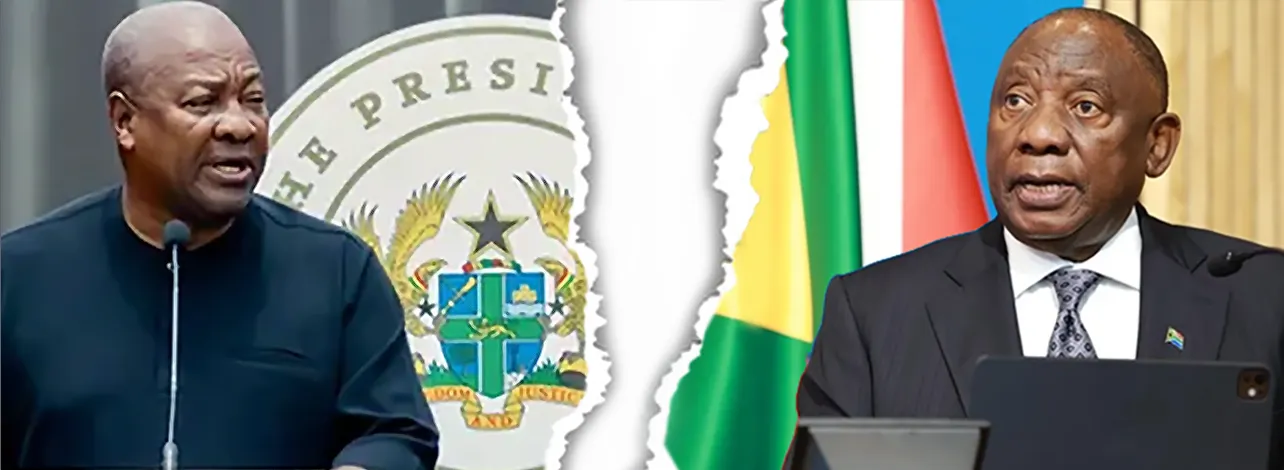

There is a particular kind of African tragedy that plays out not in a courtroom or a coroner’s office, but on the letterhead of a foreign ministry. This week it was Ghana’s turn to write that letter – and South Africa’s turn to send one back, sharper and angrier, essentially telling Accra to get its facts straight before it gets its diplomats involved.
The row erupted after Ghana’s Ministry of Foreign Affairs announced, with what it called “profound shock and sadness,” that a 40-year-old Ghanaian national, Bashiru Isak, had been shot dead on Monday, 30 June, in Cape Town’s Khayelitsha township — allegedly during the anti-immigrant demonstrations that gripped South Africa around the so-called June 30 deadline set by vigilante movements for undocumented foreigners to leave the country. Accra did not mince words. It condemned, it said, “in the strongest terms, this senseless act of violence and the rising tide of xenophobia targeting African nationals, including Ghanaians, in South Africa.”
Ghana’s High Commission in Pretoria moved fast: a formal protest note to South Africa’s Department of International Relations and Cooperation (DIRCO), a complaint lodged with the South African Police Service, and a demand for a criminal investigation that leads to “arrest and prosecution.” Ghana also confirmed it had ordered an autopsy at its own request and was arranging to fly Isak’s body home for burial — the grim, familiar choreography of a nation burying a son killed for being a foreigner in someone else’s country.
“The taking of any life is unacceptable and those responsible must be brought to justice without delay.”
Ghana Ministry of Foreign Affairs statement, 1 July 2026
PRETORIA’S COUNTER-PUNCH
But South Africa did not simply absorb the blow. It swung back — hard, and fast, and with a level of irritation that suggests Pretoria has grown tired of being cast, statement after statement, as the villain of the continent’s migration story.
South Africa’s Minister of Justice and Constitutional Development, Mmamoloko Kubayi, rejected Ghana’s account outright, saying Western Cape police records point to an entirely different picture: a 35-year-old Ghanaian man, identified as Kwabena Boagen, was shot dead not in Khayelitsha but in a barbershop on Emms Drive in Nyanga — not during the protests, but a full day earlier, on 29 June, in what police have classified as an extortion-related robbery, not a xenophobic attack. Police, for their part, said they had no record of any Khayelitsha killing matching Ghana’s description.
DIRCO’s head of public diplomacy, Clayson Monyela, was blunter still, telling the BBC that the version of events linking the death to the anti-migrant protests amounted to a “fabricated tale.” Kubayi went further, accusing Accra of bypassing established diplomatic channels to push an unsubstantiated narrative into the public domain — and warning that using an isolated criminal incident to brand South Africa as a xenophobic state was, in her words, unacceptable.
“Fabricated tale.”
Clayson Monyela, DIRCO Head of Public Diplomacy, to the BBC
TWO NAMES, TWO TOWNSHIPS, ONE CONTINENT WATCHING
Strip away the diplomatic fury for a moment, and what remains is a genuinely troubling discrepancy that neither government has yet resolved for the public: Ghana is mourning Bashiru Isak, 40, allegedly killed in Khayelitsha on 30 June during the protests. South Africa’s police records point to Kwabena Boagen, 35, killed in Nyanga on 29 June in a robbery. Two names. Two ages. Two townships. Two dates. Whether these are two separate deaths that Accra has conflated into one, or a single case bedevilled by early confusion over identity — as so often happens in the chaotic aftermath of township violence — is precisely the kind of factual clarity that responsible journalism, and responsible diplomacy, ought to have chased down before either government reached for a podium.
This is the uncomfortable truth sitting beneath the outrage on both sides: it is entirely possible for South Africa’s xenophobia crisis to be real, documented and lethal — and for one specific diplomatic protest note to still contain an error. The two are not mutually exclusive, however much each government would like the other’s admission to settle the whole argument in its favour.
THE CONTEXT PRETORIA WOULD RATHER NOT DISCUSS
South Africa’s counter-offensive, however sharp, cannot erase the backdrop against which this row is playing out. Researchers at Wits University’s African Centre for Migration and Society have documented well over 1,300 Afrophobic incidents and at least 690 deaths between 1994 and this year, alongside roughly 128,000 displacements — a grim ledger spanning the riots of 2008, 2015, 2016 and 2019, and now this year’s vigilante-enforced “deadline” campaign that saw thousands march, some 900 arrests, and reports of Mozambican, Ethiopian and Malawian nationals also killed in the lead-up to 30 June. President Cyril Ramaphosa has publicly rejected the vigilante movements’ ultimatums, while human rights groups, including Human Rights Watch, have criticised the state’s policing response as inadequate long before this week’s diplomatic theatre began.
It is against that backdrop — not a clean slate — that Ghana’s Foreign Minister, Samuel Okudzeto Ablakwa, has spent recent months positioning Accra as the continent’s most vocal irritant on the migrant question. In May, Ghana wrote formally to African Union Commission chairperson Mahmoud Ali Youssouf demanding that the xenophobia crisis be placed on the agenda of the AU’s Mid-Year Coordination Meeting. That same month, Ghana announced a dramatic evacuation exercise for Ghanaians who “feared for their lives” in South Africa — complete with reintegration allowances, psychosocial support and a promised database of jobs and start-up opportunities for returnees. The optics collapsed almost immediately: of the 300 Ghanaians the first charter flight was meant to carry home from OR Tambo, precisely one person showed up. It was Monyela, again, who used the moment to publicly invite Ablakwa to a more “solution-driven, holistic discussion” about the push-and-pull factors behind migration, rather than unilateral evacuation drama.
THE AU CARD, AGAIN
This week’s statement from Accra also revived a petition Ghana first lodged with the African Union Commission months ago, and the Foreign Ministry says it now expects the continental body to treat the matter “with the urgency it demands” at its next statutory meeting. It is, in effect, Ghana’s second attempt this year to force the AU to do what it has historically been reluctant to do: publicly discipline a fellow member state over the treatment of African migrants within its borders. Whether the AU — an institution not exactly famous for confronting its most economically powerful members — will oblige remains, as ever, an open question.
WHAT THIS ROW REALLY EXPOSES
Strip this down to its diplomatic bones, and the Isak-Boagen affair is a case study in how quickly African solidarity curdles into African suspicion when a body is on the table. Ghana’s instinct — protect nationals abroad, demand accountability, escalate to the AU — is not unreasonable given South Africa’s documented history. But a foreign ministry statement built on facts that Pretoria’s own police records appear to contradict hands South Africa exactly the rhetorical gift it needed: the chance to reframe a structural xenophobia crisis as a case of Ghanaian misinformation, and to make the conversation about Accra’s sloppiness rather than Pretoria’s vigilantes.
That is the real cost of this diplomatic brawl. Every African government with citizens exposed to South Africa’s cyclical xenophobic violence — Nigeria, Malawi, Zimbabwe, Mozambique, Ethiopia among them — needed this moment to sharpen continental pressure on Pretoria. Instead, an unverified name and an uncorroborated township have handed South Africa’s government a talking point that will likely outlive the actual victim’s memory: that African critics of its migration record cannot be trusted to get the basic facts right.
Two governments, two statements, two dead Ghanaian men whose stories have now been flattened into a single argument about who is lying. Somewhere in Khayelitsha or Nyanga, a family is still waiting for a body to bury. The rest of the continent is still waiting for the reckoning with xenophobia that neither a protest note nor a press briefing has yet managed to deliver.