SINCE I am talking to a gathering of South Africa’s best journalists, I assume that you’re not going to take that assertion at face value. It is perfectly reasonable to ask why an entity like Standard Bank should have an interest in supporting and celebrating high-quality journalism. I have four answers.
The first answer is the most obvious – and there’s no point in denying it. Banks are powerful. Banks sometimes make mistakes. Banks are often on the front line in the fight against fraud and other forms of crime. And, perhaps most importantly, banks are the only kind of business that regularly have to say ‘no’ to our clients. Everything else aside, that is not a recipe for popularity.
Banks, therefore, are often in the news – and not always in the best light. Let me be as clear as I can be. Support for the Sikuvile Awards is not an attempt to suborn you. If we have done something wrong, I actively and sincerely want you to put us on the front page. We will emerge better and stronger from your scrutiny. Having said that, in sponsoring these awards, what we are doing – obviously enough – is to remind people that our decisions are made by human beings, and that we’re always open to scrutiny and to conversation. Our ask is just that you remember to give us a hearing.
Second, there is actually a very deep historical connection between Standard Bank and the South African media. Standard Bank was founded in 1863 by someone called John Paterson – a Scottish immigrant to South Africa. But before founding Standard Bank, Paterson founded another South African institution that this audience will know about – the Eastern Province Herald.
Standard Bank’s next important relationship with South African journalism is even more distinguished. We are very proud that we banked Sol Plaatje, activist, novelist, founding Secretary General of the ANC, and founder of the first Setswana-language newspaper, Kuranta ya Becoana.
We are also proud to have banked the precursor of Independent Media from 1905; the newspapers now in the Arena stable from 1915; the ancestor of the Mail and Guardian also from 1915; and Naspers from 1917. In other words, supporting the media is in our DNA: it is something that Standard Bank has always done and will, I trust, always continue to do.
Our third reason for supporting the Sikuvile Awards moves from shared history to shared philosophy – and thereby to the deepest and strongest connection between journalism and finance.
At our best, journalists and bankers both want as much information as possible and are both very interested in getting to the truth.
Bankers seek accurate information and truthful analysis in order to safeguard our depositors’ funds, to allocate capital accurately in the interests of our shareholders and, thereby, to promote economic growth.
Journalists are primarily interested in gathering information and finding the truth because you believe – correctly – that South Africa, and the world, are always better off when people have more information, when the truth emerges, when those in power are required to account for their actions, and when institutions function transparently and efficiently.
And this brings me to the crucial points. Yes, our motivations may differ to some extent. As I have said, bankers and journalists have strong common interests in ensuring a steady flow of useful information and in having the analytical capacity to get to the truth. We have an equally strong common interest in the quality of institutions in general, and in the rule of law in particular. Both journalists and bankers know that these are the preconditions that matter most for economic and human development.
Let’s put some numbers to this. According to the World Bank, crime and corruption now cost us 10% of GDP: that’s around R800 billion a year. Conversely, according to the IMF, if South Africa were to improve our governance to the point where it was just half as good as the leading emerging markets, annual economic growth could increase by as much as 1.4 percentage points over the medium term. We would move from growing at our current 1.6 to 2% a year, to around 3 to 3.5% a year.
And, of course, your brave and determined investigations into corruption, maladministration and abuse of power are essential links in the feedback loop that strengthens institutions and, therefore, enables faster growth.
Unfortunately, as we gather this evening, we are in the middle of a particularly clear demonstration of why and how the rule of law and the quality of institutions matter.
Let me start by giving credit where it is due. The President and the Government of National Unity have been admirably clear that xenophobic violence is unacceptable, and equally clear that South Africans have a right to peaceful protest – with heavy emphasis on peaceful. This week, the security cluster has done a good job in keeping protests largely within acceptable parameters.
But it should never have come to this in the first place. If South Africa had had stronger institutions over the past twenty years, we would have had better control over our borders. We would have had a legal migration system that was more rational, more humane, and more in line with the goal of African unity. We would have enjoyed significantly faster growth and much lower unemployment. We could have generated a lot more public goods, including the goods of better housing, better healthcare and better public safety.
And we would not be dealing with severe damage to our national and commercial reputations in many African countries. Our collective folly and ineptitude on migration have lost us the moral high ground in Africa, making it harder for South African businesses to trade in the rest of our continent.
Just as bad, xenophobia damages the South African economy directly, slowing growth and job creation here at home. It does this by reducing business and consumer confidence; by increasing the costs of doing business; by worsening country risk; and by increasing the cost of capital.
For all of these reasons, we need to get our act together regarding migration and our relationships with our fellow Africans.
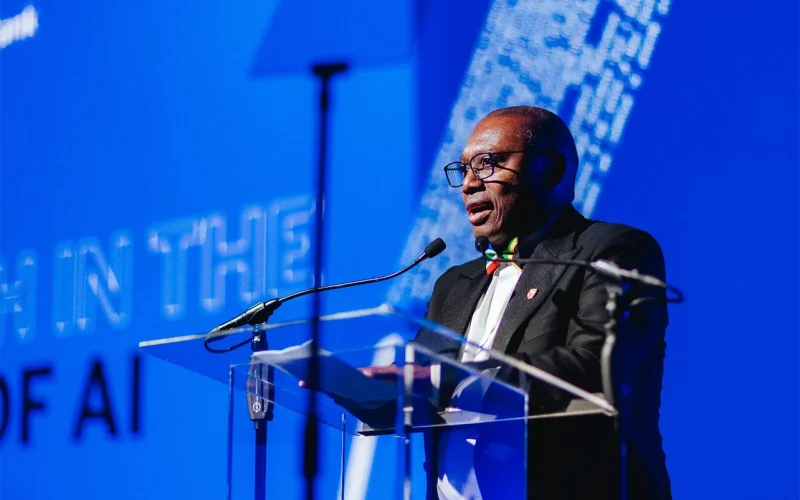
The theme of this evening is, of course, ‘Truth in the Age of AI: The Fight for Sustainable Journalism.’ I’ve aimed to discuss truth. But I haven’t yet said anything about sustainability and AI, so let me now try to draw AI and sustainability together.
My view is that AI will turn out to be another ‘general purpose technology’ like steam, or electricity or the internet. In all previous cases, the new technology caused significant changes in the capital and labour markets.
Let’s start with labour. New technology has meant that some categories of work were no longer done by humans unaided. But, in all such cases, the net effect on human employment and human welfare has been positive. Since I’m a rational optimist – and since I tend to be resistant to hype – I think that AI will follow this general pattern.
Yes, there will be some difficult occupational and sectoral transitions, and we should think hard about how to mitigate these. But many of these transitions will not be disastrous. Take carriage builders – one might imagine that they were all put out of work by the arrival of the internal combustion engine. Not at all – demand for vehicle interiors rose. There’s a similar story with bank tellers and ATMs. As machines took over the most routine tasks, demand for human interaction with bank staff rose.
Both of these are examples of the Jevons Paradox that’s been so much discussed lately. Basically, when the price of something falls because of a technological advance, demand for its complements rises – the cost of transport fell, demand for seats inside vehicles rose; the cost of dispensing cash fell, demand for other financial services rose.
Turning briefly to capital: again, dislocations are going to happen. The railroad boom – and bust – in the 19th century is a well-known case, when there was wild overinvestment in that new technology. More recently there was the Dot Com boom and crash of the 1990s. But this kind of hype cycle doesn’t last – and says relatively little about the enduring uses or real worth of the underlying technology.
Further, if all previous general-purpose technologies are any guide, the pace of innovation in AI is likely to slow, and it will take a surprisingly long time for the new technology to show up in productivity statistics.
For all these reasons, I do not believe that any form of AI apocalypse is upon us
As well as observing these general patterns, I also have a more personal reason for being relatively upbeat. I now use AI quite a lot, and I am equally sure that you do too.
You can tell, therefore, that this speech was written by a human. There’s something about the slightly jagged structure and irregular tone which makes this clear. AI writing would be smoother. It would also contain the usual ‘tells’, such as a lot of ‘not only… but also’ constructions, and too many similes which sound marvellous at first, but don’t actually mean anything. “AI is like a mighty ocean, not only vast, but also green.”
Now, it is of course possible, even likely, that the next generation of LLMs will fix some of these problems.
But an AI-written speech would also be a lot vaguer than this one. LLMs can’t be specific. They have no sense of the pride that I, Sim Tshabalala, feel about Standard Bank’s association with Sol Plaatje. They can’t know what I, Sim Tshabalala, think about the role of institutional quality in economic development – or how much I loathe xenophobia.
Even more importantly, LLMs are much better at ‘what’ than at ‘why.’ And they’re particularly incapable of answering one very important why question – ‘why should I care’ – one of the central philosophical questions.
I think this pattern may generalise: as the price of ‘what’ falls, demand for ‘why’ is likely to rise. This is good news for journalists, and for everyone – like me – with a humanities or social sciences background, such as our MC Ayanda, who is an economist by training. As a philosophy major myself, I was particularly pleased to learn from the Economist (the magazine, not our MC) that the unemployment rate for philosophy graduates is now lower than for computer science graduates.
It is therefore my hope – and my expectation – that serious, detailed, investigative, crusading South African journalism will be made easier by AI data-sifting and research assistance, freeing up your time for in-person reporting and analysis.
I therefore look forward, with confidence, to reading, seeing and hearing brilliant journalism from the people in this room – undoubtedly assisted by AI, but certainly not replaced by it.
*This is an edited version of the keynote address by Sim Tshabalala, CEO of Standard Bank South Africa, at the Sikuvile Journalism Awards ceremony held in Johannesburg.