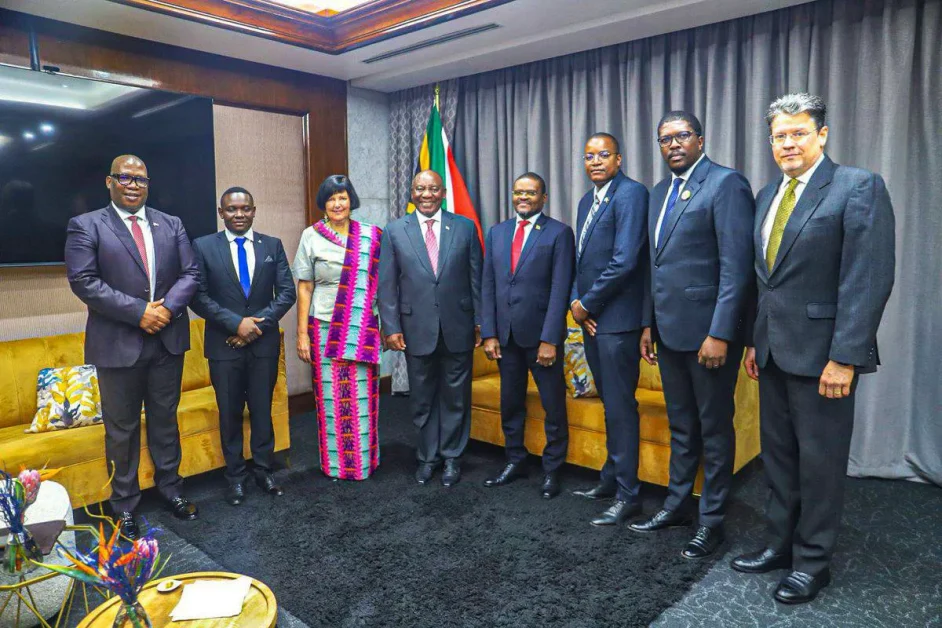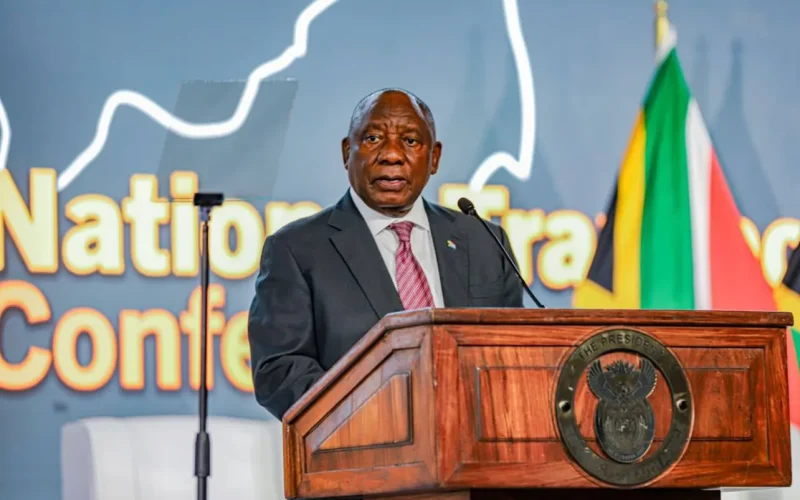
PRESIDENT Cyril Ramaphosa placed Transnet at the front of South Africa’s growth agenda on Monday, using the platform of the country’s inaugural National Transport Conference to celebrate measurable progress at the state logistics utility while laying out an ambitious, multi-modal vision that could reorder the competitive landscape for African trade and investment in the years ahead.
Addressing delegates gathered at Gallagher Estate in Midrand – a conference convened under the banner of a logistics crisis that has cost the South African economy an estimated R1 billion a day – Ramaphosa reported that Transnet’s revenue for the 2024–2025 financial year climbed to R82 billion, nearly 8 percent above the prior year, while freight volumes on rail grew 5.5 percent to 160 million tonnes.
“These are early signs of recovery,” the President said. “They tell us that the interventions are working.”
“Inefficiencies in logistics are estimated to cost our economy close to R1 billion a day. That is a cost we should not — and need not — bear.”
President Cyril Ramaphosa, National Transport Conference, 16 March 2026
Open Access: A New Era for South African Rail
The headline policy announcement of the day was the confirmation that eleven train operating companies have been conditionally awarded slots covering 24 million tonnes a year under the newly operational Transnet Rail Infrastructure Manager – the mechanism established by the National Rail Policy of 2022 to open South Africa’s rail network to private competition for the first time. The first private operator is expected to begin commercial operations in April 2027.
The reform, underpinned also by the National Freight Logistics Roadmap of 2023, sets South Africa on a course towards moving 250 million tonnes of freight by rail by 2029 — a target that, if achieved, would represent a 56 percent increase on current volumes and relieve mounting stress on a road network that currently carries approximately 69 percent of all freight in the country.
Ramaphosa pointed to work on the coal and iron ore corridors through the National Logistics Crisis Committee — a cross-government task force modelled on the successful National Energy Crisis Committee — as evidence of the institutional approach beginning to yield dividends. Security incidents on the rail network, which had become a significant drain on operational performance and investor confidence, have seen a substantial reduction.
Passenger Rail: Dignity Restored, Millions More to Follow
Ramaphosa’s address was equally emphatic on the human dividend of logistics reform. The Passenger Rail Agency of South Africa (PRASA) has, he announced, revived 37 of 40 priority passenger rail corridors and deployed more than 300 locally manufactured train sets onto the network – a visible and tangible marker of the agency’s recovery from years of institutional decay and deliberate asset stripping documented by the Zondo Commission.
The government is now targeting 116 million passenger journeys in the current financial year, on a trajectory towards 600 million annual trips by 2029. For working-class South Africans in townships and peri-urban areas deliberately displaced from economic centres during the apartheid era, this is not merely a transport statistic – it is a measure of restored mobility and narrowed spatial inequality.
“In a country where the majority of its people was deliberately removed and settled far from economic opportunities, an effective, affordable and safe transport system is essential to narrow those distances,” Ramaphosa said. “To take people to opportunity, and to take opportunity to people.”
Ports, Skies and Roads: Positioning South Africa for a Shifting World
The President framed South Africa’s transport future squarely within a volatile and rapidly changing geopolitical order. With more than 90 percent of the country’s trade by volume moving by sea, the ongoing conflict in the Middle East has renewed focus on South African ports as potential alternative hubs when global shipping lanes are disrupted – an opportunity Ramaphosa indicated must be seized through sustained upgrading and maintenance investment by Transnet.
On aviation, Ramaphosa invoked the African Union’s Single African Air Transport Market, the continent-wide framework for a deregulated and liberalised airspace, calling for African cities to be genuinely brought closer together, with cheaper, more direct connections becoming the norm rather than the exception. “A flight that should take four hours should not take eighteen,” he said to an audience that understood the layers of that observation.
Road safety received pointed attention. South Africa loses more than 12,000 people annually on its roads – an ongoing national emergency. Ramaphosa said he intends to at least halve it by 2030. He reported that strategic deployments of the National Traffic Police on prioritised routes contributed to the country recording its lowest number of festive season road crashes in five years, a result he presented as early evidence that deliberate intervention changes outcomes.
A Transport Council: Institutionalising the Recovery
In his most significant institutional proposal of the day, Ramaphosa called for the establishment of a permanent National Transport Council – a body that would bring together the government, the private sector, and all passenger and freight service providers across land, air and sea. He explicitly modelled the proposed council on the National Energy Crisis Committee, whose cross-sector, problem-solving structure he credited with transforming South Africa’s response to load shedding.
The proposal carries real weight in the context of South Africa’s political economy. When government, business and organised labour coordinate with a defined mandate and accountable leadership – as the energy model demonstrated – the results have proven durable. A Transport Council would institutionalise the cross-sector collaboration that has driven early logistics gains and prevent it from dissipating once crisis pressure eases.
| ANALYSIS | THE NUMBERS BEHIND THE RECOVERY R82 billion — Transnet revenue in 2024–2025, up nearly 8% year-on-year 160 million tonnes — Freight moved by rail in the past financial year, up 5.5% 11 train operators — Conditionally awarded slots covering 24 million tonnes/year under open-access rail 250 million tonnes — Rail freight target by 2029, a 56% increase on current volumes 37 of 40 — Priority PRASA passenger rail corridors revived, with 300+ new local train sets deployed 600 million — Passenger journey target by 2029, from a base of 116 million this financial year |
The Stakes: Continental Competitiveness and the AfCFTA Dividend
The broader context of Monday’s conference is one that South Africa can ill afford to misread. Other African nations – Ethiopia, Kenya, Tanzania, Egypt and Morocco among them – are investing aggressively in rail, port and aviation infrastructure, reshaping the continent’s logistics architecture and creating genuine alternatives to South African gateways. Ramaphosa acknowledged this directly: the competitive pressure is real, but so is the opportunity, particularly as the African Continental Free Trade Area begins to generate serious intra-African trade flows that demand reliable, affordable and integrated regional logistics corridors.
A modern, efficient and inclusive South African transport system – one that lowers the cost of doing business, connects rural producers to markets, and positions the country’s ports as AfCFTA hubs – would constitute one of the most powerful structural reforms available to this government. The data presented on Monday, including rising Transnet revenues and growing freight and passenger volumes, suggests the foundation is being laid. Whether the political will, the institutional muscle and the private investment can hold together long enough to reach the 2029 targets is the question that will define Ramaphosa’s economic legacy.