TRANSNET SOC Ltd has reported a 74% improvement in its net loss to R1.9 billion for the year ended 31 March 2025, down from R7.3 billion in the previous year, as the state-owned freight logistics company’s recovery plan begins to yield results.
Revenue increased 7.8% to R82.7 billion while net operating expenses decreased 4.9% to R52.1 billion, driving EBITDA up 39.4% to R30.6 billion and pushing the EBITDA margin to 37%.
The company increased capital investment by 44.2% to R24 billion as it accelerates infrastructure modernisation under its Reinvent for Growth strategy.
“The annual improved revenue performance, reliable cash generation from operations after working capital changes, and improved rail volume performance collectively provide an adequate platform for Transnet to continue its drive to sustainable profitability,” the company said in a statement.
Private operators approved for rail network
In a significant milestone for South Africa’s logistics sector, Transport Minister Barbara Creecy announced on 22 August that 11 new train operating companies (TOCs) have been approved to operate across 41 routes on six corridors, marking the end of Transnet’s rail monopoly.
The approved operators will transport coal, iron ore, manganese, chrome, containers and other commodities across the North, Iron Ore, Cape, North-East, Central and Container corridors from the 2025/26 financial year.
Transnet Rail Infrastructure Manager (TRIM) expects these new entrants to collectively contribute approximately 20 million tonnes annually between 2026/27 and 2028/29, in addition to Transnet Freight Rail’s current forecasted volumes.
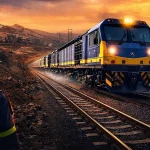
Rail volumes increased 5.46% year-on-year to 160.1 million tonnes, achieving 94% of the company’s 170 million tonne target despite network constraints and security incidents.
Return to profitability targeted for 2025/26
Group Chief Financial Officer Nosipho Maphumulo said the corporate plan projects a return to profitability in the upcoming financial year, underpinned by operational improvements across all divisions focused on volume growth.
“This positive outlook is built on a solid foundation established through our Tactical Recovery Plan, in line with the R4G strategy,” Maphumulo said.
The company targets 180 million tonnes of rail freight for 2025/26, building toward the national goal of 250 million tonnes by 2030.
Peak weekly rail volumes reached between 3.3 and 3.6 million tonnes during the year following targeted operational efficiency interventions.
Private sector partnerships accelerate
Transnet has set firm timelines for major private sector participation (PSP) tenders following completion of a Department of Transport request for information process:
- Richards Bay Dry Bulk Terminal: November 2025
- Manganese Corridor: January 2026
- Container Corridor: April 2026
- Northern Cape-Saldanha: June 2026
In a landmark development, Transnet National Ports Authority appointed the first private operator to develop and manage a container terminal at Richards Bay port, expected to add 200,000 TEUs of annual capacity.
The preferred bidder is a consortium comprising an established local logistics firm with global reach and a regional local entity.
Financial position strengthens
Cash generated from operations after working capital changes declined marginally by 0.6% to R28.6 billion. The company’s gearing ratio stands at 49.6% with cash interest cover at 1.8 times.
Government guarantees will assist with liquidity, reduce financing costs and mitigate refinancing risk, Maphumulo said, while the company focuses on debt reduction subject to improved performance.
Both S&P and Moody’s downgraded Transnet’s credit ratings during the period, citing ongoing operational challenges and high debt levels.
Reform initiatives advance
Transnet made significant progress implementing reforms aligned with the Freight Logistics Roadmap, including formally separating rail infrastructure management from operations through TRIM’s establishment as an interim operating division.
TRIM published the final network statement detailing access conditions and fee structures for the national freight rail network, enabling a competitive multi-operator market.
Port infrastructure improvements included delivery of new tugboats for Durban and other ports, plus landside and maritime equipment for terminals.
Legal challenges persist
The company faces multiple legal proceedings, including 11 lawsuits totalling R9.06 billion related to 2022 flood damage in KwaZulu-Natal, and ongoing disputes with Maersk over the Durban Container Terminal Pier 2 concession.
A court case with IT services provider Gijima over system migration services concluded with closing arguments in August, with judgment pending.
ArcelorMittal South Africa has referred a tariff competitiveness complaint to the Competition Tribunal after the Competition Commission dismissed its initial complaint.
Safety concerns remain
Despite overall safety improvements, derailments continue to affect operations due to infrastructure conditions, theft, vandalism and human factors.
Level crossing incidents have decreased significantly, with no public fatalities recorded since April 2025, following enhanced community engagement and collaboration with traffic authorities.
The company has implemented outcome-based security strategies to address cable theft and infrastructure vandalism, which disable communication and train control systems.
Transnet operates South Africa’s rail, port and pipeline networks, handling the bulk of the country’s import and export cargo.