FOR most of Africa’s post-independence history, a simple, brutal fact has governed the movement of wealth across the continent: minerals worth billions in the ground are worth a fraction of their potential when trapped by roads that crumble, ports that congest, and borders that bottleneck. A tonne of copper mined in Zambia’s Copperbelt could spend six weeks crawling toward the sea, bleeding value at every pothole and checkpoint.
That calculation is changing. Rapidly. Decisively. And at a scale that would have seemed improbable a decade ago.
| $6bn+ Lobito Corridor total invested | $1.4bn TAZARA Rehab CCECC concession | $5bn Zambia–Lobito Rail 830km greenfield | $2bn+ Lion’s Den–Kafue Zim–Zambia MOU |
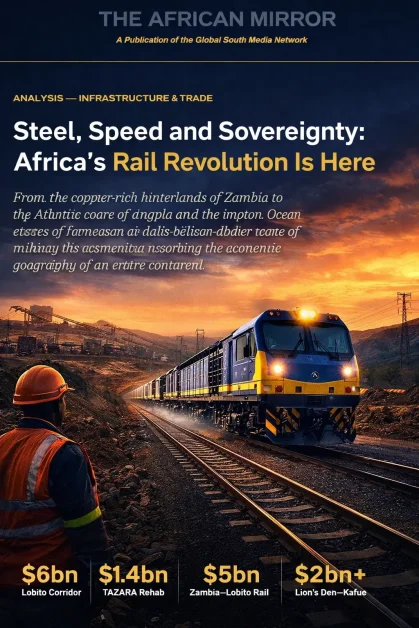
Across the southern and central African spine of the continent, a cluster of transformational rail projects — totalling well over ten billion dollars in combined investment — is moving simultaneously from ambition to reality. Together, they constitute the most consequential transformation of African transport infrastructure since the colonial era. And unlike the railways of that era, which were built to extract wealth for Europe, these corridors are being designed, in the words of the Africa Finance Corporation’s chief executive, Samaila Zubairu, as gateways to African integration and global competitiveness.
“It is not just about railways or minerals or food security — it is about fostering partnerships, creating jobs, and driving a sustainable future for Africa and the world.”
Samaila Zubairu, Africa Finance Corporation
THE LOBITO CORRIDOR: AFRICA’S ATLANTIC ARTERY
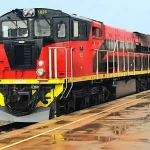
At the centre of this continental reconfiguration sits the Lobito Corridor — a 1,739-kilometre rail and logistics spine stretching from Kolwezi in the copper heartland of the Democratic Republic of Congo, across Angola, to the deep-water port of Lobito on the Atlantic coast. Already operational since 2024, the corridor is rapidly becoming the defining infrastructure project of a generation.
The financial architecture now underpinning it reflects the seriousness of the moment. In December 2025, a $753 million financing package was secured for the rehabilitation of approximately 1,300 kilometres of rail infrastructure in Angola alone — anchored by a $553 million direct loan from the U.S. International Development Finance Corporation and $200 million from the Development Bank of Southern Africa. The U.S. total commitment along the corridor now exceeds $4 billion, with the broader international investment package — including contributions from the European Union’s Global Gateway programme, the Africa Finance Corporation, and Gulf sovereign wealth funds — surpassing $6 billion.
The economic mathematics are straightforward and staggering. The financing package is projected to increase the corridor’s transport capacity tenfold, to approximately 4.6 million metric tonnes per year, while reducing the cost of transporting critical minerals by an estimated 30 percent. For the mining companies extracting the copper and cobalt that the world’s electric vehicle and renewable energy industries desperately need, the corridor does not merely shave cost — it restructures the entire logic of their supply chains.
Beyond minerals, the corridor is already demonstrating its broader potential. Angola’s largest food producer, the Carrinho Group, has begun shipping food products along the Lobito Atlantic Railway into the DRC — a quiet but powerful proof of concept for what integrated trade corridors can unlock. In a region where food insecurity remains chronic, the ability to move agricultural produce efficiently across borders is not a secondary benefit. It is transformational.
The Zambia–Lobito greenfield project will cut travel time from the Copperbelt to international markets from 45 days to just seven.
THE ZAMBIA–LOBITO GREENFIELD: 830KM OF NEW HISTORY
If the Lobito Corridor is Africa’s Atlantic artery, the 830-kilometre Zambia–Lobito greenfield railway is its beating heart. Spearheaded by the Africa Finance Corporation, this $5 billion project — the largest new railway to be built in Zambia since the Tazara line of the 1970s — will run from Zambia’s Copperbelt through the North-Western Province, across the border into Angola and onward to the Port of Lobito.
The concession agreements between Angola, Zambia and the AFC were signed at the United Nations General Assembly in September 2024. A groundbreaking was committed for early 2026. The project’s ambition is not simply logistical: it will open up the entire Western Corridor of Zambia to agriculture, cross-border commerce with Angola and the DRC, and direct access to global markets.
The DRC holds more than 75 percent of the world’s cobalt and, together with Zambia, accounts for over 13 percent of global copper. When the greenfield line is completed — targeted for 2030 — these resources will reach export markets via a route that bypasses the historically congested ports of southern Africa entirely. The AFC estimates that transit times from the Copperbelt to international markets will fall from 45 days to just seven. The carbon arithmetic is equally compelling: shifting freight from road to rail is projected to reduce emissions by at least 300,000 tonnes of CO2 annually.
TAZARA REBORN: THE FREEDOM RAILWAY RUNS AGAIN
On 20 November 2025, in a ceremony in Lusaka attended by Chinese Premier Li Qiang — the first Chinese premier to visit Zambia in nearly three decades — the foundation stone was laid for the rehabilitation of one of Africa’s most storied railways. The Tanzania-Zambia Railway Authority, known as TAZARA or the Uhuru Railway — the Freedom Railway — is being reborn.
The $1.4 billion deal, handed to China Civil Engineering Construction Corporation under a 30-year concession, will overhaul all 1,860 kilometres of track connecting Zambia’s Copperbelt to the port of Dar es Salaam on the Indian Ocean. The scope is comprehensive: track rehabilitation along the full route, upgrades to major workshops, and the procurement of 34 locomotives, 760 wagons, 18 coaches and two passenger trains. On completion, the railway’s freight capacity is projected to rise from roughly 400,000 tonnes annually to 2.4 million tonnes — a six-fold increase.
Built in the 1970s as an act of solidarity with newly liberated Africa — and to give Zambia an export route that bypassed the apartheid regime in South Africa — TAZARA carries a political and symbolic weight beyond its rail gauge. Its rehabilitation, in the words of Zambian development expert Fredrick Mutesa, should be understood not merely as infrastructure repair but as the construction of a “belt of prosperity” along the route. The corridor opens opportunities in agro-processing, manufacturing, and mineral value-addition industries — sectors where reduced transport costs directly improve competitiveness.
Tanzania stands to benefit significantly as well. The rehabilitation positions the Port of Dar es Salaam as a major regional logistics hub, strengthening trade linkages within the Southern African Development Community and the East African Community. Rehabilitation is confirmed to begin in June 2026.
LION’S DEN TO KAFUE: ZIMBABWE AND ZAMBIA SEAL THE SOUTHERN NETWORK
While global attention has been drawn to the continental-scale corridors, a bilateral deal of immense regional significance is quietly taking shape between Zimbabwe and Zambia. The two countries have signed a Memorandum of Understanding for the Lion’s Den–Kafue railway — a project valued at over $2 billion — that will construct 311 kilometres of new rail line (217 kilometres in Zimbabwe, 94 in Zambia) and rehabilitate an additional 445 kilometres of existing track.
The distance savings are dramatic. The Lion’s Den–Kafue corridor will cut freight distances by approximately 800 kilometres to the port of Beira, up to 1,000 kilometres to South Africa, and around 500 kilometres to Dar es Salaam. For landlocked countries where transport costs represent a disproportionate share of trade expenses, these are not marginal efficiency gains — they are structural competitive advantages.
Accompanying the rail deal, Zimbabwe and Zambia have advanced a joint minerals strategy through the Pan-African Minerals Development Company — a framework to unlock dormant mineral assets held by the National Railways of Zimbabwe and Zambia Railways Limited through their jointly owned entity, Emerging Railways Property. The minerals initiative has been escalated to the two countries’ respective Presidents for approval, signalling that the rail and resources agenda is being pursued in an integrated fashion.
When linked to the Lobito Corridor and the broader SADC rail network, the Lion’s Den–Kafue line cements the southern African interior into a genuinely connected trade system — and accelerates the vision of the African Continental Free Trade Area, which requires precisely this kind of physical connectivity to move beyond aspiration into practice.
Across Africa, rail is not merely infrastructure. It is sovereignty in steel — the physical expression of a continent’s right to own its own economic future.
THE AFCFTA IMPERATIVE: RAIL AS THE INFRASTRUCTURE OF INTEGRATION
The African Continental Free Trade Area has, since its launch, faced a fundamental paradox: an agreement designed to boost intra-African trade cannot achieve its ambitions if the physical infrastructure to move goods across borders remains inadequate, expensive, and unreliable. The rail investments now under construction or advanced planning are, in the most direct sense, the material conditions for AfCFTA’s success.
Rail changes this calculus decisively. It is lower-cost, lower-carbon, higher-capacity, and more reliable than road transport at scale. For the agribusiness sectors of Zimbabwe, Zambia and Tanzania — countries with vast agricultural potential that have consistently been undermined by high logistics costs — improved rail connectivity translates directly into market access and price competitiveness. For manufacturing industries seeking to serve continental markets rather than simply exporting raw materials, efficient multimodal corridors are the prerequisite for industrialisation.
Analysts have also noted the environmental dimension with growing urgency. As the European Union implements its Carbon Border Adjustment Mechanism, African mineral exports arriving via high-emission trucking fleets will face mounting cost penalties. Rail, by contrast, offers a lower-carbon supply chain pathway that aligns with both ESG investor mandates and the requirements of global buyers increasingly scrutinising Scope 3 emissions. Africa’s rail renaissance is thus not only economically rational — it is strategically essential for remaining competitive in the green economy.
A CONTINENT IN MOTION
Taken individually, each of these projects is significant. Taken together — the Lobito Corridor, the Zambia–Lobito greenfield, the TAZARA rehabilitation, and the Lion’s Den–Kafue line — they constitute something approaching a continental rail revolution. From Angola’s Atlantic port to Tanzania’s Indian Ocean gateway; from the copper mines of the DRC to the corridors of Zimbabwe and beyond; from the landlocked interior to the global markets that hunger for Africa’s critical minerals, a new infrastructure geography is being drawn.
For decades, Africa’s economic geography was defined by what it lacked: the roads, ports and railways to move goods efficiently, to connect communities, to make the promise of integration more than a document. That constraint is being dismantled, billion by billion, kilometre by kilometre.
Across Africa, rail is not merely infrastructure. It is sovereignty in steel — the physical expression of a continent’s right to own its own economic future, to move its own wealth on its own terms, to build the arteries of integration that no external partner can sever. The train is leaving the station. This time, it belongs to Africa.