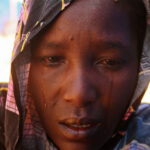
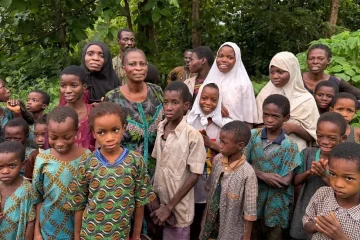
THEY called it Operation Tchéfari 2 — Warriors’ Honey in Fulfulde —, but for the Fulani families of 16 villages near the northern Burkinabè town of Djibo, December 2023 delivered only death. In a single military sweep, soldiers and allied militiamen killed more than 400 civilians. A 35-year-old woman who survived described watching her two daughters being shot dead. She herself was wounded, along with her nine-month-old son. Before the militia withdrew, she heard a command: “Make sure no one is breathing before heading out.”
That massacre is one of 57 documented incidents at the heart of a devastating new report published today by Human Rights Watch (HRW). The 316-page indictment — “None Can Run Away: War Crimes and Crimes Against Humanity in Burkina Faso by All Sides” — lands as one of the most comprehensive human rights investigations ever conducted into the Sahel’s least-reported killing field. Its conclusion is unsparing: all sides have committed war crimes and crimes against humanity, and almost no one has been held to account.
“The scale of atrocities taking place in Burkina Faso is mind-boggling, as is the lack of global attention to this crisis.”
Philippe Bolopion, Executive Director, Human Rights Watch
A JUNTA THAT KILLS ITS OWN PEOPLE
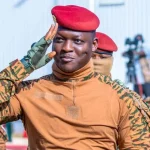
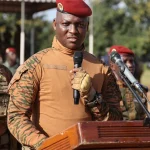
Since Captain Ibrahim Traoré seized power in a coup in September 2022, his junta has fought a brutal counterinsurgency against JNIM — Jama’at Nusrat al-Islam wa al-Muslimin — an Al-Qaeda-linked armed group that has waged an expanding insurgency across the Sahel since 2016. The strategy has been as catastrophic for civilians as the insurgency itself.
HRW researchers, who interviewed more than 450 people across Burkina Faso, Benin, Côte d’Ivoire, Ghana, and Mali over 18 months, found that Traoré’s military and its allied VDP militias — Volunteers for the Defence of the Homeland — have systematically targeted ethnic Fulani communities on the presumption they support JNIM. The pattern, HRW says, amounts to ethnic cleansing.
In the western village of Bassé in November 2023, government-allied militias killed 13 Fulani civilians — six women and four children among them — hands bound behind their backs, blindfolded with their own torn clothing, shot in the back of the neck. “My son was lying on his stomach,” a 41-year-old man recounted. “He had been shot in the back of the neck.” He was one of the dead. The others — except the witness’s son — had been grouped together in a courtyard before execution.
HRW found that Traoré himself, as supreme commander of the armed forces, along with six senior military commanders, may bear command responsibility for grave abuses. The report stops short of certainty but is unambiguous: these individuals should be investigated. The junta has offered denials and deflections while conducting no credible probe into documented massacres.
JNIM: TERROR AS STRATEGY
The Islamist armed group has been no less savage. On August 24, 2024, JNIM fighters descended on the central town of Barsalogho and killed at least 133 civilians — dozens of them children — accusing the entire community of providing support to government VDP forces. A 39-year-old survivor described the attack with shattering simplicity: “People were falling like flies. They came to exterminate us. They did not spare anyone.” Five members of his family were killed.
JNIM’s campaign extends far beyond single atrocities. The armed group has besieged dozens of towns and villages across Burkina Faso, blockading the movement of goods and people to induce hunger and disease. Roads are littered with improvised explosive devices. Bridges, water sources, and telecommunications infrastructure have been methodically destroyed. At least two million people have been displaced by the conflict.
HRW named JNIM’s supreme leader, Iyad Ag Ghaly — already wanted by the International Criminal Court for alleged crimes in Mali between 2012 and 2013 — along with four JNIM commanders, as potentially liable under command responsibility for atrocities committed in Burkina Faso.
“They told us: ‘It’s Ibrahim Traoré who sent us to kill you.’ And they began slitting the throats of people in front of us.”
Survivor testimony, Burkina Faso
THE SILENCE THAT ENABLES SLAUGHTER
Part of what makes Burkina Faso’s catastrophe so intractable is that the junta has actively engineered invisibility. Traoré’s government has suppressed opposition, jailed dissidents, conscripted journalists, and driven out independent and international media, constructing a wall of silence around what HRW now confirms is a sprawling atrocity crisis. Without witnesses, the world does not act. Without accountability, the killing continues.
HRW deployed artificial intelligence to penetrate that silence, processing thousands of hours of footage from Burkina Faso’s state broadcaster and JNIM’s own social media channels. The AI identified command structures, military units, and named individuals present during specific attacks — information that, combined with survivor testimony, allowed researchers to map lines of responsibility from massacres on the ground to commanders who gave orders or failed to prevent them.
A CRISIS AFRICA CANNOT AFFORD TO IGNORE
For the African Union, the ECOWAS bloc, and the broader international community, the report is a challenge that cannot be deferred. HRW has called on the AU, EU, UN, and the United States to impose targeted sanctions against identified abusive commanders. It has called on the ICC’s Office of the Prosecutor to open a formal preliminary examination into crimes committed in Burkina Faso since September 2022.
The Sahel crisis — of which Burkina Faso is the bleeding heart — has been catastrophically underprioritised by multilateral bodies fixated on conflicts in Gaza, Ukraine, and Sudan. Yet the numbers in this report demand attention: 1,800 civilians confirmed killed, two million displaced, dozens of towns under siege, and a junta that has turned its own military into an instrument of ethnic terror while simultaneously failing to protect those in JNIM’s crosshairs.
The African Mirror has long argued that African suffering commands less international bandwidth than it deserves, and that African accountability architecture — from the AU to domestic institutions — must step into the void when global institutions fail. Burkina Faso is exactly that void. The people of the Sahel are not periphery; their lives are not footnotes.
The report’s title comes from a survivor’s account of the Barsalogho massacre: that JNIM fighters told their victims none could run away. It is an epitaph for more than 1,800 people. It must not become the epitaph for accountability itself.