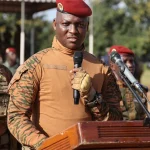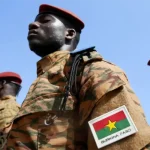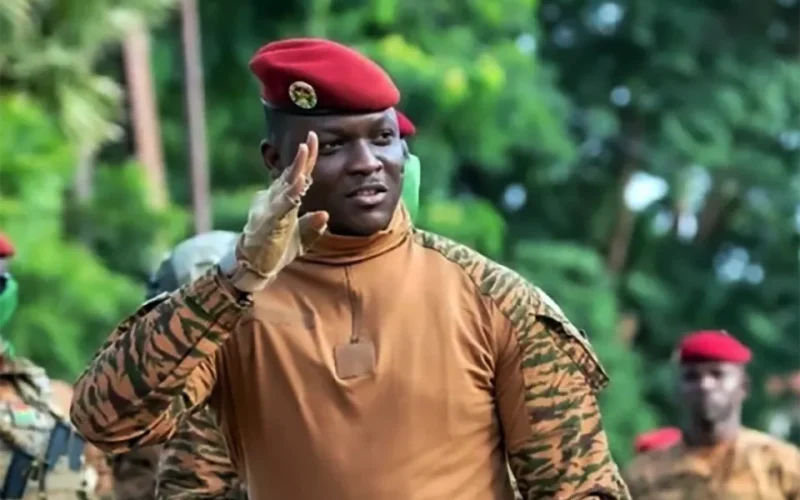
THE dissolution of all political parties in Burkina Faso marks a definitive break from Captain Ibrahim Traoré’s early promises of democratic restoration, revealing what critics say is an increasingly authoritarian trajectory that contradicts the junta’s carefully crafted international image.
The decree, approved by the West African nation’s council of ministers on Thursday, eliminates the legal framework governing political operations and transfers all party assets to the state. The move represents the starkest consolidation of power since Traoré seized control in September 2022, effectively ending any pretence of a return to civilian rule.
When Traoré launched his coup, he justified the overthrow by citing the previous government’s failure to address the people’s needs and contain the escalating Islamist insurgency. His administration invested heavily in a sophisticated social media campaign, producing content in both French and English that portrayed Burkina Faso as undergoing an economic renaissance, complete with new highways and hospitals.
However, conditions on the ground tell a different story. Press freedom has sharply deteriorated, with numerous journalists forced into exile for reporting that contradicts official narratives. Those who remained faced a stark choice: echo government propaganda or face conscription into the military – an especially harsh punishment given the ongoing conflict with Islamist militants linked to al Qaeda and Islamic State.
Interior Minister Emile Zerbo framed Thursday’s decision as necessary to “rebuild the state,” claiming the country’s multiparty system had fostered divisions and weakened social cohesion. Before the coup, Burkina Faso had over 100 registered political parties, with 15 represented in parliament following the 2020 elections.
The dissolution follows a pattern of tightening control. Political activities were suspended immediately after the coup, and subsequent measures have systematically eliminated spaces for opposition or dissent. The government now plans to repeal laws governing party financing and the status of opposition leaders.
Burkina Faso’s trajectory mirrors that of neighbouring Mali and Niger, both also under military rule. The three nations formed the Alliance of Sahel States in 2024, signalling their shared departure from traditional regional governance structures and democratic norms.
While the Traoré government continues to cite the Islamist insurgency—which has killed thousands and displaced millions over the past decade—as justification for emergency measures, critics argue the regime is exploiting security concerns to entrench authoritarian rule. The gap between the administration’s polished external messaging and the repressive reality faced by Burkinabé citizens continues to widen, with the political party ban serving as the latest confirmation of this disconnect.