WEST Africa over the past five years. A military officer steps before television cameras, dressed in fatigues, flanked by colleagues with weapons. He speaks solemnly of suffering, of a corrupt civilian government that has failed the people, of a new dawn that only the armed forces can deliver. The crowds – frustrated, impoverished, often genuinely aggrieved – cheer. And then, methodically and without apology, the soldier does exactly what the man he overthrew did: he reaches for permanent power.
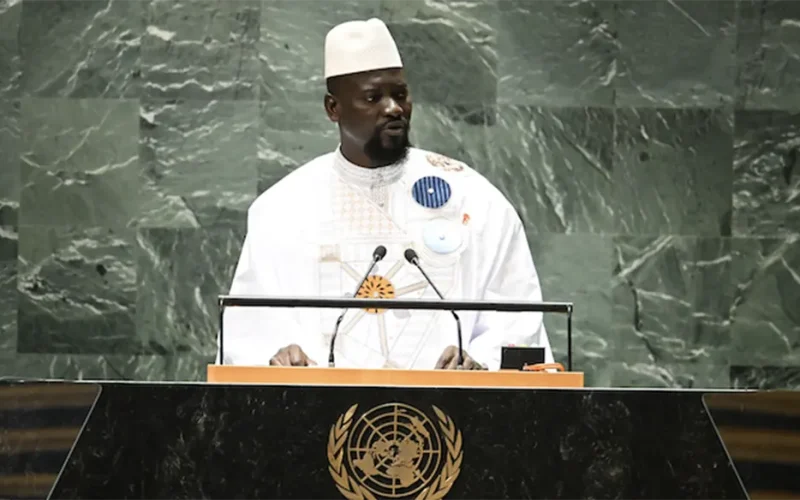
The dissolution of 40 political parties in Guinea – announced in a late-night decree, fewer than two months after former junta leader Mamady Doumbouya was sworn in as president following an election in which all major opposition leaders were barred – is not an isolated act of authoritarian housekeeping. It is the latest instalment in what has become a coordinated, cross-border assault on the institutional architecture of democracy in West Africa, pursued by men who came to power promising the opposite of what they are now building.
The decree issued by Guinea’s Ministry of Territorial Administration and Decentralisation cited the dissolved parties’ “failure to fulfil their obligations”, the same bureaucratic language that authoritarians across history have employed to eliminate political opponents under the cover of procedure.
Among the organisations dissolved are the Union of Democratic Forces of Guinea (UFDG), led by exiled opposition figure Cellou Dalein Diallo; the Rally of the Guinean People (RPG), the party of former president Alpha Condé; and the Union of Republican Forces (UFR). The assets and property of these parties have also been placed under sequestration, pending transfer under the supervision of a state-appointed administrator.
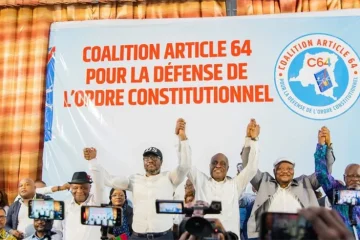
The reaction from what remains of civil society in Conakry was swift and damning. One opposition communications official described the decision as “the final act of a true political farce whose objective is the establishment of a single-party state.” Pro-democracy activist Ibrahima Diallo, a leading member of the National Front for the Defence of the Constitution, said the dissolution had “formalised a dictatorship now established as the mode of governance,” warning that Guinea was “sinking into profound uncertainty.”
What makes Doumbouya’s trajectory so instructive is its shamelessness. Doumbouya, who came to power in 2021 when he toppled Alpha Condé – Guinea’s first freely elected president – has since cracked down on civil liberties and banned protests. Political opponents have been arrested, put on trial, or driven into exile, while enforced disappearances and kidnappings have multiplied.
The constitutional engineering has been equally brazen. A new constitution approved by referendum last September allows members of the ruling junta, including Doumbouya, to contest elections and extends presidential terms from five to seven years, renewable once. The three main opposition parties had already been suspended in August – shortly before the referendum that allowed the junta leader to run for president – ensuring that when Doumbouya’s election victory was announced in December, it was choreographed rather than contested. The dissolution of 40 parties this week simply formalises what has been true since 2021: Guinea is a one-man state.
The human cost is not merely political. Two well-known pro-democracy activists, Oumar Sylla and Mamadou Billo Bah, have been missing since July 2024. Several relatives of prominent dissidents have also been abducted. In Doumbouya’s Guinea, opposition is not merely outlawed – it disappears.
Burkina Faso: The Template for Extinction
If Guinea represents the latest domino, Burkina Faso laid down the playbook. The end of January 2026 effectively marked the end of party politics in Burkina Faso. On 29 January, Captain Ibrahim Traoré’s government formally dissolved all political parties, including those that had supported his September 2022 coup. Party assets have also been taken over by the state.
The justification from Interior Minister Emile Zerbo was that political parties had “fuelled divisions among citizens and weakened the social fabric” – a formulation that will strike students of authoritarianism as instantly familiar, since it is precisely the charge levelled against pluralism by every government that has ever sought to eliminate it. In April 2025, Traoré himself stated openly that Burkina Faso was “no longer in a democracy,” but rather in a “progressive people’s revolution.”
The institutional dismantling has been comprehensive. Prior to the dissolution of parties, the military government also dissolved the Independent National Electoral Commission in July 2025, citing cost. The dissolution of these democratic institutions and the extension of elections to 2029 have cast serious doubt on the government’s commitment to returning to civilian rule.
The violence statistics tell a story that Traoré’s anti-Western sovereignty rhetoric cannot obscure. Fatalities have tripled in the three years since Traoré took power to reach 17,775 – mostly civilians – by last May, compared with 6,630 combined recorded deaths in the three years prior. The security crisis that justified the coup has worsened catastrophically under the coup leader. But rather than acknowledge failure, Traoré has tightened his domestic grip while blaming external forces.
The Pattern: Betraying the Very People Who Welcomed Them
What unites the trajectories of Guinea, Burkina Faso, Mali and Niger is not merely ideology – it is the cynical betrayal of civil society actors and opposition movements who initially celebrated the coups as deliverance.
In Mali, the M5-RFP movement was among the earliest supporters of the August 2020 coup. After months of mass protests against President Ibrahim Boubacar Keïta, the movement welcomed the military’s intervention and expected it to help steer the transition. That expectation faded quickly. The junta sidelined M5-RFP during the formation of the transitional government, and when Colonel Assimi Goïta carried out a second coup in May 2021, removing the civilian interim leadership, the movement’s influence shrank even further. What began as a tactical alliance ended with M5-RFP pushed to the margins.
Guinea followed the same arc. Opposition leaders against former president Alpha Condé initially welcomed Doumbouya’s coup. Expecting a meaningful role in the transition, party leaders even urged ECOWAS not to impose sanctions and publicly legitimised the takeover. Within months, those same leaders were in exile or in prison.
This pattern exposes the fundamental dishonesty at the heart of the “popular coup” narrative. These military interventions were not revolutions led by the people – they were career manoeuvres by soldiers who understood that popular frustration was an asset to be exploited once and then neutralised.
The AES: A Brotherhood of Permanent Power
The Alliance of Sahel States – formed by Mali, Burkina Faso and Niger after they formally withdrew from ECOWAS in January 2025 – represents something new and alarming in African geopolitics: a regional bloc explicitly organised around the mutual protection of military rule.
In Mali and Niger, all opposition political parties have been dissolved by the junta government. Elections scheduled for July 2024 in Burkina Faso have been postponed by five years, to July 2029. In Niger, the military junta postponed elections until at least 2030. Mali’s General Assimi Goïta has gone further still, signing a law granting himself the presidency until at least 2030, with the ability to extend his rule “as many times as necessary,” without the need for democratic elections.
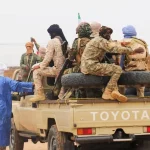
The AES nations have dressed this consolidation of permanent military power in the language of Pan-African sovereignty and anti-colonialism – rhetoric that has found genuine resonance among populations exhausted by decades of French neocolonial interference and the failures of Western-backed civilian governments. The military leaders kicked out France and the United States as security partners, and turned to Russia instead. About 1,000 fighters from the Kremlin-controlled Africa Corps are now stationed across the three countries.
The sovereignty argument deserves serious engagement, because it rests on real grievances. But it collapses under scrutiny. Replacing French soldiers with Russian mercenaries is not independence – it is a change of landlord. And despite having come to power on promises to restore security quickly, the military regimes have been unable to curb rising violence. Meanwhile, coup leaders’ rejection of democratic norms, heavy-handed crackdown on media and civil society, and excessive use of force against civilians create recurrent instability.
The AES states have not merely failed to defeat the jihadist insurgencies that justified their coups – they have created political vacuums that extremist groups are actively filling. UN reports observe that entire communities have been emptied in Burkina Faso, northern Mali, and western Niger as violence spreads. The people in whose name these coups were launched are fleeing their homes while the generals consolidate their palaces.
Guinea Steps Into the AES Shadow
Guinea is not a member of the AES, but the sequential dissolution of its political parties – coming barely six weeks after Burkina Faso’s identical move – suggests ideological contagion. The operational template is now established and exportable: seize power invoking popular discontent, hold a controlled election to launder legitimacy, rewrite the constitution to entrench the ruler, dissolve the opposition, confiscate party assets, and then govern permanently in the name of “the people” – a people who have been systematically stripped of every tool required to challenge, replace, or hold accountable those who claim to speak for them.
The impact extends beyond the immediate removal of these parties. It creates a chilling effect on political activity, discouraging new formations and potentially driving underground those who remain committed to opposing the junta.
That chilling effect is precisely the point. Democracy does not die only in fires – it dies in administrative decrees issued at midnight, in the quiet freezing of bank accounts, in the silence that descends when activists understand that dissent carries the risk of enforced disappearance.
What Remains
ECOWAS, weakened by the departure of three member states and struggling with internal fractures, has issued expressions of concern. The African Union has called for restraint. The United States and France have voiced disapproval. None of this has slowed the march.
The uncomfortable truth is that these juntas have correctly calculated that the international architecture designed to protect democracy – sanctions regimes, regional bodies, Western pressure – lacks the coherence and political will to impose meaningful costs. They have also, with some justification, identified the hypocrisy in Western democracies that maintained warm relationships with their own authoritarian client states for decades before discovering the language of democratic norms.
But none of that hypocrisy justifies what is being built across the Sahel and now in Guinea. Political parties are not a Western import or a colonial imposition – they are the mechanism by which ordinary people aggregate their power against the state. Dissolving them does not strengthen society. It strips citizens of the only institutional tool capable of contesting power peacefully.
Captain Traoré, in a moment of unusual candour, announced that Burkina Faso was no longer a democracy. He was right – and that honesty, divorced from any apparent concern about its implications, may be the most chilling statement made by any African leader in recent memory. Guinea’s Doumbouya has said the same thing in practice, if not yet in words.
The question now is not whether these men intend to stay in power permanently – the evidence makes that abundantly clear. The question is whether West Africa’s remaining democratic states, its civil society movements, its diaspora communities, and the international institutions that still claim to care about human governance will find a response proportionate to the crisis unfolding before them.
Because what is being built across the Sahel and coastal West Africa is not an experiment in African self-determination. It is the architecture of permanent, hereditary military rule – constructed brick by brick, decree by decree, dissolved party by dissolved party – in broad daylight, while the world watches and issues statements.