ON the morning of Saturday, 25 April 2026, the pre-dawn silence over Kati – Mali’s main military garrison town, some fifteen kilometres north of the capital Bamako – was shattered by two massive explosions. Within minutes, gunfire was erupting simultaneously at Bamako’s international airport, in the northern cities of Kidal and Gao, and in the central town of Sévaré. Mali was simultaneously at war in every corner of its vast, landlocked territory.
It was the most devastating and most coordinated assault on Mali’s military-led government in nearly fifteen years – and it may prove to be its death blow.
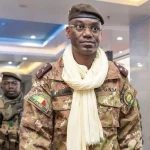
By the time the dust settled on that first terrible morning, Mali’s Defence Minister, General Sadio Camara – a key architect of the junta’s partnership with Russia and widely regarded as one of its most powerful figures – was dead. A suicide bomber had driven a car into his residence in Kati. Camara died alongside his second wife and two grandchildren. He was 47 years old.
“Overthrowing the junta is not enough. We must, together, prevent any chaotic vacuum that would plunge our nation into total collapse.”
JNIM statement, 30 April 2026
Seven days later, the picture is bleaker still for junta leader General Assimi Goïta. The northern city of Kidal – recaptured from separatists in a celebrated military offensive in 2023 – has fallen again. The Tessalit military base near the Algerian border, described by a military officer as “the oldest base built by the colonial power” and offering “a panoramic view of the entire Sahara,” has been abandoned without a fight. Russian Africa Corps mercenaries are withdrawing from position after position across the north. And the al-Qaeda-affiliated insurgent group JNIM has placed road checkpoints on multiple major arteries leading into Bamako itself, threatening to strangle the capital into submission.
Mali – and with it, the entire anti-Western, pro-Russian security experiment in the Sahel – is in existential crisis.
THE ANATOMY OF AN OFFENSIVE
The attacks of 25 April were not random or spontaneous. They were the product of months of deliberate military coordination between two forces that have historically been rivals: Jama’at Nusrat al-Islam wal-Muslimin (JNIM), the Sahel’s dominant al-Qaeda affiliate, and the Azawad Liberation Front (FLA), a coalition of Tuareg separatists fighting for independence of the vast northern desert region they call Azawad.
The groundwork had been laid long before the first explosion. From September 2025, JNIM had systematically targeted fuel tanker convoys on Mali’s main supply routes, bringing the capital to a near-standstill in October and returning briefly in March 2026 with another diesel shortage. This was economic warfare designed to erode public confidence in the junta’s capacity to govern – and it worked. By the time the military offensive was launched, Bamako’s residents had already lived through months of fuel queues, power disruptions, and mounting frustration.
Diplomatically, contacts between FLA and JNIM – groups that had previously clashed – intensified through late 2025. Their convergence on a common enemy, Goïta’s junta and its Russian backers, produced a unified command that the Malian state’s intelligence services evidently failed to detect or disrupt.
On the morning of 25 April, they struck everywhere at once.
| KEY FACTS: THE ASSAULT ON MALI • 25 April 2026: Coordinated strikes hit Bamako, Kidal, Gao, Mopti, and Sévaré simultaneously • Casualties: At least 23 dead, including Defence Minister Gen. Sadio Camara • Kidal — recaptured by the junta in 2023 — falls back into rebel hands • Tessalit military base abandoned; Malian troops and Russia’s Africa Corps withdraw • JNIM imposes a road blockade on multiple arteries leading into Bamako • Russian Africa Corps also withdraws from Aguelhok, Labbezanga, and Tessit • JNIM calls on all Malians to rise up, topple the ‘terrorist junta’ and establish Sharia law • Alliance of Sahel States (AES) — Mali, Niger, Burkina Faso — conducts air campaigns in response |
THE FALL OF THE NORTH
Of all the symbolic and strategic losses suffered by the junta in the past week, none is more devastating than the loss of Tessalit – confirmed on Friday, 1 May, when FLA forces entered the base without firing a shot. Malian troops had already evacuated. A security source in Gao confirmed to AFP that “no clashes took place.”
Tessalit is no ordinary base. Built by France during the colonial period, it sits in the far north near the Algerian border, offering commanding sightlines across the Sahara. Its well-maintained airstrip can accommodate helicopters and large military aircraft. It hosted significant numbers of Malian troops and their African Corps allies, along with substantial military equipment. Its fall – in silence, without resistance – speaks volumes about the demoralisation now gripping Mali’s security forces.
The FLA’s seizure of Tessalit followed the fall of Kidal, the symbolic heart of the Azawad separatist cause. Kidal had been taken by the junta in a November 2023 offensive that was hailed as a historic triumph – the first time government forces had controlled the city in a decade. That triumph lasted less than three years. FLA fighters entered the residence of the junta-appointed Governor of Kidal and raised their flag. Videos circulating on social media showed the militia moving freely through the streets.
Algeria – whose border with Mali runs through this territory – played a quiet but significant role in the Tessalit handover, with Algerian mediation helping ensure the peaceful withdrawal of Africa Corps soldiers. This detail is significant: it suggests that even Mali’s neighbours are accommodating the new reality rather than defending the junta’s territorial integrity.
“The junta cannot withstand simultaneous offensives in the north and around the capital.”
Mohamed Elmaouloud Ramadane, FLA spokesman
THE BAMAKO BLOCKADE AND THE CALL TO REVOLUTION
Even as the north fell, JNIM turned its attention to the capital itself. The group placed checkpoints on at least four major roads into Bamako – the RN24 to the northwest, the RN7 to the south, the RN6 to the east, and the RN5 to the southwest. Businesses confirmed that goods were being prevented from entering the city. The tactic mirrors JNIM’s earlier fuel convoy strategy: not to storm the capital, but to throttle it.
Then came the political dimension – and it was remarkable. In a rare French-language statement issued late on 30 April and confirmed by the US-based SITE Intelligence Group, JNIM did something it almost never does: it addressed Malian society directly, in the language of government and business, in a tone that was political rather than simply military. It called on political parties, soldiers, religious authorities, traditional leaders, and, as the statement put it, “all segments of Malian society” to end the dictatorship of the government, which it described as a “terrorist junta.”
JNIM’s statement called for a “peaceful, responsible, and inclusive transition” – language borrowed from international democratic discourse – alongside, in the same breath, the establishment of Sharia law. The group was trying to speak to everyone at once: to the secular political class, to traditional and religious leaders, and to its own Islamist base. It was a sophisticated political manoeuvre, not merely a military one.
It was also a signal that JNIM understands the dangers of the vacuum its offensive might create. “Overthrowing the junta is not enough,” the statement said. “We must, together, prevent any chaotic vacuum that would plunge our nation into total collapse.” After years of operating in the shadows, JNIM is now attempting to position itself as a governing alternative.
THE RUSSIAN QUESTION
Nothing about this crisis is more consequential for the continent – or for Moscow – than the performance of Russia’s Africa Corps. The mercenary force, successor to the Wagner Group, was deployed to Mali as the centrepiece of the junta’s strategic pivot away from France and towards Russia. It was sold to the Malian public as a guarantee of security that France had failed to provide. The events of the past week have exposed that guarantee as hollow.
Africa Corps fighters withdrew from Kidal under FLA escort – a humiliating image, whatever the tactical rationale. They have subsequently pulled back from Aguelhok, Tessalit, Labbezanga, and Tessit. Russia’s Defence Ministry acknowledged the situation was “difficult.” The Kremlin, through spokesman Dmitry Peskov, vowed to continue counter-terrorism operations — but the words rang hollow against the backdrop of abandoned bases.
In a telling rhetorical move, Africa Corps accused “Ukrainian mercenaries” and Western intelligence of involvement in the offensive – a claim that serves Moscow’s domestic narrative but that independent analysts have not verified. It also labelled the assault a “Syrian scenario” – an invocation that, given how Syria ended for Russia’s clients, may have been poorly chosen.
Russian Ambassador Igor Gromyko met with Goïta and reaffirmed Moscow’s support. But reaffirmations are not reinforcements. The question now is whether Russia has the will and the capacity to mount a visible, effective counter-operation – or whether it will watch its most prominent African partnership unravel in real time.
A CRISIS LONG IN THE MAKING
To understand what is happening in Mali today, one must understand what was dismantled over the past five years. When Goïta’s junta expelled French forces and terminated the UN peacekeeping mission MINUSMA, it removed two imperfect but functional layers of counter-insurgency pressure. France, for all its contradictions and colonial baggage, had maintained persistent military pressure that prevented JNIM from reaching the gates of Bamako. MINUSMA provided information and stabilisation presence in the north. Both were expelled. Both vacuums were filled by the insurgents they had been restraining.
The junta’s political choices compounded the military vulnerability. In July 2025, Goïta granted himself a five-year presidential mandate, renewable indefinitely, without elections. Political parties were banned. Independent media was suppressed. When there is no political mechanism through which grievances can be channelled, pressure finds military outlets.
The irony is acute. The junta seized power in 2020 and again in 2021 on the explicit promise of improving security. Five years later, Mali faces its worst security crisis since the 2012 rebellion that first tore the country apart.
Novarapress Security Analysis
“April 25, 2026, marks the beginning of the end of the post-coup security order in Mali.”
THE REGIONAL DIMENSION
Mali does not collapse in isolation. The Alliance of Sahel States – the political and security pact between Mali, Niger and Burkina Faso – has responded with coordinated air campaigns following last weekend’s attacks. But AES is a fragile construct, its 15,000-strong joint force more political statement than operational reality. Neither Niger nor Burkina Faso can afford to lose Mali without triggering questions about their own junta-led orders.
The FLA has explicitly warned neighbouring Sahel countries to stay out of Mali’s affairs. Algerian mediation is already factoring into the northern withdrawal dynamics. ECOWAS — the regional body from which Mali, Niger and Burkina Faso dramatically withdrew — may yet find itself drawn back into relevance by events. Even Mali’s Foreign Minister attended a security forum in Senegal last week, a gesture that analysts read as a quiet signal that the junta may be seeking off-ramps.
France has urged its citizens to leave Mali. The US Embassy has told American citizens to shelter in place. International Bamako is closing in on itself.
As of this writing, Goïta’s government is holding – but only just. The junta leader appeared publicly on Tuesday to declare the situation “under control” and vow to “neutralise” the insurgents. By Friday, three more strategic positions had been lost. The gap between the junta’s declarations and the facts on the ground is widening by the day.
Three dynamics will determine what follows. The first is whether the Africa Corps mounts a visible and effective counter-operation. A capable Russian response could stabilise the military situation; its absence would be a signal heard across the entire continent. The second is whether JNIM’s blockade of Bamako holds and deepens, transforming a military crisis into a humanitarian one. The third – and most politically complex – is how Malian society responds to JNIM’s unprecedented invitation to collective political action.
JNIM is not calling for sympathy; it is calling for submission. Its vision of a “peaceful, inclusive transition” is inseparable from its call for Sharia law. Whether the political parties, civil society leaders, and military figures the group is courting find that bargain acceptable — or whether they seek a third path between the junta and the jihadists — will define Mali’s trajectory for a generation.
For the moment, Mali’s capital city wakes each morning to checkpoints on its roads, silence from a junta that is running out of things to say, and the sound of a country fighting for its soul.