
KINSHASA BURNS – AGAIN
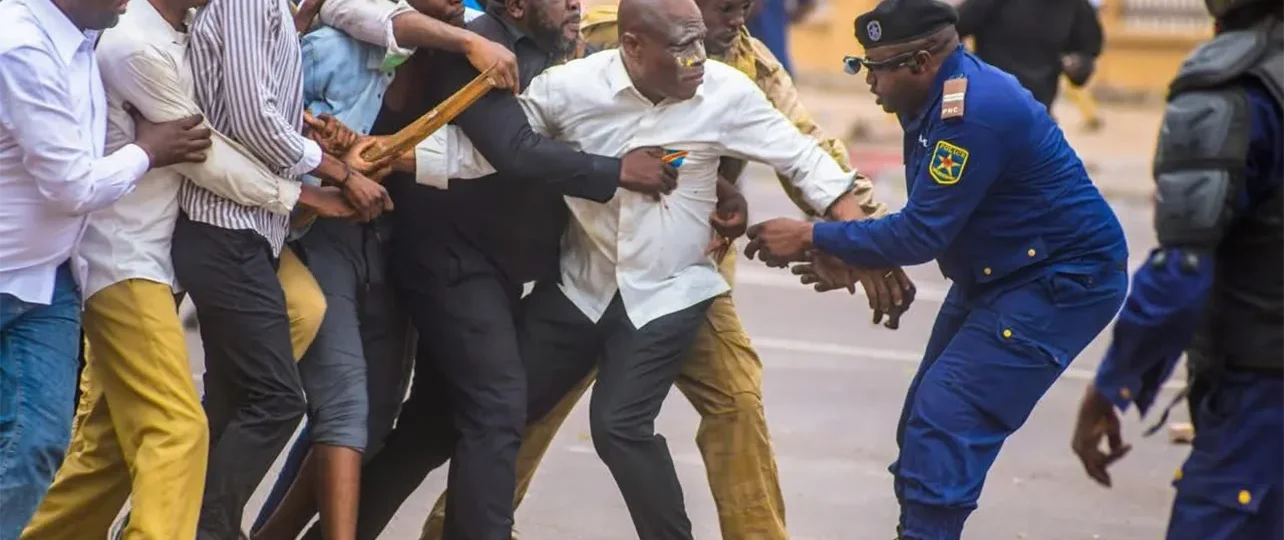
The images that emerged from Kinshasa on the afternoon of Friday, 12 June 2026, were visceral and deeply familiar to anyone who has followed the DRC’s tortured democratic trajectory. Martin Fayulu — one of the country’s most prominent opposition leaders and a man who may never have been allowed a fair shot at the presidency he arguably won in 2018 — was photographed with blood around his eyes and across his shirt. Around him, supporters frantically tried to shield him as security forces dispersed protesters with tear gas and live ammunition.
Fayulu and his allies had gathered outside the Palais du Peuple, the seat of the DRC National Assembly, as part of a sit-in organised by Coalition Article 64 (C64) — a broad opposition front named for the constitutional provision calling on all Congolese to resist efforts to seize power illegitimately. The demonstration defied a government ban. The government’s response was to deploy force.
| Security forces used tear gas and live ammunition to disperse protesters throwing stones. Police, the army, and militants backing the Tshisekedi party were deployed around the parliament from early morning to prevent the demonstration. |
The sit-in came three days after the DRC National Assembly passed a bill that would allow constitutional amendments to be put to a public referendum — a procedural move that opposition leaders have branded a ‘constitutional coup’ designed to clear the path for President Felix Tshisekedi to run for a third consecutive term, in direct violation of a two-term limit enshrined in the constitution he swore to uphold.
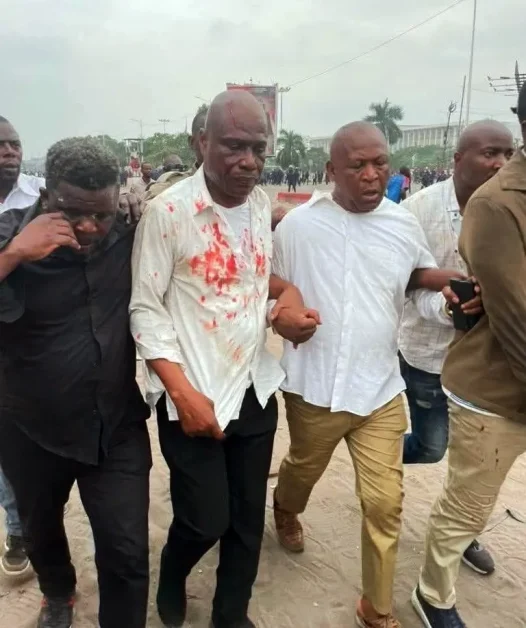
Fellow opposition figure Prince Epenge was also injured. No official death toll had been released at the time of publication. The Human Rights Foundation (HRF) condemned the violent repression, describing Tshisekedi as a ruler who has never legitimately secured a popular mandate through elections, and who is now attempting to cling to power through constitutional manipulation — cracking down on dissent in exactly the same way his predecessor Joseph Kabila did.
THE MAN WHO WOULD BE KING — FOR A THIRD TIME
Felix Tshisekedi, 62, has been in office since January 2019, having been declared the winner of the December 2018 elections in a result that was widely contested. The consensus view among independent observers — including the Catholic Church’s Congo Episcopal Conference (CENCO), whose election monitors had the broadest coverage on the ground — was that opposition candidate Martin Fayulu had actually won that election. The published results told a different story, one that many analysts attributed to a backroom deal between Tshisekedi and outgoing president Joseph Kabila.
His 2023 re-election — in which he was declared the winner with over 70 percent of the vote — was similarly disputed by opposition candidates Moise Katumbi and Fayulu, who refused to recognise the results amid reports of widespread logistical failures and credibility gaps across the electoral process.
Yet it is now this twice-contested president who is manoeuvring to extend his rule beyond the constitution’s hard limit of two five-year terms. In early May 2026, Tshisekedi telegraphed his intentions at a press conference in Kinshasa: ‘I have not asked for a third term, but I tell you this: if the people want me to have a third term, I will accept.’ Critics were quick to note that the ‘people’ being mobilised to request his continuation were not arising spontaneously.
| Political analysts say so-called ‘standing parliament’ mass gatherings are being deliberately engineered by Tshisekedi’s inner circle to manufacture the appearance of grassroots demand for scrapping constitutional term limits. |
For Fayulu, Katumbi, and the C64 coalition, the passage of the referendum bill by the National Assembly was the final confirmation of what they had long suspected. C64 mobilised. The government banned the protest. Protesters came anyway. Security forces arrived with guns.
TSHISEKEDI AND KABILA: A REPRESSION CONTINUUM
The HRF’s characterisation of Tshisekedi as repeating Kabila’s playbook is historically precise. In September 2015, violent clashes erupted in Kinshasa when up to 3,000 people gathered to oppose any bid by then-president Joseph Kabila to seek an unconstitutional third term. Kabila ultimately used delay tactics, postponing elections multiple times and clinging to power years beyond his constitutional mandate, before engineering the 2018 transition that brought Tshisekedi to power under terms that many believe preserved Kabila’s influence for years.
Now the successor stands accused of the same instinct toward self-perpetuation. Human Rights Watch documented in April 2026 that Tshisekedi’s administration was already prosecuting peaceful protesters before military tribunals under martial law orders imposed in North Kivu and Ituri provinces — a mechanism designed for conflict zones, extended to suppress civilian dissent far from the front lines. Activists calling merely for access to safe drinking water were being charged with ‘undermining state security.’
The DRC’s human rights situation has remained dire throughout Tshisekedi’s tenure. Over 100 armed groups operate in eastern Congo. Some 5.8 million people remain internally displaced — more than anywhere else on the continent. Against this backdrop, the president is directing state resources toward ensuring his own political survival rather than the survival of his citizens.
ZIMBABWE: THE SOUTHERN ECHO
The DRC is not alone. Approximately 2,700 kilometres to the south, President Emmerson Mnangagwa of Zimbabwe is pursuing a strikingly similar path — and meeting similarly fierce resistance.
Zimbabwe’s 2013 constitution is unambiguous: a president may serve no more than two five-year terms. Mnangagwa, who came to power in November 2017 following a military coup that toppled founding president Robert Mugabe, was elected in 2018 and re-elected in 2023. Under the constitution, his term ends in 2028 — and that is where it should end.
But ZANU-PF’s ruling machinery has other ideas. The party’s 2025 annual conference passed a resolution directing the government to initiate legislative amendments to extend Mnangagwa’s tenure to 2030. By February 2026, the cabinet had gazetted Constitution Amendment Bill No. 3, formally initiating the process. In June 2026, Zimbabwe’s parliament was expected to consider these sweeping changes, including a term extension for an 83-year-old president who arrived in power via coup, not ballot.
‘The attempt by ZANU-PF to extend President Mnangagwa’s term must be vehemently resisted! Following Mugabe’s long and disastrous tenure, we pushed so hard to get term limits. Never again must we allow any president to overstay.’
Zimbabwean opposition politician Gladys Kudzaishe Hlatywayo
Human Rights Watch documented in March 2026 that Zimbabwean authorities had intensified their crackdown on critics of the amendment — a pattern of violence and intimidation against those daring to oppose it. Ten people, including senior citizens over the age of 70, were arrested for attempting to participate in an unsanctioned demonstration against the term extension. The Zimbabwe Council of Churches warned that the bid to extend Mnangagwa’s tenure would undermine years of re-engagement diplomacy and the country’s fragile path out of international isolation.
The economy, meanwhile, continued to struggle under the weight of mismanagement: extreme poverty in Zimbabwe stood above 42 percent. The argument that Mnangagwa must stay in power for developmental continuity, analysts noted pointedly, was an absurdity against those numbers. Adding a further layer of complexity, Vice President Constantino Chiwenga — himself a product of the 2017 coup — was reportedly bitterly opposed to the extension, because he had his own succession ambitions. The constitutional crisis was thus also fuelling a factional war within ZANU-PF with profound risks for national stability.
THE PLAYBOOK: HOW AFRICAN LEADERS REWRITE THE RULES
Neither Tshisekedi nor Mnangagwa is innovating. They are following a well-worn playbook that has enabled a generation of African leaders to convert constitutionally limited mandates into indefinite tenures. The methods vary — referendum, legislative supermajority, judicial interpretation, or the creative claim that term limits do not apply retroactively — but the destination is the same: power without exit.
The roster of those who have succeeded is long and instructive:
• Paul Kagame (Rwanda): Kagame originally championed Rwanda’s constitution limiting presidents to two seven-year terms. In December 2015, Rwandans voted — by a reported 98 percent majority — to amend the constitution, allowing him to run for a third term in 2017 and then two further five-year terms, potentially keeping him in power until 2034. He won that third term and has announced a bid for a fourth. Human rights groups have documented widespread abuses, suppression of opposition, and the muzzling of independent media throughout his tenure.
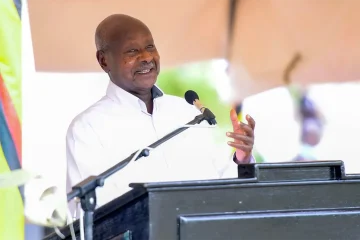
• Yoweri Museveni (Uganda): Once declaring that no African leader should remain in power for more than ten years, Museveni has governed Uganda since 1986. In 2005, parliament removed presidential term limits entirely from the constitution. In 2017, lawmakers further removed the age limit of 75 years, allowing the then-73-year-old to continue running indefinitely. He won a sixth term in 2021 amid widespread reports of ballot fraud and human rights violations.
• Paul Biya (Cameroon): In power since 1982, Biya was barred by a two-term limit from running again in 2011 — until his parliament abolished all presidential term limits in 2008, despite violent protests. Now in his fifth decade of rule, Biya remains among the longest-serving leaders on the continent.
• Denis Sassou Nguesso (Republic of Congo): First ruled from 1979 to 1992, then returned to power in 1997 following a civil war, and has retained it since — manipulating successive constitutional frameworks across four decades to remain in office.
• Alpha Conde (Guinea): Pushed through a new constitution in 2020 via referendum, controversially resetting term limits to allow him to run for a third term. He won the election amid major protests and allegations of fraud. He was ousted in a military coup the following year — illustrating the instability that constitutional manipulation almost invariably produces.
• Idriss Deby (Chad): A 2005 referendum removed term limits, allowing Deby to remain in power until his death in 2021 — at which point power was transferred to his son via the military, bypassing the democratic process entirely.
• Pierre Nkurunziza (Burundi): Declared in 2015 that his first term did not count because he had been elected by parliament rather than by popular vote, entitling him to a ‘third term.’ His bid prompted mass protests, a failed coup, and widespread violence. He died in office in 2020.
The lesson that runs through all these cases is stark: constitutional manipulation to extend executive tenure almost invariably produces instability, suppression of civil society, weakened institutions, and — in the worst cases — armed conflict or coup. The constitution is not merely a legal document; it is the social contract between the governed and the governing. When those in power shred it for personal benefit, they do not merely break a law — they break a compact with their people.
THE DEMOCRATIC RECESSION AND WHAT IT MEANS FOR AFRICA
The concurrent crises in the DRC and Zimbabwe are not isolated phenomena. They are symptoms of a broader democratic recession across Africa — one that is particularly dangerous at this moment of multiple, overlapping continental pressures: active conflicts in the Sahel, eastern DRC, and Sudan; economic fragility across most of the Global South; and a geopolitical environment in which great powers are increasingly willing to prop up African autocrats in exchange for strategic resource access.
The African Union, which has nominally committed itself to democratic governance through the African Charter on Democracy, Elections and Governance, has been conspicuously muted on both the DRC and Zimbabwe situations. Its silence is not merely institutional failure — it is enabling. When the continental body looks away as member states violently suppress legitimate protest against unconstitutional power-grabs, it signals to other leaders that the costs of authoritarianism are low.
For the DRC specifically, the timing of Tshisekedi’s constitutional manoeuvre is particularly cynical. The country is still reeling from the M23 insurgency and the broader conflict in eastern Congo, which has displaced nearly six million people. That the president should choose this moment to direct his political energies toward ensuring his own political survival — rather than the survival of his citizens — reveals a troubling hierarchy of priorities that should alarm every African democracy.
THE VOICE OF THE STREET
What is perhaps most significant about the events of 12 June 2026 in Kinshasa is not the violence itself — terrible as it was — but what the violence reveals: that ordinary Congolese citizens are willing to defy a government ban, face live ammunition, and take to the streets to defend their constitution. Fayulu’s bloodied face is not only an image of suffering. It is an image of defiance.
C64’s Coalition Article 64 draws its name directly from the Congolese constitution — the article placing on every citizen the obligation to resist any person or group that seizes power in violation of constitutional order. In organising under that banner, the opposition is making a pointed legal and moral argument: that it is Tshisekedi who is in violation of Article 64, not they.
In Zimbabwe, a similar dynamic is at work. Church leaders, civil society organisations, opposition politicians, members of the legal profession, and even factions within ZANU-PF itself are raising the alarm. The fact that it is not only opponents of Mnangagwa but rivals within his own party who are resisting the term extension speaks to how broadly the consensus against constitutional manipulation runs — when that manipulation threatens their own futures as much as the nation’s.