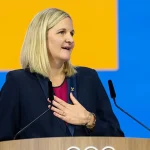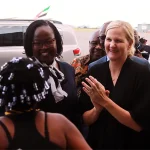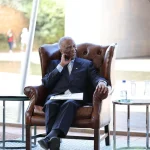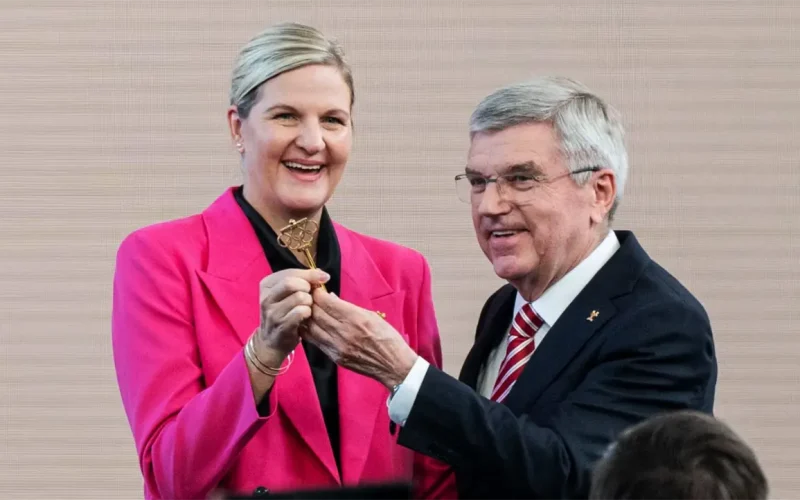
IN a ceremony steeped in Olympic tradition and historic significance, Kirsty Coventry officially has assumed the presidency of the International Olympic Committee, becoming the first woman and first African to lead the multibillion-dollar global sports organisation.
The symbolic handover took place at Olympic House in Lausanne on Olympic Day, as outgoing president Thomas Bach passed the ceremonial key to Coventry before more than 700 assembled guests, including IOC members, athletes, Olympic Movement representatives, and political leaders.
Coventry, 41, a double Olympic swimming champion from Zimbabwe who won gold medals in 2004 and 2008, was elected as the IOC’s 10th president at the 144th IOC Session in March in Olympia, Greece. She will serve an eight-year term leading an organisation that oversees the world’s largest sporting event and commands billions in revenue through broadcast rights, sponsorships, and commercial partnerships.
“IOC Members are the guardians of this Movement,” Coventry said in her inaugural address. “As the Olympic Movement, as Federations, as NOCs, as our sponsors and our partners, we are the guardians of this incredible platform. And it’s not just about a multi-sport event. It’s a platform to inspire. It’s a platform to change lives. And it’s a platform to bring hope.”
Bach, who led the IOC for 12 years after his election in 2013, emphasised the historic nature of the transition in his farewell remarks. “With her election, you have also sent a powerful message to the world: the IOC continues to evolve,” he said. “As the first female and first African to hold this position – and indeed the youngest IOC President since Pierre de Coubertin – she reflects the truly global nature and the youthful, forward-looking spirit of our Olympic community.”
The ceremony featured emotional moments, including a standing ovation when Bach received the Olympic Order in Gold from Coventry, the highest honour granted by the IOC. Bach was also named IOC Honorary President for Life during the March session.
Coventry’s ascension to the IOC presidency marks a watershed moment for the Olympic Movement, which has faced criticism over diversity and inclusion. Her appointment signals a shift toward broader representation in an organization that has been traditionally dominated by European men since its founding in 1894.
The new president, who began her Olympic career as a teenager and later served on the IOC Athletes’ Commission, brings a unique perspective as both a former competitor and sports administrator. She referenced her athletic background in her speech, noting how her first meeting with Bach as a new Athletes’ Commission member shaped her approach to leadership.
“[He said:] ‘Even though you’ll be at the very back of the room, I want to see your hands raised, and I want to hear you,'” Coventry recalled of Bach’s early guidance. “And that stuck with us as athletes. And it made a huge difference, because from the very first moment, you set the tone.”
Coventry also highlighted the global significance of her role, comparing the Olympic Movement to a spider’s web that requires unity to maintain its strength. “Our Movement, each and every single one of you, is that spiderweb. It’s complex, it’s beautiful, and it’s strong. But it only works if we work together, and if we remain united.”
The handover ceremony took place on Olympic Day, June 23, which commemorates the founding of the modern Olympic Games in 1894. Earlier that morning, both Bach and Coventry visited the cemetery where IOC founder Pierre de Coubertin is buried, laying a wreath in his honour.
Bach’s 12-year tenure was marked by significant challenges, including navigating the COVID-19 pandemic’s impact on the Tokyo 2020 Olympics and overseeing reforms within the organisation. His leadership during what he called “turbulent times” was praised by Coventry, who credited him with keeping the movement “united.”
As Coventry assumes control of the IOC, she inherits an organisation managing preparations for the 2026 Winter Olympics in Milan-Cortina, the 2028 Summer Olympics in Los Angeles, and the 2032 Summer Olympics in Brisbane, while also overseeing ongoing reforms and commercial partnerships worth billions of dollars annually.
The new president, who is also a mother of two young children, emphasised the personal motivation driving her leadership. “My little baby today is seven months old,” she said, referencing how her children serve as “constant reminders of why this Movement is relevant, why it needs to change, why we need to embrace the new ways.”
Coventry’s presidency begins immediately, with her first major challenge being to maintain the Olympic Movement’s global unity and commercial success while addressing calls for greater inclusion and modernisation in an increasingly complex international sports landscape.