TANZANIAN security forces killed and injured scores of people who had no part in post-election protests during and after the country’s disputed October 2025 general elections, Human Rights Watch has found – with the organisation warning that at least hundreds may have been killed across the country in what it describes as a brazen security crackdown on dissent.
In a report released on Thursday, Human Rights Watch said it had documented the deaths of 31 people not participating in protests and received credible information of a further 19 such deaths. The victims included market vendors, motorcycle taxi drivers, a pregnant woman, and a lawyer shot as he returned home from shopping. A national commission of inquiry established by President Samia Suluhu Hassan’s government to investigate the election-related violence is due to conclude its work on 3 April.
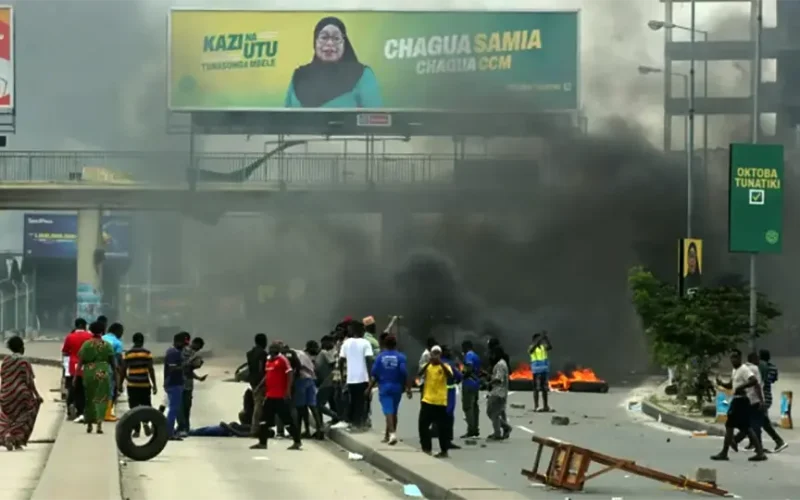
The unrest followed the arrest of Tundu Lissu, chairman of the main opposition party Chadema, in April 2025, and the subsequent barring of Chadema from participating in the elections. Weeks of mounting repression of government critics, journalists, and civil society culminated in protests that broke out on election day, 29 October, in Dar es Salaam, Mwanza, and Arusha. The government responded by imposing a nationwide internet blackout and a sweeping five-day lockdown, with police and military forces deployed to the streets.
“The police were shooting directly at any group of people.”
Eyewitness, Buhongwa market, Mwanza, 30 October 2025
Among the most deadly incidents documented was a police assault on the Buhongwa market in Mwanza on the morning of 30 October. Witnesses told Human Rights Watch that approximately 20 officers arrived at the market, ordered vendors to leave, beat those who were slow to comply, and then opened fire with live ammunition into the crowd. At least seven people were killed and around 50 were injured. Victims included a shoe salesman shot in the chest as he tried to close his stall, a tailor shot in the leg from behind as he fled, and a herb seller shot while seated. Survivors said officers blocked access to the hospital for hours, and the bodies of those killed were left in the market until 6 p.m.
The following evening, seven uniformed police officers arrived at a small restaurant in Mjimwema, 16 kilometres north of Buhongwa, where residents were watching football. Witnesses said officers opened fire on those seated outside, killing two. They then ordered others inside to lie face down in the street. When one man rose with his hands raised and pleaded for their lives, he was shot first. Officers then killed the remaining men on the ground. A total of 14 people died in the attack. Videos shared online six days later, corroborated by photographs passed directly to Human Rights Watch, showed 13 bodies lying mostly face down in pools of blood — one inside the bar, two in the doorway, and ten in the street. Deutsche Welle subsequently reported that forensic analysis of bullets recovered at the scene matched ammunition consistent with Kalashnikov-style rifles used by Tanzanian police.
In Dar es Salaam, Human Rights Watch documented multiple cases of civilians shot in their homes or on the street while not participating in protests. A twenty-year-old woman and her mother were shot in the legs outside their home in the Ubungo district. A lawyer, Peter Elibariki Makundi, was killed on Shekilango Road as he returned from shopping. In the city’s Temeke district, a 49-year-old man, Master Tindwa Mtopa, was shot outside his home. Family members said security forces at a checkpoint prevented them from transporting him to the hospital; he died two hours later after a relative in the army intervened to secure passage.
In Arusha, witnesses described scenes of indiscriminate fire in residential neighbourhoods. Among those killed were a 32-year-old pregnant woman shot in the back as she returned from a market, a man shot in the head while running errands, and a 47-year-old man shot twice in the head as he walked home after voting. The violence extended to the Tanzania-Kenya border town of Namanga, where police fired live rounds across the border, killing at least two people and seriously injuring others who were on the Kenyan side. Relatives of one injured man said they feared bringing him to a Tanzanian hospital, having heard reports that wounded people were being arrested.
Beyond the killings, Tanzanian authorities arrested more than 2,000 people during the crackdown, including children, many of them charged with treason — an offence that carries the death penalty. Among those detained was a boda boda driver in Dar es Salaam who said police arrested him while he was transporting a passenger, beat him severely, and falsely accused him of protesting. He was held for nearly two months before being released on 24 December, after President Hassan instructed the public prosecutions director to review the cases. He told Human Rights Watch he remained unable to work due to his injuries.
The commission of inquiry established by the government in November 2025 is composed of former officials and retired civil servants. Human Rights Watch has raised concerns about whether its mandate is broad enough to cover the killing and wounding of bystanders and arbitrary arrests. The organisation wrote to both the Tanzania Police Force and the commission on 6 March to share its findings and request information, but had received no response at the time of publication.
Human Rights Watch has called on the commission to investigate all killings and injuries documented in the report and to ensure that those responsible are prosecuted. It has also called on Tanzania’s development partners and concerned governments to publicly demand accountability. Oryem Nyeko, the organisation’s senior Africa researcher, warned that without accountability, the cycle of political violence would continue. “The Tanzanian authorities should recognise that impunity for rights abuses encourages further political violence,” Nyeko said. “They should end the continuing political repression and the detention of government critics, civil society and media.”