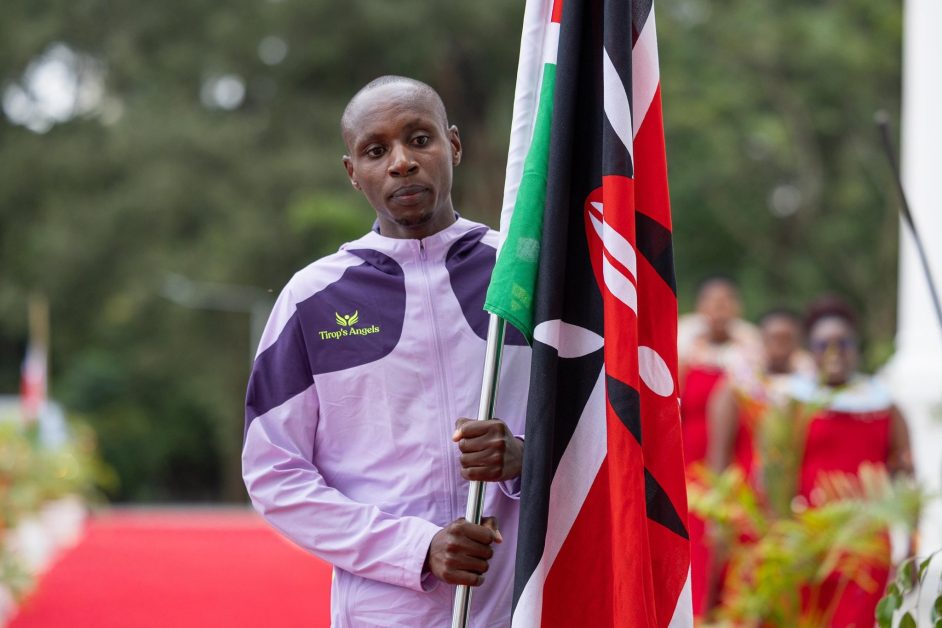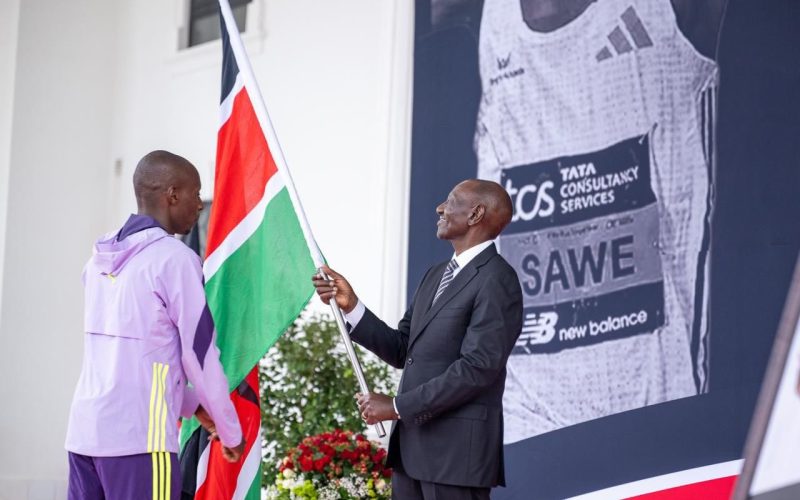
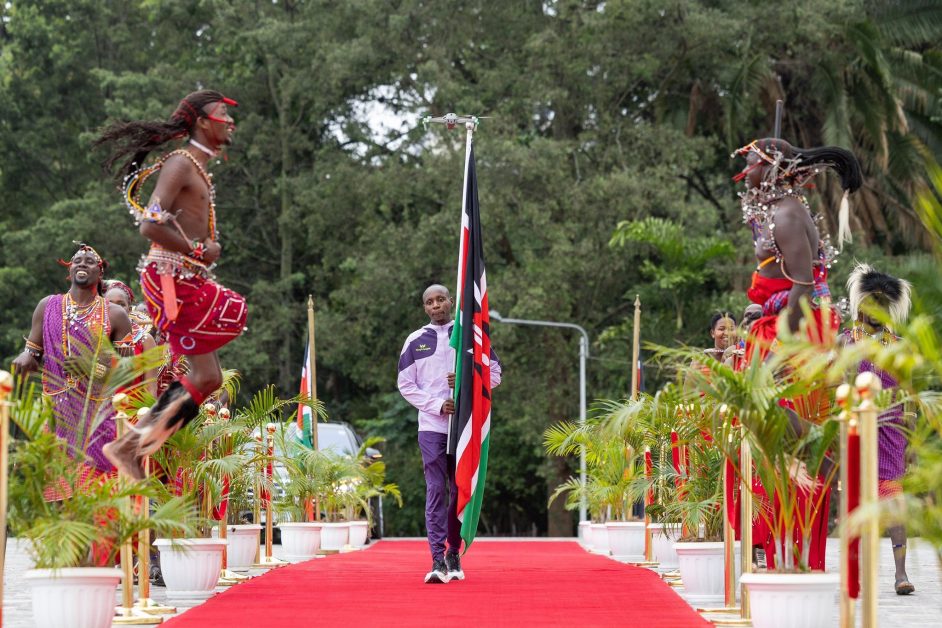
HE came home on a plane that was saluted by water cannons. He stepped onto Kenyan soil adorned with a traditional wreath of victory, serenaded by dancers, and welcomed by a crush of cameras, government officials, and the two parents who always knew he was destined for something extraordinary. And on Thursday, Sabastian Sawe — the 31-year-old from Kapsabet who remade the history of human achievement — stood before his president and received the nation’s gratitude in full.
Kenya does not forget its giants. And in Sabastian Sawe, it has produced perhaps its most monumental one yet.
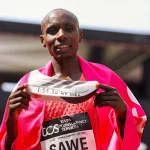
On Sunday, 26 April 2026, Sawe became the first man in history to run a marathon under two hours in a competitive race, winning the London Marathon in a time of 1 hour, 59 minutes, and 30 seconds — obliterating the previous world record held by the late Kelvin Kiptum by a staggering 65 seconds. The barrier that had defined the outer edges of human possibility for generations did not merely fall — it was demolished.
Kenya’s response was immediate and overwhelming. When Sawe’s aircraft touched down at Jomo Kenyatta International Airport in Nairobi on Wednesday, it received a water cannon salute. Sports Minister Salim Mvurya was there to receive him, declaring the achievement “a win for Kenya.” Traditional dancers sang his praises as he was adorned with a wreath made from twigs, the ancient symbol of victory, before climbing into a luxury government vehicle for a homecoming befitting a national hero.
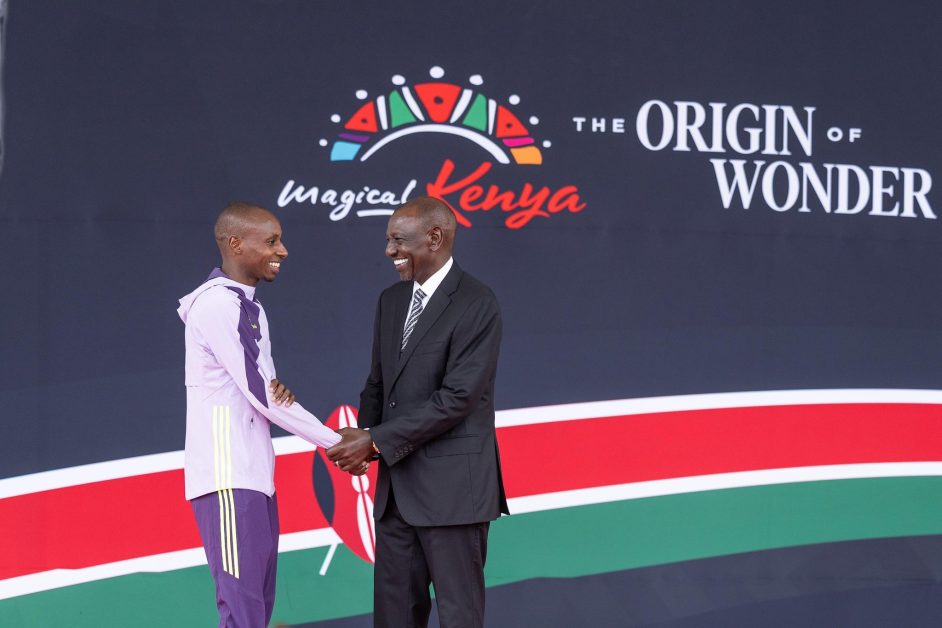
But it was Thursday’s encounter with President William Ruto that elevated the homecoming into something even more profound.
President Ruto hosted a formal welcoming ceremony where he described Sawe’s feat as “a defining moment in the history of human endurance,” and awarded the champion the sum of $61,000 along with a car. In a moving gesture of reciprocity, Sawe presented the President with an autographed Adidas Adizero shoe — the very shoe he wore on the day he remade history — along with a signed photograph of the moment he crossed the finish line.
It was the kind of exchange that captures something essential about sport at its highest level: a nation giving its son the material recognition he deserves, and a son giving his nation something money cannot buy — a permanent place in the record books of civilisation.
President Ruto had earlier written on his X account that Sawe had “redrawn the limits of human endurance,” adding: “Your triumph firmly places you among the greats of global athletics and reaffirms Kenya as an enduring force at the pinnacle of distance running.”
Those are not empty words. They are the verdict of history.
THE NUMBERS THAT SHOOK THE WORLD
Sawe ran the 42.195 kilometres of the London course with an average pace of 2 minutes 49.9 seconds per kilometre — and did so with a negative split, meaning the second half of his race was faster than the first. He reached the halfway mark in 60:29, before accelerating to a second half of 59:01. The man did not slow down as the weight of history descended on him. He ran faster.
He came through 30 kilometres alongside Ethiopia’s Yomif Kejelcha, then broke away — running his next 5km in 13:54 and covering the final 2.195km in 5:51, ten seconds faster than any man has ever closed a marathon.
The London podium that afternoon told the full, extraordinary story of East African dominance. Kejelcha, competing in his very first marathon, crossed the line in 1:59:41 to become the second man in history under two hours. Uganda’s Jacob Kiplimo finished third in 2:00:28 — itself seven seconds faster than Kiptum’s previous world record. In any other moment in athletic history, any of the three finishers would have been the headline of the century.
On this Sunday in London, they were the supporting cast to Sabastian Sawe.
THE QUIET RISE OF A RIFT VALLEY CHAMPION
Sawe comes from Kapsabet in Kenya’s Rift Valley running belt — the high-altitude cradle of champions that has produced generations of distance-running giants. But unlike Eliud Kipchoge before him, Sawe did not arrive in London as a global celebrity. His rise has been quiet, built almost entirely on results.
He won the Valencia Marathon in 2024, then London, then Berlin, and returned to London as defending champion — only to do what no man had done in a record-eligible race. And the record was even more remarkable because his preparation was far from ideal. He had been injured throughout the autumn and only resumed proper training in January 2026. By February, the goal was simply to defend his title — not to rewrite history.
He was introduced to professional running by his uncle, Abraham Chepkirwok, who represented Uganda in the 800 metres at the 2008 Beijing Olympics.
His mother, Emily Sawe, told journalists that she had always sensed the fire in him. “He would run too fast. So I would say to myself, this boy will shine for me one day,” she said.
His father, Simion Kiplagat Sawe, admitted to missing the actual finish — the television signal broke down at the critical moment. “The moment my son pulled in front, I walked out and didn’t see him finish the race. I watched the replay afterwards. I was so happy, extremely happy. We screamed so much that now it is hard to swallow anything,” he said.
Neither parent had to wait long for the next chapter. Sawe’s father reports that his son has already declared the record insufficient: “Even now, he still says that the record was not enough; he wants to lower it further.”
KENYA’S TORCH PASSES — AND BURNS BRIGHTER
For Kenya, Sawe’s victory carries the weight of succession. Paul Tergat helped define the country’s marathon identity. Eliud Kipchoge transformed the event into a philosophy of human possibility. Kelvin Kiptum pushed the official record to the very edge of two hours before his tragic death in 2024. Now Sawe has crossed the line that Kiptum seemed destined to break.
Eliud Kipchoge had, in fact, run under two hours in Vienna in 2019, but in a specially arranged challenge race not held under standard competitive conditions, meaning his time of 1:59:40 did not enter the official record books. Sawe went ten seconds faster — and did it in an open race, on a public road, against the world’s best.
The torch has not merely been passed. It has been thrown skyward.
“For the new generation, it shows that running a record is possible. Everything is possible with a matter of time,” Sawe said after crossing the line in front of Buckingham Palace.
He is right. And Kenya — under a president who showed up, gave thanks, gave gifts, and gave the nation’s full pride to a son of the Rift Valley — knows exactly what it has in Sabastian Sawe.
Not just a record-holder. Not just a champion.
A king of the road. And the road stretches further still.