
THE silence of prayer was shattered on a Sunday morning in June 2022. Inside St. Francis Catholic Church in Owo, Ondo state, families had gathered for worship when gunmen stormed the sanctuary, turning a place of peace into a scene of unimaginable horror. Fifty souls were lost that day. More than one hundred others bore the physical scars of wounds that would never fully heal, while an entire nation grappled with the spiritual wound of an attack that defied comprehension.
For three long years, the families of those lost have waited. They have buried their loved ones, tended to the survivors, and carried the weight of unanswered questions. Why here? Why them? Who would bring such darkness to their doorstep? In a country already struggling with insurgency and violence, the Owo massacre stood apart – not just for its brutality, but for the mystery that surrounded it.
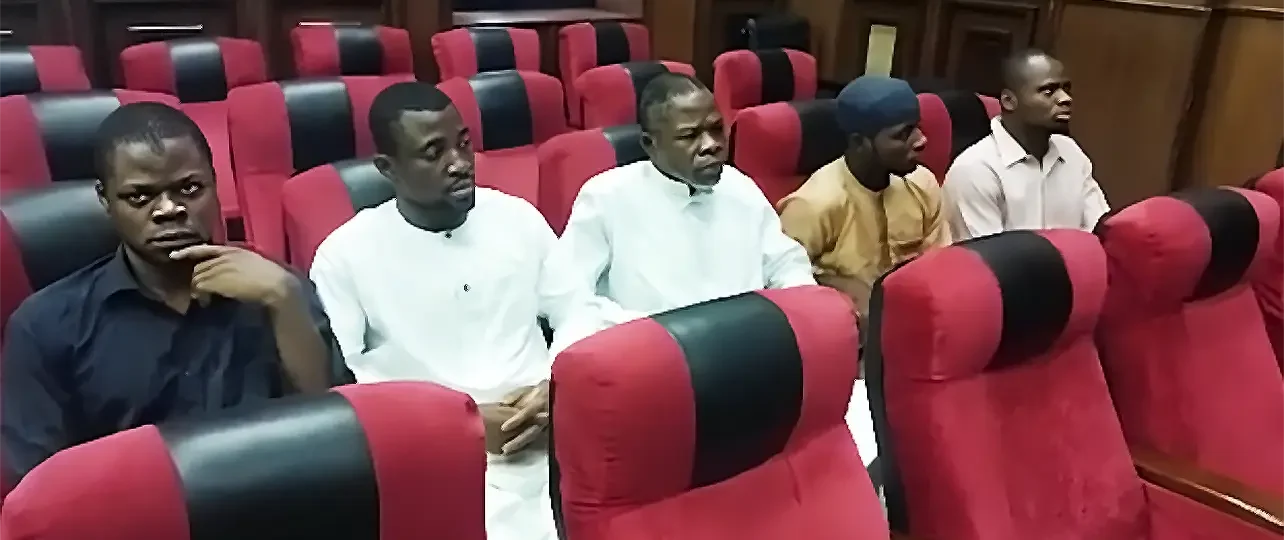
Now, in the sterile halls of a federal courthouse in Abuja, those questions may finally find their answers. On Monday, five men stood before Judge Emeka Nwite, their faces betraying nothing as the charges were read: terrorism, conspiracy, murder. Their names – Idris Omeiza, Al Qasim Idris, Jamiu Abdulmalik, Abdulhaleem Idris, and Momoh Otuho Abubakar – will now be forever linked to one of West Africa’s most shocking acts of religious violence.
The accused pleaded not guilty, their denials echoing in a courtroom where grief and hope sat side by side. According to prosecutors, these men had crossed more than mere geographical boundaries when they allegedly joined Al Shabaab, the East African militant group, in 2021. They had crossed moral ones, too, plotting not just the church attack but assaults on a school and a mosque – targeting the very institutions that bind communities together.
The charges paint a chilling picture of premeditation. The attack on St. Francis was not a moment of madness but allegedly part of a calculated campaign of terror that would have struck at the heart of Owo’s social fabric. That a mosque was also targeted reveals the indiscriminate nature of the alleged plot – this was not merely religious persecution but an assault on the community’s very soul.
Yet mysteries remain. Al Shabaab, primarily active in Somalia and East Africa, never claimed responsibility for the Owo attack. Neither did the more obvious suspects – ISWAP or Boko Haram, the insurgent groups that have terrorized Nigeria’s northeast for over a decade. This silence has haunted investigators and families alike, leaving room for speculation and conspiracy theories to flourish in the absence of clear answers.
The trial that will unfold beginning August 19 carries weight beyond the fate of five men. It represents a test of Nigeria’s judicial system and its capacity to deliver justice in terrorism cases – a challenge made more daunting by the country’s ongoing security crisis. For a government struggling to contain multiple insurgencies and widespread violence, the Owo prosecution offers a chance to demonstrate that no act of terror, no matter how shocking or mysterious, will go unpunished.
In the courtroom gallery, the families of victims will watch as evidence unfolds and testimonies are given. Some may find the closure they’ve desperately sought. Others may discover that justice, while necessary, cannot fill the void left by empty chairs at dinner tables and missing voices in church pews.
The Owo massacre shocked not just Nigeria but the entire West African region, serving as a stark reminder that terrorism knows no borders and respects no sanctuaries. As this trial begins, it offers more than just the possibility of individual accountability—it represents a moment when a wounded nation affirms that its commitment to justice remains unbroken, even in the face of unspeakable tragedy.
Three years later, the silence of that Sunday morning in Owo still reverberates. But now, finally, it may be broken by the voice of justice itself.