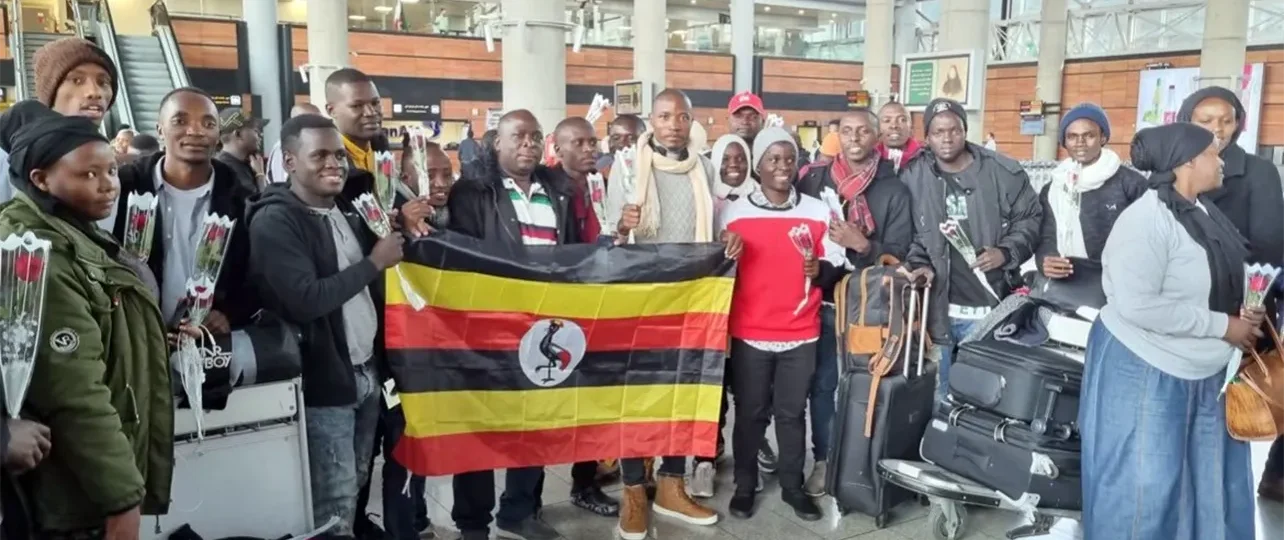

WHEN Major General Bob Ogiki, Uganda’s Defence Advisor in Turkey, shepherded 43 Ugandan students out of bomb-battered Tehran and across the border into safety this week, he was doing something many African governments are struggling to do at all: actually getting people out.
African nations are launching an extensive evacuation of their nationals from Iran and other countries in the Middle East in the wake of the escalating security crisis in the region. Ghana, Kenya, Nigeria, Sudan and Uganda have all been working to move their nationals from harm’s way – but the responses have varied sharply in speed, capacity, and honesty about what governments can and cannot deliver.
Ghana: Africa’s Fastest Mover
Ghana has been one of the first African countries to act. The government has closed its embassy in Tehran and started evacuating Ghanaians from Iran through land routes. The Foreign Affairs Ministry says the evacuation includes diplomats, students, professionals, and other citizens. In Israel, Ghana has also scaled down its diplomatic presence and is working on special clearances to evacuate more than 900 Ghanaians, including 65 students. No Ghanaian casualties have so far been reported in either country.
The closure of Ghana’s Tehran embassy is a significant diplomatic signal — and an acknowledgement that the conflict is not ending soon. Land routes through Azerbaijan and Turkey have become the primary escape corridors for nearly everyone, given that Iran’s airspace has been closed since the opening strikes on February 28.
Nigeria: Plans Finalised, Execution Pending
Nigeria’s foreign ministry says it is finalising plans to evacuate its citizens from the affected regions, working with international partners to ensure the safe and timely return of Nigerians. Citizens in Israel and Iran have been advised to reach out to Nigerian embassies or consulates in nearby countries for further guidance.
Nigeria has also called for an immediate ceasefire and urged both sides to protect civilians and return to dialogue. With Africa’s largest population and a substantial student and trading diaspora across the Middle East, the scale of Nigeria’s potential evacuation challenge dwarfs that of its neighbours — making the “finalising plans” language from Abuja a source of some anxiety among Nigerians still waiting to hear from their government.
Uganda: The Military Model
Uganda’s approach stands out for its use of a military attache network and its speed of execution. The Ugandan Ministry of Foreign Affairs is coordinating its evacuation with help from Ugandan embassies in Turkey, Azerbaijan, and Jordan. With airspace over Iran and Israel closed, evacuations are being rerouted through neighbouring countries by road. Uganda is also reaching out to officials in Saudi Arabia, the UAE, and Qatar for transit assistance. The 43 students now in Turkey represent a first wave; authorities confirm that search efforts for other Ugandans still inside Iran are continuing.
Sudan: Ordered, But Complicated
Sudan’s transitional government has moved quickly, ordering the evacuation of its citizens from Iran. The Sudanese ambassador in Tehran has been tasked with assessing the situation and ensuring a safe departure for nationals still in the country. That Sudan — itself a country still in the grip of a devastating civil war between the army and the RSF — is mounting an overseas evacuation speaks to both the depth of the Sudan-Iran relationship and the particular vulnerability of Sudanese nationals who study and work in Tehran.
Kenya: Advisory, Not Action
The Kenyan Ministry of Foreign Affairs has not started evacuations but issued a strong advisory urging its citizens in Israel and Iran to take extreme precautions. Citizens have been instructed to avoid unnecessary travel, remain indoors, and follow local authorities’ instructions. Kenyans in distress have been directed to contact their missions in Tel Aviv or Tehran for emergency assistance. For Kenyans already inside the conflict zone, an advisory to “remain indoors” is cold comfort when hospitals and universities have been shuttered, and bombs are dropping.
South Africa: Blunt About Its Limits
At least Pretoria has been frank. A South African government official said on Sunday that evacuating citizens from the Middle East is currently impossible, citing widespread airspace closures across the region. “It is impossible to move in or out of those countries. We are in touch with South Africans using various communication platforms,” said Clayson Monyela, deputy director-general of the Department of International Relations and Cooperation, adding that “various interventions and options are being explored.”
South Africa’s foreign ministry had earlier asked its citizens in Iran to register with the country’s embassy, while warning that its consular support is limited and that it may not be able to offer assistance during emergencies. That admission of limited capacity — from Africa’s most industrialised economy — is a signal of just how constrained this crisis has left every government south of the Sahara.
The Broader Picture: What Africa Stands to Lose
The evacuation crisis is only the most visible layer of Africa’s exposure to this conflict. More than ten African states, including Algeria, Tunisia, Libya, Chad, Sudan, Nigeria, Ghana, Tanzania and South Africa, have called on the parties to the conflict to refrain from further escalation. ECOWAS has sounded the alarm that the war with Iran threatens food supplies to Africa.
The economic risks go deeper than food. A US-Iran war would trigger a cascading economic and geopolitical crisis across Africa, transmitted through the world’s most vulnerable chokepoints. African net oil importers face an immediate inflationary hit and widening current-account deficits if conflict spikes the risk premium on shipping through the Strait of Hormuz. Around 15 percent of global maritime trade normally passes via the Suez Canal, a route already badly disrupted by regional conflict.
There are security ripple effects closer to home, too. Tehran had been supporting the Alliance of Sahel States — Mali, Niger and Burkina Faso — with drones and security assistance. With Iran’s capacity degraded, jihadis in the Sahel could press their advantage against the juntas. In Nigeria, Islamic militant groups are already building an anti-US narrative around the attacks, likely using them as a recruitment tool.
For now, the most urgent question for millions of African families is simpler and more personal: where is my child, my sibling, my spouse — and is their government doing enough to bring them home? The answers, country by country, are painfully uneven.