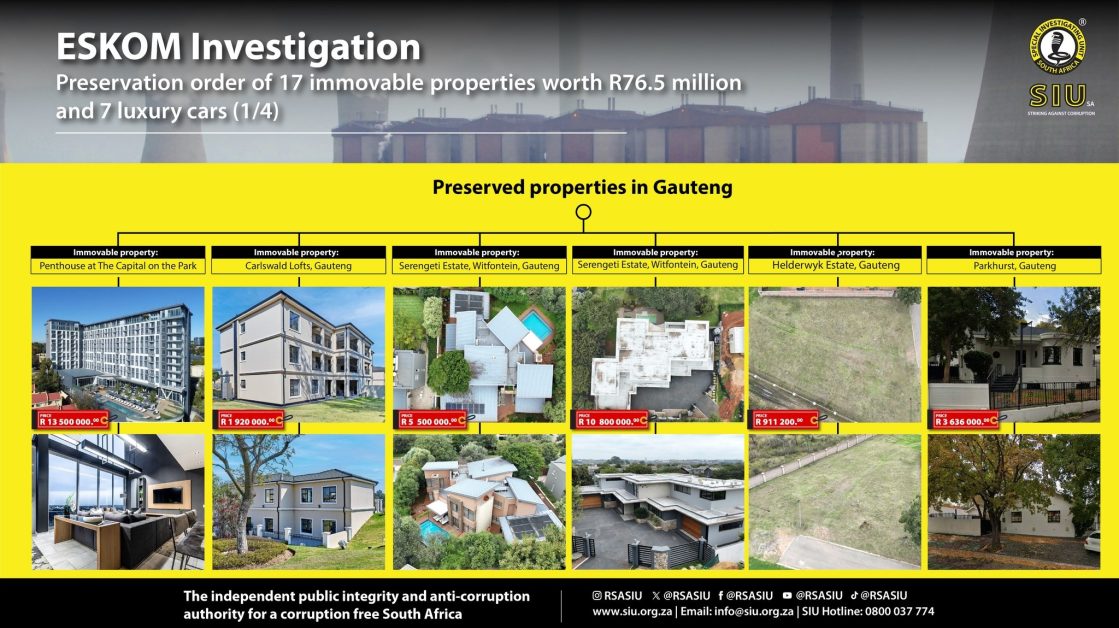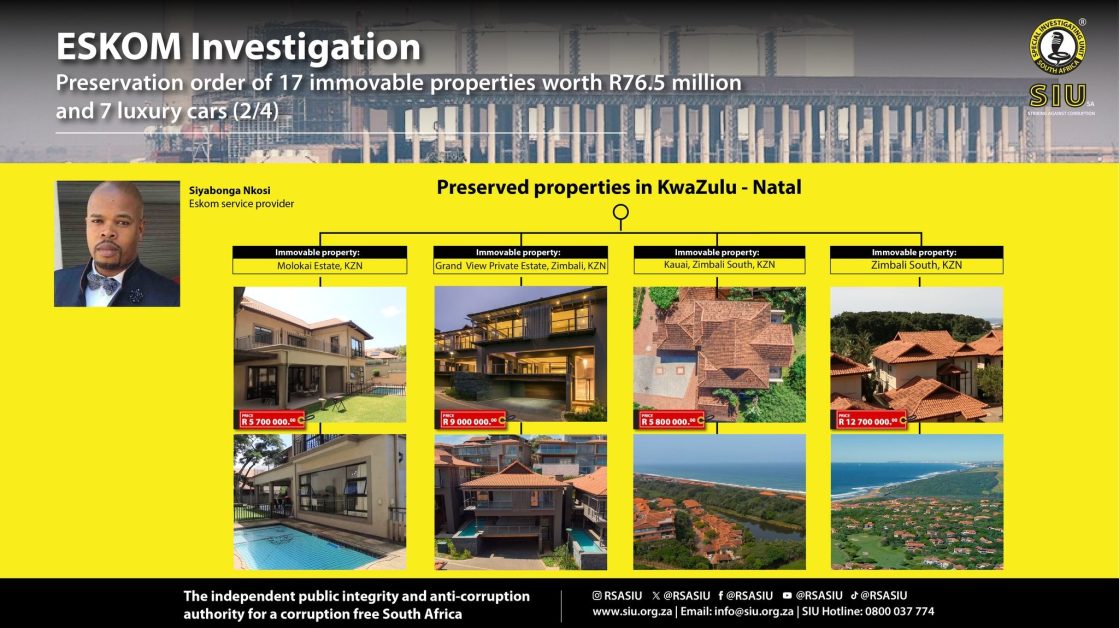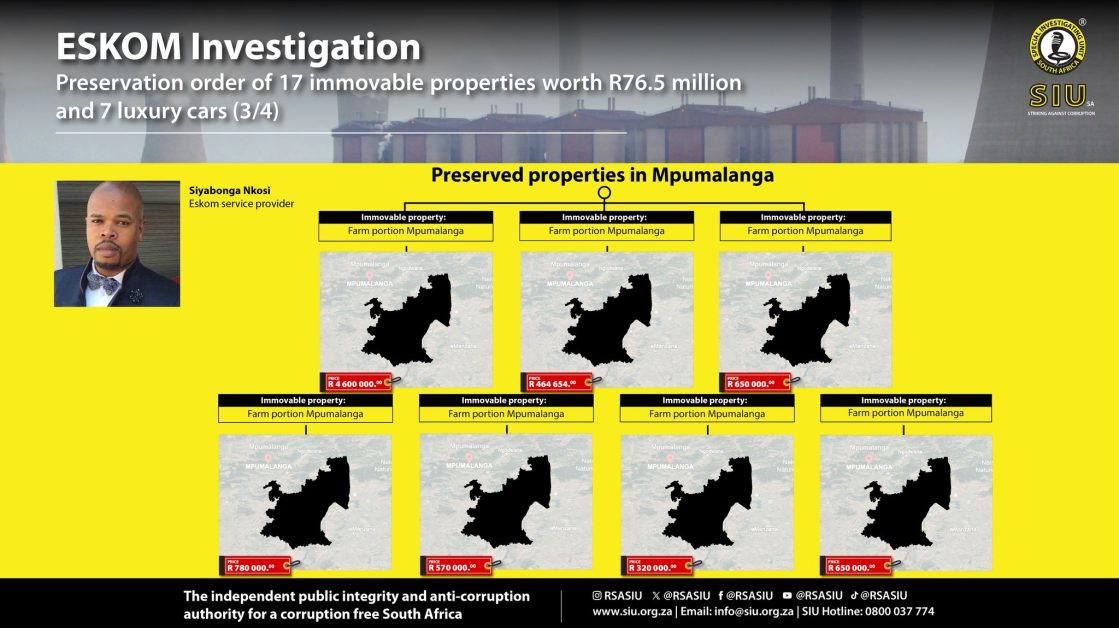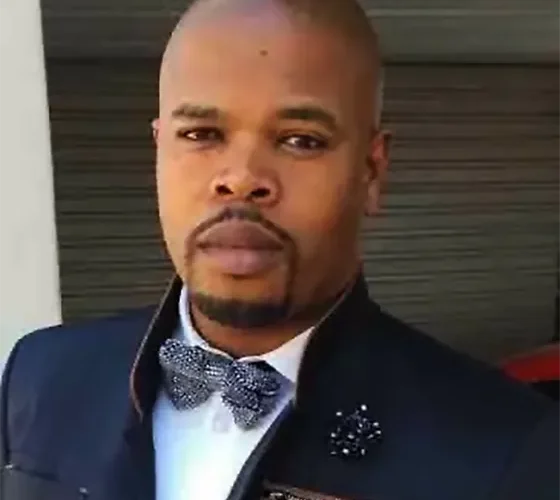
THE Special Investigating Unit (SIU) has delivered another decisive blow to the culture of impunity that has long plagued South Africa’s state-owned enterprises, securing a sweeping preservation order that freezes R76.5 million worth of assets linked to a single businessman and his web of family trusts – assets prosecutors allege were built on the proceeds of a brazen scheme to loot Eskom’s procurement budget.
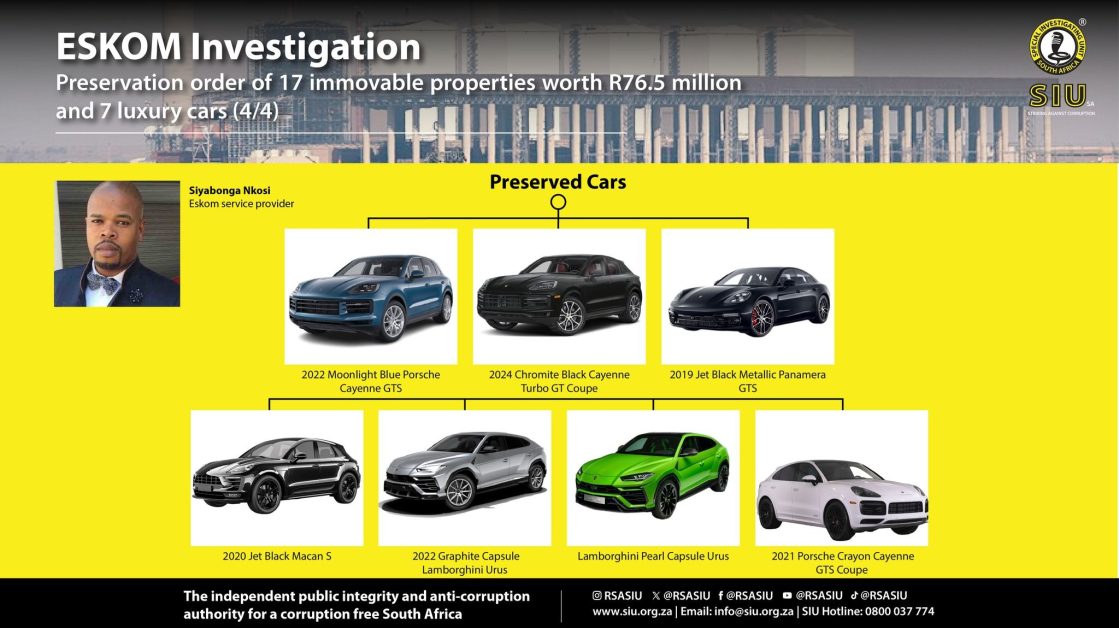
Judge BM Ngoepe of the Special Tribunal granted the order, prohibiting the sale, transfer, concealment or disposal of 17 immovable properties spread across Gauteng, KwaZulu-Natal and Mpumalanga, as well as seven luxury vehicles – among them Lamborghinis, Porsche Cayennes and a Porsche Panamera – tied to businessman Siyabonga Moses Goodwill Nkosi and three trusts through which he is alleged to have routed and laundered state funds.
The order triggers a sixty-day countdown within which the SIU must approach the Special Tribunal to formally review and set aside the underlying contracts. It also sets the stage for the unit to pursue civil recovery proceedings in the High Court – and, critically, to refer the full body of evidence to the National Prosecuting Authority (NPA) for potential criminal prosecution.
“Officials priced relays at R50,000 each. The market price: between R180 and R450.”
THE ARCHITECTURE OF THE ALLEGED FRAUD
The SIU investigation, authorised under Proclamation R.80 of 2022, centres on procurement irregularities at two of Eskom’s coal-fired power stations: Kusile, the giant under-construction plant in Mpumalanga, and Matla, in the same province. Between 2021 and 2023, officials at both facilities are alleged to have systematically manipulated the purchase order process for electrical relays – components critical to the safe operation of power station infrastructure.
The scale of the alleged manipulation is striking in its audacity. Relays were priced in Eskom’s procurement system at R50,000 per unit. The prevailing market price for equivalent equipment, the SIU found, ranged between R180 and R450. The cumulative financial loss flowing directly from this price manipulation amounts to R73,650,994.87 – a figure that, with grim irony, approaches the total value of the frozen assets.
But the scheme did not rely on inflated pricing alone. Officials at Kusile and Matla are alleged to have deployed a suite of techniques to insulate the fraud from oversight. Purchase orders were deliberately split to keep individual transactions below the R1 million threshold that triggers formal competitive procurement processes – a textbook abuse of the informal tendering system that has been repeatedly identified as a vulnerability in state entity procurement.
More technically sophisticated was the manipulation of Eskom’s internal systems. False part numbers were uploaded to the utility’s procurement database, ensuring that only vendors coordinating with the colluding officials could successfully bid. The effect was to create an artificial monopoly, channeling contracts to Nkosi’s companies while locking out legitimate suppliers. And in a detail that encapsulates the contempt with which public resources were treated, much of the equipment procured through this scheme was never needed: investigators found it sitting unused in Eskom stock, years later.
NKOSI, THE TRUSTS, AND THE TRAIL OF IMMOVABLE PROPERTY
At the centre of the SIU’s case stands Siyabonga Moses Goodwill Nkosi, cited in the preservation order both in his personal capacity and as trustee of three entities: the Nkosi Royal Trust, the Sibongukukhanya Trust, and the Siyabonga Kankosi Trust. It is through this trust architecture, investigators allege, that the proceeds of Eskom’s looted procurement budget were converted into tangible wealth – prime residential and commercial property in some of South Africa’s most desirable suburbs and estates, and a garage of vehicles that read like a luxury car dealership’s inventory.
The 17 immovable properties span three provinces. In Gauteng, where Johannesburg’s northern suburbs have long served as a preferred destination for illicitly acquired real estate, the SIU identified multiple high-value holdings. Properties in KwaZulu-Natal and Mpumalanga complete the portfolio – a geographical spread that mirrors Eskom’s own operational footprint and raises pointed questions about the local networks that enabled the alleged scheme.
The seven luxury vehicles subject to the preservation order – including at least one Lamborghini, Porsche Cayenne models, and a Porsche Panamera – are among the most viscerally compelling elements of the case. They represent, in physical form, the conversion of public funds into personal status.
“False part numbers were uploaded to Eskom’s systems to ensure only colluding vendors could bid.”
LEGAL MECHANISM: THE PRESERVATION ORDER AND WHAT FOLLOWS
The preservation order secured by the SIU operates as an immediate protective measure, preventing the dissipation of assets while the unit builds its civil case. Under the Special Investigating Units and Special Tribunals Act 74 of 1996, the SIU now has sixty days from the date of the order to approach the Special Tribunal for a formal review and setting aside of the irregular contracts.
In parallel, the SIU retains the authority to initiate civil proceedings in the High Court or before the Special Tribunal – acting in its own name – to correct the wrongdoing uncovered and to recover the full quantum of financial loss suffered by the state, including payments made for goods and services that were either not rendered or grossly overpriced.
The referral pathway to the NPA is equally significant. Should prosecutors determine that the evidence meets the criminal threshold, individuals identified in the investigation – including officials who signed off on the manipulated purchase orders – could face charges of fraud, corruption, and money laundering. The SIU Act compels the unit to make such referrals where evidence of criminal conduct emerges, and the alleged conduct in this matter – systematic procurement manipulation, false documentation, and the laundering of proceeds through trust structures – would appear to meet that bar on its face.
ESKOM, ACCOUNTABILITY, AND THE BIGGER PICTURE
The Eskom procurement environment has been fertile ground for corruption. The utility’s deep financial distress – it carries a debt burden in the hundreds of billions and has for years been the single greatest drag on South Africa’s public finances – has its roots partly in decades of mismanagement and deliberate looting. The Kusile project, at the centre of this investigation, has itself been a focal point for allegations of procurement irregularity, construction fraud, and mismanagement on a massive scale.
The SIU’s work at Kusile and Matla is thus not an isolated intervention. It forms part of a broader accountability architecture that includes the Zondo Commission’s findings, the NPA’s ongoing prosecutorial efforts, and the work of oversight bodies within the Presidency. Each preservation order, each asset attachment, each referral to prosecutors represents a brick in the edifice of consequence that South Africa’s anti-corruption framework has, haltingly but meaningfully, begun to construct.
That an investigation launched under a 2022 proclamation has, within a relatively short period, produced a preservation order of this scale – 17 properties, seven luxury vehicles, R76.5 million in frozen assets – speaks to the SIU’s operational capacity when mandated and resourced to act. It also speaks to the scale of what was allegedly taken.
“R73.6 million directly lost. A garage of Lamborghinis and Porsches. Properties in three provinces. This is the alleged price of Eskom’s procurement culture.”
WHAT HAPPENS NEXT
With the preservation order in place, the immediate focus shifts to the SIU’s sixty-day window to launch formal contract review proceedings before the Special Tribunal. Legal observers will watch closely to see whether the unit meets that deadline and whether the Tribunal moves swiftly to set aside the contracts – a step that would formally invalidate the payments made to Nkosi’s companies and anchor the civil recovery claim.
The NPA referral, if and when it is made, will carry its own timeline and dynamics. Criminal prosecutions arising from SIU investigations have historically moved slowly through South Africa’s courts, and the unit’s role formally ends at referral. But the body of evidence assembled through a dedicated proclamation investigation, with access to Eskom’s internal systems and documentation, should provide prosecutors with a more solid evidentiary foundation than many previous corruption matters.
For Siyabonga Nkosi and the trusts bearing his name, the preservation order marks not the end of the legal journey but the beginning of a protracted reckoning. For Eskom, its ratepayers, and the South African public who have borne the cost of the utility’s dysfunction in load shedding and financial bailouts, it is at minimum the confirmation that someone, somewhere, is keeping score.
KEY FIGURES AT A GLANCE
| Assets frozen | 17 immovable properties + 7 luxury vehicles |
| Total asset value | R76,500,000 |
| Direct loss to Eskom | R73,650,994.87 |
| Period of alleged scheme | 2021 – 2023 |
| Power stations implicated | Kusile and Matla (Mpumalanga) |
| Properties — provinces | Gauteng, KwaZulu-Natal, Mpumalanga |
| Vehicles | Lamborghini(s), Porsche Cayennes, Porsche Panamera |
| Trusts cited | Nkosi Royal Trust; Sibongukukhanya Trust; Siyabonga Kankosi Trust |
| Legal authority | SIU Act 74 of 1996; Proclamation R.80 of 2022 |
| Next legal step | SIU to approach Special Tribunal within 60 days |