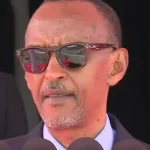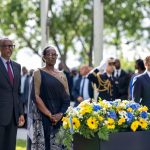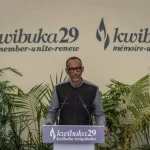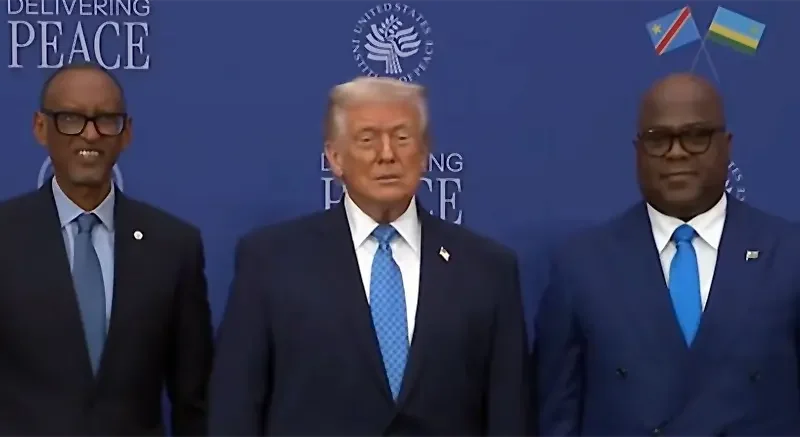
THE optics should have been the first warning. In the grand theatre of the White House, under the glare of cameras meant to capture a historic moment, two presidents stood carefully apart. Paul Kagame of Rwanda and Felix Tshisekedi of the Democratic Republic of Congo could not bring themselves to look at one another. A handshake – that most basic diplomatic gesture – was impossible. Yet US President Donald Trump proclaimed the moment “historic,” the beginning of the end to a decades-long conflict that has claimed countless lives and displaced millions.
Eight days later, the fiction collapsed entirely.
On Wednesday evening, Rwanda-backed M23 rebels seized the strategic city of Uvira in eastern DRC, one of the Congolese army’s last remaining strongholds in a region that has become synonymous with human suffering. The so-called Washington Accord, signed with such fanfare, had proven to be exactly what the body language in that White House ceremony suggested: an empty performance, a diplomatic mirage that dissolved the moment it encountered reality.
The Anatomy of a Failed Deal
The fundamental flaw in the Washington Accord was visible from its inception, yet somehow overlooked in the rush to claim a foreign policy victory. The M23 rebels – the actual armed force prosecuting the war on the ground – were not signatories to the agreement. They were not even in the room. Instead, they participate in a separate, parallel peace process led by Qatar, creating a bizarre diplomatic architecture where the parties signing peace agreements are not the parties holding the guns.
Bertrand Bisimwa, Deputy Coordinator of the AFC-M23 rebel alliance, made this disconnect brutally clear when he noted that the Washington Accord concerned relations between Congo and Rwanda, not the conflict his forces are waging inside Congolese territory. His words carry the weight of uncomfortable truth: the war his group has been fighting since the beginning has never stopped, regardless of whatever ceasefire agreements have been signed in distant capitals.
This is not merely a technical oversight. It represents a catastrophic misunderstanding -or perhaps a willful ignorance – of the conflict’s true nature. More than 100 armed groups compete for control in mineral-rich eastern Congo. The M23 may be the most prominent, but the proliferation of armed actors makes any peace deal that fails to address ground realities fundamentally inadequate.
The Accountability Vacuum
US Ambassador to the UN Mike Waltz’s statement on Friday captured the administration’s belated recognition of failure. Washington, he said, was “incredibly disappointed” with the renewed violence and would hold “spoilers to peace” accountable. But the question hangs heavy in the air: accountable how, and accountable when?
Waltz laid out in stark detail what UN experts have documented for years – that Rwanda maintains strategic control of M23, that Kigali has been intimately involved in planning and executing military operations in eastern DRC, and that between 5,000 and 7,000 Rwandan defence force troops have fought alongside M23 fighters. This is not new information. It was known when Kagame arrived in Washington. It was known when Trump hailed the accord as historic.
The reality is that the Washington Accord was built on a foundation of deliberate ambiguity about Rwanda’s role in the conflict. By treating the crisis primarily as a bilateral dispute between Rwanda and DRC – rather than as Rwandan military aggression through proxy forces – the agreement allowed Kigali to maintain plausible deniability while continuing its military objectives. Rwanda could sign a peace deal even as the forces it controls continued fighting.
The Regional Powder Keg
The M23 advance has now brought the conflict to Burundi’s doorstep, threatening to ignite a broader regional conflagration. Burundi’s UN Ambassador Zephyrin Maniratanga delivered a stark warning that should chill anyone following this crisis: “Let me be clear: restraint has its limits. Should these irresponsible attacks continue, it would become extremely difficult to avoid a direct escalation between our two countries.”
This is the Great Lakes region’s nightmare scenario – a widening war that pulls in multiple states, each with its own security concerns, ethnic calculations, and historical grievances. Burundi has maintained troops in eastern Congo for years. Uganda has interests in the region. The potential for miscalculation and escalation grows with each rebel advance.
DRC’s Foreign Minister Therese Kayikwamba Wagner put the international community on notice, declaring this a “moment of truth” where the world must choose between accepting open defiance of the international order or holding Rwanda accountable. Her frustration is palpable, her accusation of impunity damning. For years, the international community has documented Rwandan involvement in eastern Congo, issued reports, made statements—and done little else of consequence.
The Human Cost of Diplomatic Theatre
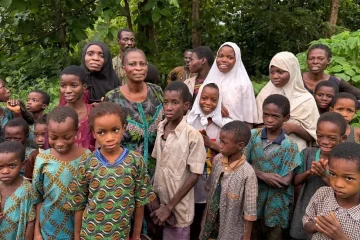
Behind the diplomatic rhetoric and geopolitical manoeuvring lies a humanitarian catastrophe of staggering proportions. The UN refugee agency reports that more than seven million people have been displaced by the fighting – one of the world’s most significant humanitarian crises, yet one that receives a fraction of the attention given to conflicts elsewhere.
These millions of displaced people – families torn apart, lives shattered, futures stolen – were the ostensible beneficiaries of the Washington Accord. The peace deal was supposed to be for them. Instead, they have watched as armies continue to advance, as cities fall, as the international community’s promises of peace prove hollow.
The rebels, meanwhile, speak openly of their true objectives. Bisimwa’s comments about establishing a federal system in DRC, about creating “a new balance between the provinces and the central government,” reveal ambitions that extend far beyond self-defence or protection of Tutsi communities. This is about fundamental restructuring of the Congolese state, about redrawing power relationships in a vast, resource-rich territory. Such objectives are not resolved by bilateral accords signed in Washington; they require political negotiations that address the deep grievances and power imbalances that fuel the conflict.
The Credibility Crisis
The collapse of the Washington Accord represents more than just another failed peace deal in a long history of failed peace deals. It represents a credibility crisis for American diplomacy in Africa. When a US president hosts regional leaders at the White House, when he proclaims an agreement “historic,” when his administration invests political capital in a diplomatic initiative – and when that initiative falls apart in eight days, it raises fundamental questions about American understanding of African conflicts and American capacity to contribute meaningfully to their resolution.
The warning signs were all visible. The absence of M23 from the negotiations. The documented evidence of Rwandan involvement. The parallel negotiating tracks created confusion rather than clarity. The body language of two presidents who could not look at each other. All of this pointed to an agreement built on sand, yet the administration proceeded as if willpower and publicity could substitute for substance.
What Comes Next
The collapse of the Washington Accord leaves the region in a precarious position. Violence is escalating. Regional tensions are rising. The humanitarian crisis deepens. And the international community’s most recent attempt at peace-making lies in ruins.
There are no easy answers, but some hard truths must be acknowledged. First, any sustainable peace process must include the actual combatants, not just the capitals that nominally control them. Second, addressing Rwanda’s role – and holding Kigali accountable for documented military involvement – cannot be perpetually deferred in the name of diplomatic convenience. Third, the underlying political and economic grievances that fuel the conflict require serious attention, not superficial agreements that paper over fundamental disputes.
The people of eastern Congo deserve better than diplomatic theatre. They deserve better than peace deals that exist only for the cameras, that collapse before the ink is dry. They deserve an international community willing to invest the time, resources, and political will necessary to address the root causes of a conflict that has devastated their lives for decades.
The Washington Accord failed not because peace in eastern Congo is impossible, but because it was never designed to succeed. It was a photo opportunity masquerading as diplomacy, a quick win substituting for hard work. The cost of that failure will be measured in lives lost, families displaced, and hopes dashed – costs borne not by the diplomats in Washington or Kigali or Kinshasa, but by ordinary Congolese caught in a war that the world continues to treat as someone else’s problem.
Until the international community -and particularly the United States – is willing to engage with the conflict’s messy realities rather than its convenient fictions, the cycle of failed peace deals and renewed violence will continue. The question is how many more millions must be displaced, how many more must die, before that lesson is finally learned.