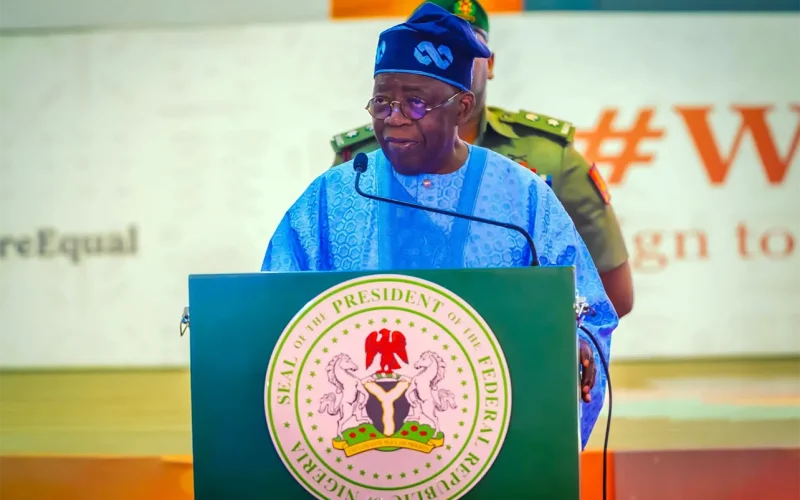
PRESIDENT Bola Ahmed Tinubu has announced national honours for more than three dozen Nigerians whose courage, sacrifice, and suffering laid the foundations of the democratic republic the country now celebrates – figures who faced prison cells, forced exile, solitary confinement, and state violence in the struggle to restore the mandate stolen from Chief M.K.O. Abiola on June 12, 1993.
The announcement, made during Thursday’s Democracy Day address at Eagle Square in Abuja, represents one of the most comprehensive acts of official recognition for the civil society actors, journalists, lawyers, and political activists who sustained the pro-democracy movement through years of military dictatorship under General Sani Abacha and, before him, General Ibrahim Babangida.
“As beneficiaries of their struggle, we have a duty to strengthen and deepen the democratic institutions for which they fought. The greatest tribute we can pay is to build a Nigeria where freedom is protected, justice is upheld, opportunity is expanded, and government is accountable.”
Among those to receive awards are veteran journalists and media proprietors who kept oppositional voices alive under conditions of severe press repression, including Olatunji Bello, Sam Omatseye, Bola Bolawole, Femi Kusa, Richard Akinnola, and Babajide Kolade-Otitoju. Several of those named were detained, threatened, or driven underground during the military era for their refusal to serve as instruments of state propaganda.
Rights lawyers also feature prominently. Barrister Ayoka Lawani, Chief Ayo Opadokun, and Barrister Titus Mann are among the legal practitioners recognised — individuals whose courtrooms became the last lines of resistance against arbitrary detention and whose chambers became safe houses for a persecuted opposition.
Two recipients will receive their honours posthumously. Dr Arthur Nwankwo, a publisher and intellectual who paid a steep personal price for his intellectual independence, and Ben Charles-Obi are to be decorated in absentia, their families the custodians of a recognition long owed.
The list also includes civil society leaders, activists and democracy campaigners: Dr Joe Okei-Odumakin, a tireless human rights advocate; Prof. Sylvester Odion-Akhaine; Debo Adeniran; Femi Aborisade; and Chief Ralph Obiora, among others. Major General Ishola Williams (retired), a rare soldier who aligned himself with the democratic cause, is also named.
In a notable addendum, the president extended recognition to what he termed “soldier-democrats” — serving military officers who, at great personal risk, resisted the excesses of the Abacha regime from within the armed forces. The group includes Major General MA Garba, Colonel Sambo Dasuki, Colonel Lawan Gwadabe, and Brigadier Yahaya Abubakar — now the Etsu Nupe — who already holds the Commander of the Federal Republic (CFR) honour. Their inclusion signals a deliberate effort to acknowledge that the democratic struggle had allies inside the barracks.
Tinubu framed the awards within a broader historical argument: that June 12 is not merely an electoral date but a moral watershed — the moment a pan-Nigerian mandate, cutting across ethnicity and religion, revealed what genuine national unity could look like. That moment, he argued, was betrayed by the military but ultimately vindicated by history.
He paid tribute to the founding figures of the June 12 struggle who have since died: Chief Gani Fawehinmi, Chief Bola Ige, Chief Alfred Rewane, Pa Abraham Adesanya, Chief Anthony Enahoro, Alhaji Balarabe Musa, Dr Beko Ransome-Kuti, Frank Kokori, Chima Ubani, and General Shehu Musa Yar’Adua, among others. He also separately honoured Alhaja Kudirat Abiola, the wife of MKO who was assassinated in Lagos in 1996 while campaigning for her husband’s release.
In recognition of General Yar’Adua’s vision of national partnership, the Federal Government announced the revitalisation and renaming of the completed Institute of Petroleum Studies in Kaduna as the General Shehu Musa Yar’Adua University of Geological Sciences and Engineering Technology.
The full honours list is to be gazetted in the coming days. Thursday’s address made clear, however, that the administration intends these awards not merely as retrospective ceremony but as a live argument: that democracy in Nigeria was purchased at great human cost, and that its present stewards are obligated — politically and morally — to ensure the price was not paid in vain.