THE floodlights of Tokyo’s Japan National Stadium cast an ethereal glow through the rain-soaked evening air, but nothing could dim the blazing brilliance of Africa’s athletic royalty as they rewrote the script of global athletics in the most spectacular fashion imaginable.
Kenya’s Golden Sweep: The Queens of Distance Reign Supreme
In the most audacious display of middle and long-distance dominance ever witnessed at a World Championships, Kenya’s women didn’t just win medals – they conquered an entire spectrum of races with the ruthless efficiency of an unstoppable force of nature.
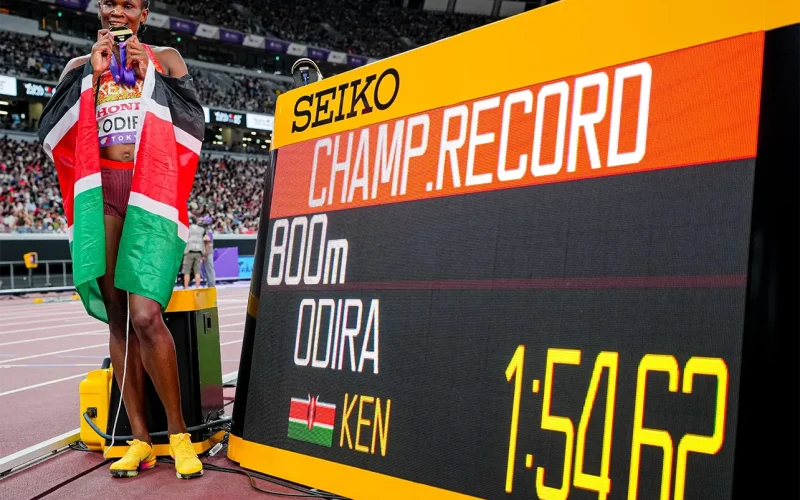
The crescendo came when 26-year-old Lilian Odira, a mother of two who had barely registered on the global radar, unleashed one of the most breathtaking finishes in championship history. Racing in the deepest women’s 800m field ever assembled, Odira had been dismissed as an afterthought – a woman with a modest 1:56.52 personal best who had finished a distant second to British champion Keely Hodgkinson just months earlier in Silesia.
But in the cathedral of athletics that is the Japan National Stadium, Odira found wings. With the defending world champion Mary Moraa setting the early pace and the seemingly invincible Hodgkinson making her trademark surge at 600 meters, the stage was set for another British victory. Yet as the field thundered into the home straight, something magical happened.
With 50 meters to go, as Georgia Hunter Bell challenged Hodgkinson and the crowd rose to its feet, Odira appeared from nowhere like a phantom in the night. Her legs moved with the fluid grace of a gazelle in full flight, and over the final 20 meters, she didn’t just catch the field – she obliterated it.
The clock stopped at 1:54.62, a championship record that shattered the 42-year-old mark set by Czech legend Jarmila Kratochvilova in 1983. Behind her, the British duo of Hunter Bell (1:54.90) and Hodgkinson (1:54.91) completed a podium where three women broke 1:55 for the first time in history, and five dipped under 1:56 in a race that redefined what was possible in women’s middle-distance running.
“This medal means the world to me,” Odira said, her voice trembling with emotion. “It is for my sons, they are four and two. They are my motivation.” Here was a late bloomer who had transformed from semi-final elimination at the Paris Olympics just over a year ago into a world champion who had improved by almost four seconds – a testament to the inexhaustible depth of Kenyan athletics.
But Odira’s triumph was merely the crown jewel in Kenya’s unprecedented sweep. Faith Kipyegon had already claimed the 1500m with her characteristic blend of tactical brilliance and devastating finishing speed. Beatrice Chebet doubled up with victories in both the 5000m and 10,000m, her range and endurance marking her as the new queen of distance running. Faith Cherotich dominated the 3000m steeplechase with the fearless abandon that has become synonymous with Kenyan steeplechasers, while Peres Jepchirchir completed the golden odyssey with marathon victory.
Seven events. Seven Kenyan victories. From 800 meters to 42.195 kilometres, the women in green had painted Tokyo gold with a dominance so complete it bordered on the supernatural.
Botswana’s Moment of Destiny: When Lightning Strikes in the Rain
As the heavens opened over Tokyo and rain hammered down on the Japan National Stadium track, creating a glistening surface that reflected the floodlights like a mirror, four young men from Botswana were about to fulfil a nation’s deepest sporting dreams.
The men’s 4x400m relay had long been America’s domain – nine victories in the past ten World Championships had established the United States as the undisputed masters of this most gruelling of relay races. When anchor leg runner Rai Benjamin, the 400m hurdles champion, took the baton with a commanding two-meter lead, it seemed as if the natural order would be restored despite the Americans’ earlier struggles in the heats.
Behind Benjamin, the battle for silver appeared to be between Olympic silver medallists Botswana and South African world relay champions, with Zakithi Nene beginning to close the gap on the outside for the Rainbow Nation. The crowd braced for another American procession to gold.
But in sport, as in life, the most beautiful moments come when the impossible becomes inevitable.
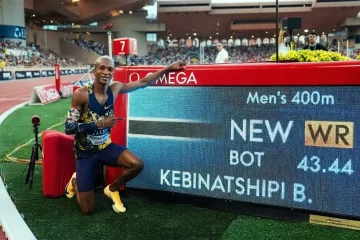
Through the middle of the track, barely visible in the rain-soaked chaos of the final straight, came the slight figure of Collen Kebinatshipi. The individual 400m champion moved with the ethereal grace of a dancer, his feet barely seeming to touch the sodden surface as he floated between his rivals like a ghost materialising from the storm.
In the space of 50 meters, Kebinatshipi didn’t just catch Benjamin and Nene – he glided past them both with a finishing kick so sublime it defied physics. As he crossed the line in 2:57.76, arms raised to the crying heavens, Botswana had claimed their first-ever global 4x400m title, edging the United States to silver by the narrowest of margins as they shared an identical time of 2:57.83 with bronze medallists South Africa.
The celebration that followed was pure poetry in motion. Led by the irrepressible Letsile Tebogo, whose super-fast second leg split of 44.05 had kept Botswana’s dreams alive, the four young men in pale blue high-stepped through the puddles with the unbridled joy of Gene Kelly in “Singin’ in the Rain.” Here was the zest and exuberance of a nation finally tasting gold on the global stage.
For Tebogo, Olympic 200m champion and Paris silver medallist, this was redemption after the cruel disappointments of earlier in these championships – a false start disqualification in the 100m final and a heartbreaking fourth place in the 200m despite running 19.65. But now, surrounded by his relay brothers, he was finally celebrating the gold his talent deserved.
Bayapo Ndori, the individual 400m bronze medallist, had run the crucial third leg that handed Kebinatshipi the baton within striking distance. Together with opening leg runner Anthony Pesela, they had formed a quartet that represented everything beautiful about athletics – young talent, unwavering belief, and the courage to dream beyond their circumstances.
Even South Africa’s bronze medal run told its own compelling story, kept alive by an inspired third leg from 33-year-old Wayde Van Niekerk, the world record holder who proved that class is indeed permanent as he battled Father Time and injury to help deliver his nation to the podium one more time.
The Thunder Continues to Roll
As the final day of the World Athletics Championships Tokyo 25 drew to a close, the statistics told only part of the story of African excellence. Kenya’s women had achieved the unthinkable with their distance double, triple, and quadruple victories. Botswana had announced themselves as a genuine relay powerhouse with their thrilling 4x400m triumph.
But beyond the medals and records lay something far more profound – the continuation of a tradition that stretches back decades, where African athletes have consistently reminded the world that greatness knows no borders, that talent can emerge from the most humble beginnings, and that the human spirit, when allied with dedication and opportunity, can achieve the seemingly impossible.
In the rain-soaked stadium of Tokyo, under lights that illuminated not just a track but a continent’s sporting prowess, Africa had once again proven that when the gun fires and the chips are down, few can match the thunder of their footsteps or the fire in their hearts.
The world watched in awe, and Africa delivered in the only way it knows how – with style, substance, and the kind of raw athletic beauty that makes sport the magnificent obsession it has always been.