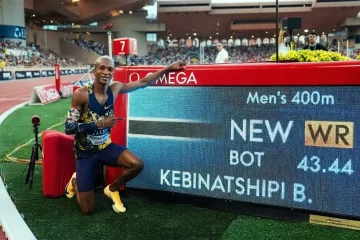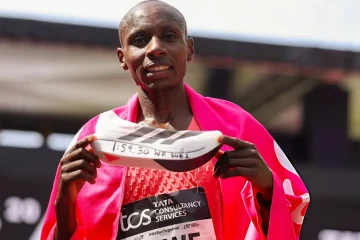
THERE are moments in sport when a single number reshapes the entire conversation. On a searing afternoon at the Botswana National Trials, one such number was born: 9.89 seconds. That was the time Busang Collen Kebinatshipi clocked to win his heat in the men’s 100 metres — a personal best, a national statement, and, most strikingly, the fastest time recorded anywhere in the world so far in 2026.
The sprint had barely been run before the news was travelling across the continent and into the global athletics community: Africa was leading the world. Not on a Diamond League stage in Zurich. Not under the lights in Eugene. In Gaborone — in Botswana — where a 25-year-old sprinter with unfinished business in multiple events sent his calling card to every rival on earth.
“9.89 seconds. Africa leading the world. Not in Zurich, not in Eugene — in Gaborone.”
THE NUMBER THAT CHANGES EVERYTHING
Context matters when reading a time. A 9.89 in an Olympic final is elite. A 9.89 in a trials heat — before the season has truly begun, before the body has been pushed through months of competition — is something else entirely. It is a declaration.
Athletics insiders know that peak times typically arrive in July or August, when sprinters have sharpened their form and the season’s high-stakes races have drawn out their finest performances. For Kebinatshipi to run 9.89 in early April is the equivalent of a heavyweight champion knocking out his sparring partner mid-training camp. It raises the question that now cannot be avoided: how fast can this man go when it truly counts?
The world lead status is not a minor footnote. It means that, at this moment in 2026, no human being on the planet has run 100 metres faster than Busang Collen Kebinatshipi. The stars of the American sprint circuit, the Jamaican powerhouses, the European challengers — all of them are, for now, looking up at a man from Botswana.
“No human being on the planet has run 100 metres faster in 2026 — not yet.”
THE 400M CHAMPION WHO JUST REWROTE THE 100M CONVERSATION
What makes Kebinatshipi’s run even more remarkable is who he already is. He is the reigning 400 metres world champion — a title that demands extraordinary reserves of speed-endurance, tactical intelligence, and physical power. The 400m is the event that breaks the merely fast and rewards only the exceptional.
And yet, here he is, posting a time that threatens the world’s purest sprinters over a quarter of that distance. It is an act of athletic ambition that evokes the ghosts of the dual-event greats — those rare athletes who refused to be confined to a single lane of excellence.
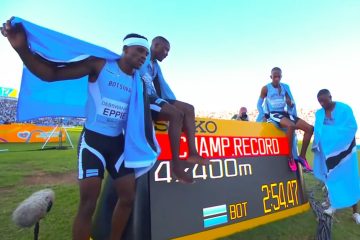
For Botswana, a nation that has progressively announced itself on the global athletics stage, Kebinatshipi’s 9.89 is not just a personal milestone. It is a civilisational moment in sport. The landlocked southern African country of some 2.5 million people has now produced a man who leads the world in an event that has historically been dominated by the United States, Jamaica, and a handful of Caribbean nations. That is a seismic shift — and one the continent should celebrate with full voice.
“For Botswana, this is not just a personal milestone. It is a civilisational moment in sport.”
AFRICA’S SPRINT REVOLUTION IS NO LONGER COMING — IT HAS ARRIVED
For decades, the narrative of African sprinting has been framed as one of potential — a story of what might come, rather than what is. Kebinatshipi’s 9.89 tears that framing apart. This is not potential. This is performance. This is present tense.
The African continent has long produced extraordinary middle and long-distance runners who have transformed those events so completely that they now own them. The sprint disciplines — the glamour events of any championship, the events that crown the fastest human alive — have been a different matter. Not anymore.
Kebinatshipi’s run in Gaborone belongs to a growing body of evidence that African sprinting is undergoing a generational transformation. He joins a cohort of African short-sprint talents who are forcing the world to reckon with a new geography of speed. But no one, in this early season at least, has run as fast as he has. That distinction matters.
THE SEASON AHEAD: A THREAT ON TWO FRONTS
The implications of this performance extend well beyond the 100m. Kebinatshipi has now announced himself as a credible multi-event sprint threat — a man who could conceivably challenge for medals, or more, across both the 100m and 400m at the major championships that await later in the year.
Coaches and rivals who have been mapping their tactical approaches to the 400m will now need to revisit their calculations. A 400m world champion who can also open with a 9.89 in the 100m is not a specialist to be managed — he is a force multiplier, an athlete whose presence in a programme disrupts the competitive logic of everyone around him.
There will be those who counsel patience — who note that a trials heat result in April is a long way from a championship final in August. They are not wrong to urge caution. But they miss the point of what today’s run represents. Kebinatshipi is not merely in form. He is in the form of his life, at the beginning of a season, in a year when the world is watching.
“A 400m world champion who opens with a 9.89 is not a specialist to be managed — he is a force multiplier.”
BOTSWANA’S MOMENT — AND AFRICA’S
There is a broader significance here that transcends athletics statistics. Botswana is a country that has built its reputation on stability, governance, and the responsible stewardship of its natural resources. It has not, historically, been a country that the world associates with sprint speed. That changes today.
For young athletes across the continent — in Lusaka, in Lagos, in Nairobi, in Dakar — Kebinatshipi’s 9.89 carries a message that is at once simple and electric: it can be done from here. The fastest human in the world this year is African. He ran that time on home soil. He did it representing a country that has never before had a reason to celebrate this particular kind of speed.
The African Mirror has long held that the continent’s athletic story is still being written — that the chapters on sprint events remain, largely, blank pages. Kebinatshipi picked up a pen in Gaborone today and wrote a sentence that will not easily be erased.
ANALYSIS: THE KEY NUMBERS
9.89s — 2026 World Lead, Men’s 100m
Personal Best — set in a heat, not a final
Current title held: 400m World Champion
Venue: Botswana National Trials, Gaborone