THE city that never sleeps rubbed its eyes on Sunday morning and found South Africa standing at the top of the world – not once, but twice. By the time the last whistle blew in Lower Manhattan and the gold medals cooled against the skin of the victors, New York had become, briefly, magnificently, a province of the Rainbow Nation.
It began on the sun-warmed ribbon of asphalt that winds through the streets of Manhattan, and it ended on a patch of synthetic grass beside the Hudson River. Twenty-one point one kilometres of road running. Fourteen minutes of sevens rugby. One nation. One story.
THE HALF MARATHON: WILDSCHUTT MAKES HISTORY
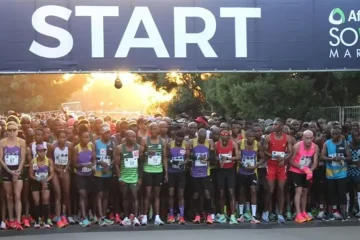
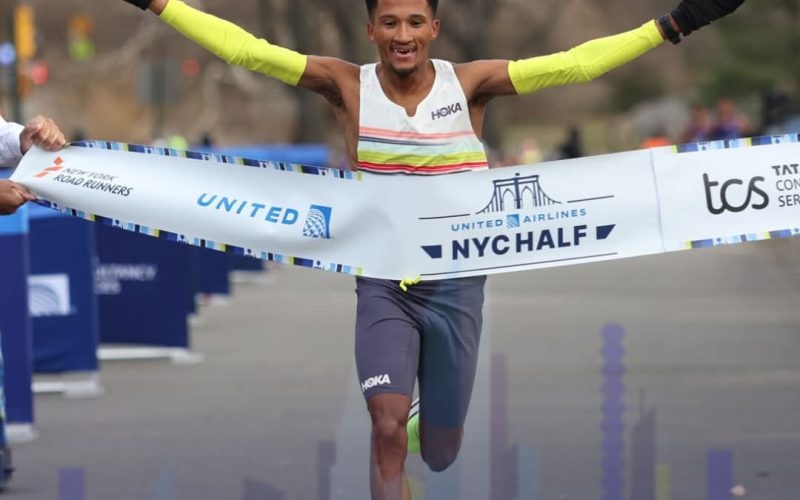
The United Airlines NYC Half Marathon is many things – a civic spectacle, a course that carves through the heart of Manhattan, a race that has hosted the world’s finest distance runners – but on Sunday morning, 15 March 2026, it became something else entirely: the stage for Adriaan Wildschutt’s coronation.
The 27-year-old from Ceres, Western Cape – a small town tucked into the Warm Bokkeveld mountains – announced himself to the world in the most emphatic manner possible: first, alone, and in 59:27. He became the first South African ever to win the prestigious New York City Half Marathon, and he did it with a performance of such controlled brutality that the chasing pack were left to run for places rather than prizes.
Wildschutt was patient in the opening miles, settling into the lead group with the composure of a man who had arrived not to race but to win. He moved through the Manhattan streets with efficient economy, biding his time, reading the field, waiting.
Then, approaching the 10-mile mark – roughly 18 kilometres – he shifted gears. The surge was decisive: a hammer blow of acceleration that sliced the lead group apart in the space of a few hundred metres. One moment there was a pack; the next, there was Wildschutt, and then a widening gap, and then everyone else.
“I knew if I wanted to win, I’d have to have the best last five kilometres. Once I hit 10 miles, I wanted to make a big move and see if everybody went. I was able to drop them and keep squeezing.” — Adriaan Wildschutt
Behind him, Morocco’s Zouhair Talbi finished second in 59:41, with India’s Gulveer Singh third in 59:42 – a podium decided by mere seconds, evidence of just how fierce the competition was. Wildschutt finished 14 seconds clear of Talbi. In this company, that is a chasm.
The victory was only his second race over the half-marathon distance — a fact that stretches credibility almost to breaking point. That a runner in just his second outing at 21.1km could produce a performance 17 seconds outside his own South African record (set in Valencia) and win one of the world’s most prestigious road races suggests that the ceiling on Wildschutt’s potential remains comfortably out of sight.
The morning had offered no favours. Temperatures hovered around one or two degrees Celsius at race start – a jarring contrast to the summer training conditions in Potchefstroom where Wildschutt had completed his preparation. He had, only two weeks prior, won the Absa RUN YOUR CITY Gqeberha 10K in a blistering 27:47. The form was there. The question was the cold.
“When we woke up it was about 32 or 33 degrees Fahrenheit, around one or two degrees Celsius,” Wildschutt explained. “I came from summer – my family and a training camp in Potchefstroom where it was over 30 degrees Celsius. I thought the cold might really get to me. Coach made sure I had everything I needed: arm sleeves, gloves and a hat. It turned out really great and I’m grateful the weather didn’t bother me.”
It did not bother him. Nothing bothered him on Sunday. He ran with the controlled strength of a marathon engine operating at well below its ceiling, the kind of performance that leaves coaches reaching for their calculators and rivals reaching for excuses.
“I was so happy that I was done,” he said at the finish, the understatement of the morning. “This was my second half and my first time in New York. The goal was to run really hard in a good effort. I was so stoked that I felt really strong towards the end.”
| ADRIAAN WILDSCHUTT – NYC HALF MARATHON | |
| Athlete | Adriaan Wildschutt 🇿🇦 |
| Age / Hometown | 27 years old | Ceres, Western Cape |
| Race | 2026 United Airlines NYC Half Marathon |
| Winning Time | 59:27 |
| 2nd Place | Zouhair Talbi (MAR) — 59:41 |
| 3rd Place | Gulveer Singh (IND) — 59:42 |
| Historic First | First South African to win NYC Half Marathon |
| SA Record Gap | 17 seconds outside his own national record (Valencia) |
| Form | Won Absa RUN YOUR CITY Gqeberha 10K (27:47) two weeks prior |
| Half Marathon Starts | Only his second race at 21.1km |
THE BLITZBOKS: SERIES CHAMPIONS, ONCE MORE
Six hours later, under the lights in New York, the Blitzboks delivered the perfect coda to South Africa’s extraordinary Sunday. A pulsating cup final against Fiji. A scoreline – 10-7 – that tells only half the story. A series title secured in the most dramatic fashion the sport can offer: clinging on, inch by inch, heartbeat by heartbeat, until a Fijian knock-on ended the contest and sent the men in green into delirium.
The New York leg of the HSBC SVNS Series had been a showcase of everything that makes sevens the most watchable sport on the planet – and the Blitzboks had been its dominant force throughout. Their defence, in particular, had been something to behold: organised, physical, suffocating. In the final, it was tested to its absolute limit. And it held.
The opening score arrived within two minutes and it was a try born of individual brilliance and collective chemistry. Captain Impi Visser – a man who plays rugby as though he has a personal grudge against the laws of physics – spotted a Fijian ball-carrier and simply took the ball from him. Not contested. Not turned over at the breakdown. Ripped. Clean. The kind of jackal work that changes games.
From the turnover, Visser found Gino Cupido in space and Cupido did what Cupido does: finished. Tristan Leyds was wide with the conversion but no matter — the Blitzboks led 5-0 and the tone had been set.
“Impi just ripped the ball and Gino was gone. That’s Blitzboks rugby. Physical. Fast. Ruthless.” — Post-match analysis
Fiji spent the next four minutes applying the kind of sustained pressure that has ended many a South African lead at many a tournament. They moved the ball with patience and precision, probing for the gap. The Blitzboks defence refused to give it. Every line was scrambled. Every breakdown was contested. The halftime whistle sounded with the score still 5-0 — a lead that felt slender but had been earned in blood.
The second half opened with the Blitzboks extending their advantage. A Fijian error gifted possession and Leyds — this time as scorer rather than kicker — pounced on a loose ball to dot down. The conversion was again missed, but with the score at 10-0 and Fiji’s frustration mounting, South Africa appeared to be in control.
Then Fiji came. They always come. Terio Veilawa launched a counter-attack from deep that stretched the Blitzboks defence across the full width of the pitch before crossing the line and adding his own conversion. Suddenly it was 10-7. Suddenly the final was alive.
The closing minutes were almost unbearable. Fiji on the attack. The seconds draining. The Blitzboks scrambling, defending, holding. The South African supporters – a wall of green and gold noise – willing every tackle home. And then, in the defining moment of the final, a Fijian knock-on. Hands on heads. Whistle. Full time. The Blitzboks had won. Not prettily at the end. Not without suffering. But champions never are. They were Sevens Series champions – the biggest prize in the circuit – and New York had delivered the decisive moment
| HSBC SVNS NEW YORK — BLITZBOKS SUMMARY | |
| Tournament | HSBC SVNS New York — Cup Final |
| Result | South Africa WON 🏆 |
| Tries Scored (Tournament) | 24 — tournament highest |
| Points Conceded (Final) | None |
| Series Championship | South Africa — HSBC SVNS Series 2025/26 |
| Series Title | First in recent era |
| Venue | Brookfield Place Arena, Lower Manhattan |
It is worth pausing to appreciate what sevens rugby at this level requires. Seven players must cover a full-size rugby pitch. The game lasts fourteen minutes. Every second of inattention, every marginal defensive lapse, every tired leg is punished immediately and without mercy. To dominate a tournament at this level – to win seven matches in two days – requires not merely talent but a shared intelligence, a collective reading of the game that approaches telepathy.
The Blitzboks possess this. They have always possessed this. On Sunday in New York, they reminded the world.
A NATION’S DAY
By Sunday evening, as the city settled into its Sunday-night rhythms, the two sets of South Africans found each other. Wildschutt and the Blitzboks shared a dinner table somewhere in Midtown, gold medals and tournament trophies passed around like dishes. There were photographs. There was laughter. There was, reportedly, an attempt at a team rendition of Nkosi Sikelel’ iAfrika that drew confused but respectful attention from the other diners.
New York City has been the stage for many great sporting stories. It has watched champions rise and fall across a century of organised competition. It has seen records broken and records mourned. But on this particular Sunday in March 2026, it witnessed something rarer than a record or a trophy.
It witnessed a country announce itself. Loudly. Beautifully. Twice.
South Africa does not merely participate. South Africa wins.