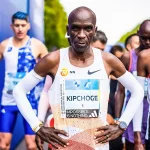
MOST legends retire to rest on their laurels. Eliud Kipchoge? He’s just getting started.
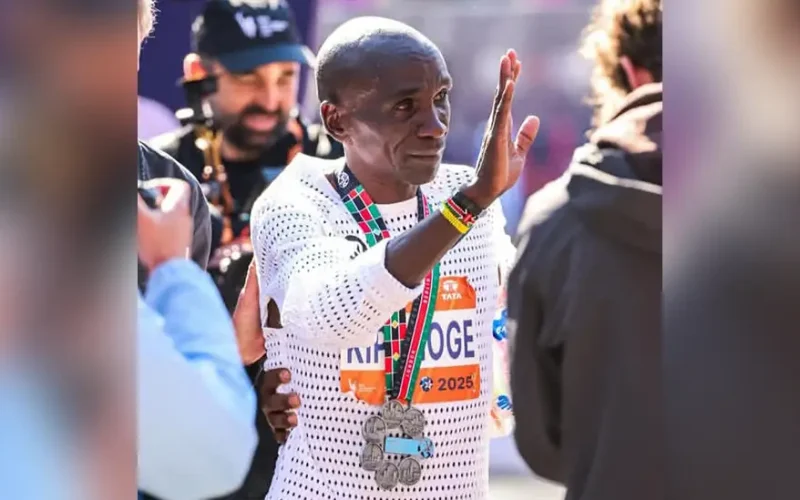
Fresh from his 17th-place finish at the New York City Marathon—completing his quest for the Abbott World Marathon Majors Seven Star Hall of Fame just three days before his 41st birthday—the greatest marathoner of all time unveiled a breathtaking new chapter: Eliud Kipchoge’s World Tour.
Over the next two years, the Kenyan icon will run seven marathons across seven continents, from the familiar roads of major cities to the frozen, unforgiving terrain of Antarctica. This isn’t about breaking records anymore. This is about breaking barriers of a different kind—connecting humanity through the universal language of running.
“Running is the most universal sport; it connects us all,” Kipchoge declared. “With this project, I want to compete not only for records, but for the people. I want to continue to push myself to run at my best, but I also want to inspire, give back, and remind everyone that no human is limited. I believe that we can all come together and become a better world.”
The Extreme Dream: Antarctica and Beyond
True to form, Kipchoge isn’t content with the conventional. While the dates and exact locations haven’t been revealed, one destination is certain—and it’s as audacious as the man himself.
“I will run in Antarctica!” he announced with characteristic determination. “I now want to do that extreme thing that can make someone work hard.”
Antarctica. The coldest, most inhospitable continent on Earth. Where temperatures plunge far below zero, where winds can reach hurricane force, where simply breathing becomes a challenge. For most athletes, it would be unthinkable. For Kipchoge, it’s the next logical step in a career built on redefining possible.
But Antarctica is just one piece of the puzzle. Kipchoge has also hinted at running ultra-distances beyond the traditional 42.195 kilometres: “I will run even 50 kilometres in Saudi Arabia. I want to do that extreme thing that can make somebody work hard and also get partners to rally for a cause.”
At an age when most elite marathoners have long since retired, Kipchoge is planning to run at least four marathons in twelve months—more than he’s ever attempted in a single year. His three marathons in 2025 alone (Sydney, New York, and his previous races) already represent new territory. Now he’s doubling down, pushing his body and spirit into uncharted waters once again.
A Career That Redefined Greatness
To understand the magnitude of what comes next, we must first honour what came before.
The Unparalleled Record:
- Two-time Olympic champion (Rio 2016, Tokyo 2021)
- 11 Abbott World Marathon Major victories across Berlin, London, Chicago, Tokyo, and Boston
- World record holder: 2:01:09 in Berlin (2022)
- The only human to break two hours: 1:59:40 in Vienna’s INEOS 1:59 Challenge (2019)
- Seven Star Hall of Fame: Completed all World Marathon Majors, including Sydney and New York
For more than a decade, Eliud Kipchoge didn’t just dominate marathon running—he transformed it. Berlin became synonymous with his brilliance. London witnessed his artistry race after race. Every major city that hosted him was blessed with history.
But his greatness transcended statistics. Kipchoge ran with a smile. He trained with monks. He lived humbly in a remote Kenyan camp, sharing meals with teammates, reading philosophy, and refusing to let fame corrupt his purpose. He became not just an athlete, but a philosopher-king of the roads.
“Only the disciplined ones are free in life,” he often said. “If you are undisciplined, you are a slave to your moods and passions.”
No Human Is Limited: From Slogan to Movement
“No Human Is Limited” was never just marketing. It was—and remains—Kipchoge’s life manifesto, demonstrated with every stride and shared with every interaction.
When he broke the two-hour barrier in Vienna, he didn’t celebrate individual glory. He celebrated human potential. “I am the happiest man in the world to be the first human to run under two hours,” he said, “and I can tell people that no human is limited.”
That philosophy will now fuel his world tour, expanding beyond personal achievement to global impact through the Eliud Kipchoge Foundation. His mission includes building libraries, promoting environmental causes, and creating opportunities for young people across the globe.
“All children deserve access to knowledge, education and healthy air to breathe,” Kipchoge explained. “Through this world tour, I hope to raise awareness and resources that help create opportunities for young people everywhere and help to improving the life around them.”
The Final Major: Grace Under Pressure
His recent New York City Marathon performance perfectly encapsulated who Kipchoge is. At nearly 41 years old, running the notoriously challenging course for the first time, he wasn’t chasing victory. He was chasing completion.
He started strong, running with the leaders through the early miles. When younger legs pulled away after the halfway point, he didn’t chase recklessly. He ran intelligently, finishing with dignity in 2:14:36—more than six minutes behind winner Benson Kipruto, but ahead of athletes more than a decade his junior.
It wasn’t his fastest time. It wasn’t his best placement. But it was everything he needed it to be: the final piece of his Marathon Major puzzle, the gateway to the Seven Star Hall of Fame, and the perfect launching pad for his next great adventure.
Running for the People
What makes Kipchoge’s world tour so compelling isn’t just the physical challenge—though running marathons on all seven continents, including Antarctica, in just two years would test even the most elite athletes.
It’s the why behind it all.
“I want to compete for the people,” he said. Not for records. Not for prize money. For connection. For inspiration. For the fundamental belief that running can unite us across borders, languages, cultures, and continents.
Each marathon will be more than a race. It will be a platform for the Eliud Kipchoge Foundation’s work, rallying support for education, environmental protection, and youth empowerment. Each finish line will be a starting point for positive change.
This is Kipchoge’s evolution from champion to changemaker, from record-breaker to bridge-builder. He’s running not to prove he’s the fastest, but to prove that running can make the world better.
The Legend Runs On
As the sun sets on his competitive Marathon Major career, it rises on something potentially even more meaningful. Eliud Kipchoge is showing us—once again—that retirement from competition doesn’t mean retirement from purpose.
From the streets of major cities to the ice of Antarctica, from traditional marathons to ultra-distance challenges, from personal glory to global good, the King of the Marathon continues to reign by redefining what it means to be a champion.
Hongera, Eliud Kipchoge!
Thank you for every record you’ve shattered and every barrier you’ve broken.
Thank you for Rio and Tokyo, for Berlin and London, for Vienna and now New York.
Thank you for teaching us that age is just a number when purpose fuels your passion.
Thank you for showing us that the greatest athletes compete not for themselves, but for something larger.
Thank you for proving, again and again, that No Human Is Limited.
Your professional Marathon Major career may have ended, but your greatest race has just begun—a world tour that will inspire millions, connect continents, and continue the mission you’ve dedicated your life to: making the world a running world.
Seven marathons. Seven continents. Two years. Unlimited impact.
The King may have left the throne of competitive racing, but he’s ascending to something even greater: becoming a living testament that our most powerful victories come not from what we achieve for ourselves, but from what we inspire in others.