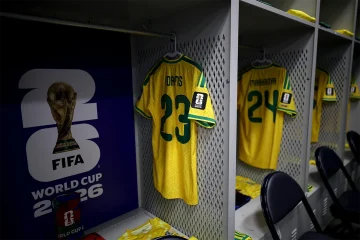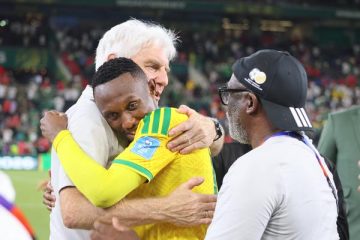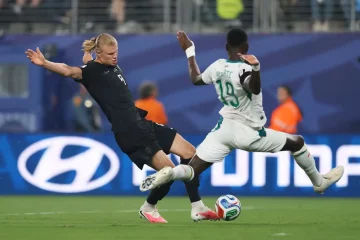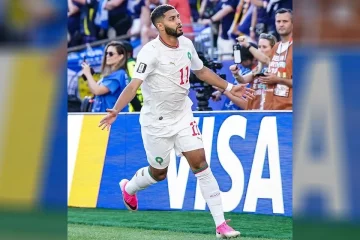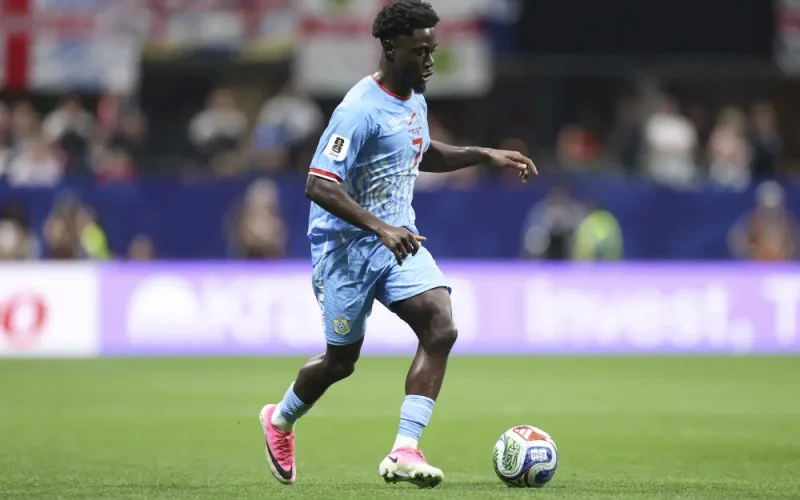
THERE is a moment in every horror film where the music goes quiet, the babysitter checks the closet one more time, and you already know – you know – that something is coming. At the 2026 FIFA World Cup, African football has found its own jump-scare soundtrack, and it strikes with metronomic cruelty somewhere between minute 74 and minute 89. Call it the Curse of the Late Kick-Off. Call it Cinderella Syndrome. Call it whatever you like – just make sure you’re sitting down when the clock gets there.
Senegal: Two Goals Up, One Belgian Waffle-Iron Away From Glory
Pape Thiaw’s Lions of Teranga did everything right for eighty-five glorious minutes against Belgium in Seattle. Goals from Habib Diarra and Ismaïla Sarr gave them a 2-0 lead with only five minutes of normal time remaining, and for a while it looked like Senegal were about to write themselves into World Cup folklore in the way only African teams seem obligated to do – the hard way, on the biggest stage, against European royalty.
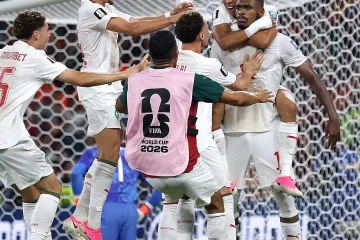
Then someone forgot to hit pause on Romelu Lukaku. Belgium, who appeared to be heading out of the tournament, found a way back through Lukaku in the 86th minute before Youri Tielemans equalised three minutes later. Extra time arrived like an uninvited in-law, and Tielemans scored from the spot deep into stoppage time after a VAR review to complete a dramatic Belgian comeback. Senegal, who had recovered from a difficult group stage and beaten Iraq 5-0 to even get this far, were sent home not by a better team, but by a clock that apparently runs on Belgian chocolate and spite.
Coach Thiaw, showing the kind of composure his back four badly needed in those final minutes, offered the football equivalent of a shrug wrapped in dignity: “We’re out – it hurts. We must congratulate the team, who gave it their all, but unfortunately we weren’t able to hold on to our two-goal lead.” That’s one way to put it. The other way is: Senegal built a house, forgot to install a door, and Belgium walked right in wearing muddy boots.
DR Congo: The Leopards Who Nearly Ate the Lions (Sorry, Three Lions)
If Senegal’s collapse was a comeback, DR Congo’s was a full-blown heist-thriller twist. Brian Cipenga’s clinical finish in the seventh minute, set up by Chancel Mbemba, silenced the stadium and handed DR Congo a dream start against tournament favourites England. For 75 minutes, Sébastien Desabre’s Leopards did not just survive England — goalkeeper Lionel Mpasi proved unbeatable for much of the first half, denying Jude Bellingham twice and producing another outstanding save to keep out Harry Kane deep into first-half stoppage time.
And then, as if summoned by some cursed World Cup alarm clock set to “Late English Fightback,” Anthony Gordon’s introduction after the hour mark injected fresh pace, and his pinpoint cross in the 75th minute found Harry Kane, who powered a header beyond Mpasi to restore parity. Congo had eleven more minutes to hold their nerve. They did not get them. Four minutes from time, Gordon again picked out Kane, who rifled an unstoppable right-footed strike into the far corner to complete the turnaround. Do the maths: that’s minute 86 again, ladies and gentlemen. Somewhere, an actuary is drawing up African World Cup insurance premiums specifically for the final quarter-hour.
Côte d’Ivoire: History Made, Heartbreak Scheduled
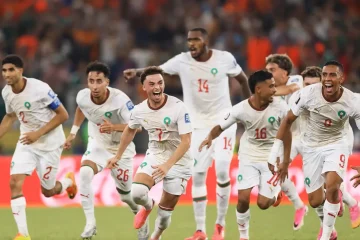
Not to be left out of the theme, Côte d’Ivoire supplied their own late-drama chapter against Norway in Dallas. Emerse Faé’s Elephants had already rewritten their own history books simply by being there — the generations of Didier Drogba and Yaya Touré never moved beyond the group phase, but this squad finally broke that barrier. Down and needing a spark, super-sub Amad Diallo provided one: in the 74th minute, after a clever one-two with Nicolas Pépé, Diallo produced a brilliant finish to pull Côte d’Ivoire level and briefly revive hopes of a comeback. Briefly being the operative word — Norway, apparently reading from the same late-goal script as Belgium and England, found their own sting in the tie’s dying embers to win 2-1.
Diallo, at least, refused to let the clock steal the romance of the run entirely: “It’s a big thing to score that goal because it’s a dream come true… At the end, even if you lose, it’s a win also.” Philosophically airtight. Tactically, it still means Norway are through and the Elephants are on a plane.
The Post-Mortems: Focus, Fatigue, and the Fine Print
Cue the panel of besuited experts, leaning into their microphones with the gravity of coroners at a very avoidable inquest. “Concentration lapses,” they say. “Game management,” they tut, as if African teams simply forgot that football matches have a second half and a final quarter. “Squad depth,” others murmur, nodding at Europe’s benches stacked with match-winners like Lukaku, Gordon, and a seemingly cloned assembly line of finishers who exist purely to appear after minute 70 and ruin someone’s evening.
There is truth in some of it — fitness, squad rotation, and composure under pressure are real, coachable things, and Thiaw, Desabre and Faé will be reviewing the tape long into the Kinshasa night (metaphorically; they’re presumably in America). But there’s also something almost mythic about the timing. Three different teams. Three different opponents. Three collapses clustered in the same brutal ten-minute window, like the tournament itself has a built-in alarm that goes off specifically to remind African football: not yet, not today, not quite.
The Silver Lining, If You Squint
Here is the part the final scorelines will not tell you: Senegal took a two-goal lead off Belgium. DR Congo led England for over an hour with a goalkeeper playing out of his mind. Côte d’Ivoire equalised deep into a knockout tie and, as Diallo noted, reached the round of 32 in their fourth appearance at the global finals — the furthest an Ivorian side has ever gone. This was not a tournament of African teams being outclassed. It was a tournament of African teams being outlasted, by matters of minutes, against sides with benches full of Ballon d’Or-adjacent reinforcements.
The 86th minute may currently belong to Europe. But if these three performances proved anything, it’s that Africa isn’t just showing up to these World Cups anymore — it’s showing up early, taking the lead, and making the world sweat until literally the last kick. The job now is simple, if unglamorous: find eleven more minutes of composure from somewhere. Preferably before Qatar, sorry — before 2030 comes around.