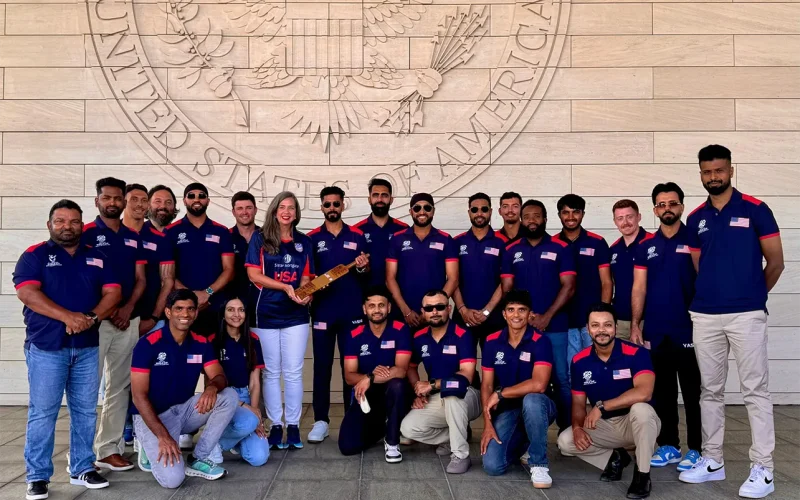
THERE’S something deliciously absurd happening on cricket pitches in India and Sri Lanka right now, and it has nothing to do with the rules of the game (though let’s be honest, most Americans still find those baffling). The United States cricket team – yes, that’s a thing – is currently competing in the T20 World Cup, and their roster reads less like a lineup from Kansas City and more like a United Nations assembly after a really successful mixer.
Picture this: While ICE agents back home are busy making life miserable for anyone whose paperwork isn’t pristine, Team USA is cheerfully fielding players from India, Pakistan, South Africa, and Sri Lanka. It’s the kind of irony so thick you could spread it on toast.
The Dream Team Nobody Saw Coming
Let’s meet our all-American heroes, shall we?
Captain Monank Patel? From Gujarat, India. Moved to the States in 2016. Saurabh Netravalkar, their star left-arm seamer? Also India. Harmeet Singh, the crafty spinner? India again. Sanjay Krishnamurthi, the 22-year-old emerging star who recently helped the team to a tournament-record total? You guessed it – India.
Oh, but it’s not just an India reunion tour. Ali Khan, the explosive fast bowler, hails from Pakistan. Andries Gous, their top scorer from the 2024 tournament, learned his cricket in South Africa. Nosthush Kenjige brings left-arm spin experience from Sri Lanka. Even 37-year-old Shadley van Schalkwyk adds South African depth.
Ten of these players have experience from the 2024 Super 8s. Zero of them learned the game in Little League.
Make America Great… at Cricket?
Here’s where it gets properly weird. The current administration has been busy redefining what it means to be “American” in increasingly narrow terms. We’re talking about an immigration policy that treats people from exactly these countries – India, Pakistan, Sri Lanka, South Africa – with roughly the same warmth as a dentist greets candy manufacturers.
ICE has been working overtime, separating families, conducting raids, and generally making sure everyone knows that “America First” means “Everyone Else: Please Form an Orderly Queue for Deportation.”
Meanwhile, in the subcontinent, eleven guys with roots in those very nations are wearing the Stars and Stripes, playing a game most Americans couldn’t explain if you spotted them the rules, proudly representing the land of the free and the home of the… wait, hang on.
The Citizenship Test Nobody’s Talking About
You have to wonder: what’s the protocol here? Do these players get a special ICE exemption card? “Yes, we represent your country at international sporting events, but please don’t deport our families while we’re gone, thanks.”
Is there a form for this? “Application for Temporary Americanness (Sports Division): Valid only while actively increasing national prestige. Subject to revocation upon return to US soil if your papers look funny.”
The cognitive dissonance is staggering. These men are American enough to wear the jersey, American enough to be cheered when they win, American enough to represent the nation on the world stage. But their cousins, their uncles, their childhood friends from the same villages? They might need to lawyer up before booking a flight to visit.
What makes this particularly delicious is that the US cricket team is actually pretty good – sitting third in Group A with a positive net run rate, they’re the classic underdogs with a shot at causing some upsets. They’ve got a balanced attack, versatile all-rounders, and enough firepower to worry the big teams.
And they’ve achieved this precisely because of immigration, not in spite of it. This team exists because people from cricket-playing nations brought their skills, their passion, and their expertise to American shores. They’re the living, batting, bowling embodiment of what immigration actually does: it makes the receiving country better at things it wasn’t particularly good at before.
The US team’s success isn’t a fluke – it’s what happens when you embrace talent regardless of where someone’s grandmother was born. Their spin bowlers are suited to Asian conditions because they learned in Asian conditions. Their tactical flexibility comes from players who grew up watching and playing cricket at the highest levels in their home countries.
One imagines Donald Trump watching a match (unlikely, but let’s pretend) and facing a philosophical crisis. Do you cheer when Monank Patel anchors the innings? Do you celebrate when Ali Khan takes a crucial wicket? Or do you check their visa status first?
What’s the move here? Give them a parade when they win, then hand them deportation papers at customs?
“Congratulations on that excellent century, Sanjay. Really put India—I mean, America—on the map. Now, about your extended family in Mumbai…”
The real kicker is that this contradiction isn’t new, and it isn’t limited to cricket. The American economy runs on immigrant labour. American innovation is driven by immigrant engineers. American hospitals are staffed by immigrant doctors. American restaurants are filled with immigrant chefs. Even American nationalism, if we’re being honest, is often loudest among second and third-generation immigrants trying to prove they belong.
But cricket makes it visible in a way that’s almost comically on-the-nose. It’s a sport Americans historically haven’t cared about, played by people some Americans seem determined to keep out, representing a country that can’t quite decide whether these people are assets or problems.
Team USA cricket is essentially saying: “We are exactly as American as baseball, apple pie, and wildly inconsistent immigration policy.”
Perhaps the most uncomfortable part of this whole situation is that it exposes a fundamental truth: the “America First” crowd wants it both ways. They want the glory, the wins, the international prestige that comes from talented people choosing to represent the United States. They just don’t want to acknowledge where that talent came from or extend the same welcome to others.
It’s the sporting equivalent of eating at ethnic restaurants while complaining about ethnic neighbourhoods.
So yes, let’s celebrate Team USA at the T20 World Cup. Let’s cheer for Monank, Saurabh, Ali, Andries, and the rest. They’ve earned it. They are American, in the way that actually matters: they chose that place, they contribute to that place, they represent that place.
Just don’t be surprised when they get home and have to explain to their families why representing America abroad is easier than being accepted as American at home.
The USA cricket team is currently sitting pretty in their group with genuine Super 8 potential. The USA immigration policy is currently sitting in last place in terms of basic human decency.
At least one of those teams knows how to play as a unit.
*The author suspects Team USA has a better chance of winning the World Cup than ICE has of figuring out that diversity is actually the point.