ON the morning of Tuesday, May 19, 2026, forensic investigators and armed detectives sealed off the fifth floor of Uganda’s Parliament building, turning the former Speaker’s chambers into an active crime scene. Evidence collection vans were parked on the forecourt. Senior CID officers carried document cases inside. Outside, an institution that is constitutionally the guardian of public accountability had become, for a morning, the subject of it.
The lockdown came less than 48 hours after Anita Annet Among made a stunning political retreat – officially withdrawing from the 12th Parliament speakership race following weeks of mounting executive and public pressure. It was a retreat born not of choice but of calculation: the auditors were already at the gate.
“I am going to send you some auditors” – those were the last words President Yoweri Museveni uttered to Among after a tense two-hour meeting at State House, Entebbe, on May 14, 2026. Within 48 hours of that meeting, the auditors had been replaced by something far more consequential: soldiers, detectives, and forensic crime scene officers.
The question now consuming Kampala – and increasingly the rest of Uganda and the Continent – is not whether Among accumulated wealth that cannot be explained by her public salary. That much is no longer contested. The question is: how, and through whom, was public money transformed into a private empire?
The Architecture of Accumulation
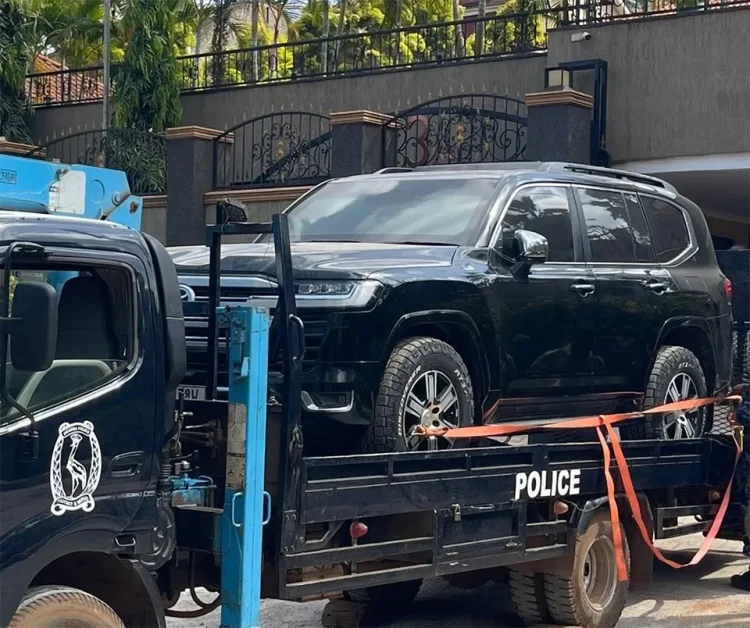
A joint security task force investigating suspected illicit enrichment, money laundering, and corruption has seized two luxury vehicles from Among’s Mutungo-Kigo mansion – among them the Rolls-Royce that fuelled recent social media outcry over corruption allegations. The joint investigations, reportedly sanctioned by President Museveni, began at Among’s Nakasero residence and continued through the night before concluding around midday on Sunday. The team consisted of police detectives from the Criminal Investigations Directorate, forensic crime scene officers, and operatives from the Defence Intelligence and Security and the Special Forces Command.
The high-stakes operation targeted Among’s upscale property in the Mutungo-Kigo area, following an exhaustive 16-hour search of her Nakasero home just days prior. Security operatives cordoned off the Kigo estate, executing a thorough search that resulted in the seizure of her high-end fleet, most notably a 2025 Rolls-Royce Cullinan.
The Rolls-Royce Cullinan, a 2025 model valued at around Shs 3.4 billion, had recently been imported into the country and cleared through customs under Anita Foundation Limited. It arrived in January 2026 and became the centre of public controversy after Among described it as a birthday gift from her businesses and wealthy friends. A leaked document reportedly showed a substantial cash payment component towards importation and taxes, sparking widespread debate on social media about the source of funds.
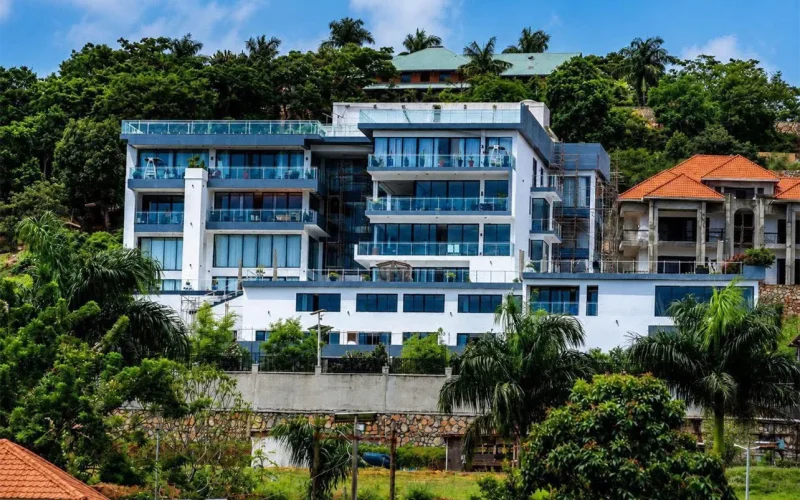
The Rolls-Royce was the visible tip. Below it lies a question of far greater magnitude: how does a politician who began her working life as a bank cleaner, rose to become a university lecturer, and entered Parliament in 2016 – legally earning a public official’s salary – come to own multiple high-value residences across Kampala, a sprawling Kigo mansion with separate basement levels, properties in Kololo, Ntinda and Nakasero, a hospital, a school, a sports park and now one of the most expensive vehicles in East Africa?
Among worked at Centenary Bank from 1998 to 2006, beginning as a cleaner during her S.6 vacation, later becoming a cashier, and eventually rising to branch manager. For the ten years prior to her election to Parliament, she served as a lecturer in accounting at Makerere University Business School and Kampala International University. Those are honourable positions. They are not, by any measure, the foundation of a multi-billion shilling empire.
The Parliamentary Money Trail
At the core of the criminal investigation is a specific allegation that goes beyond lifestyle scrutiny: that Among, as Speaker and Chairperson of the Parliamentary Commission, systematically exploited her control over Parliament’s internal financial architecture to consolidate and misappropriate public funds.
Among and a number of her staff are accused of breaching parliamentary rules by using private bank accounts to withdraw enormous amounts of money between April 2023 and January 2024, supposedly for Among’s official work, including outreach, community projects and expenses. The journalists also allege that Among oversaw the distribution of more than 1.7 billion Uganda shillings in 2022 as “service awards” for parliamentary commissioners, who oversee spending and salaries in Parliament.
At the centre of the controversy are the controversial “service awards” shared among parliamentary commissioners in 2022 and 2023. The payments, reportedly ranging between Shs 1.4 billion and Shs 1.7 billion per beneficiary, triggered public outrage after legislators approved the allocations internally without broader parliamentary scrutiny. Among those linked to the payments are Anita Among, Mathias Mpuuga, Solomon Silwanyi, Prossy Mbabazi Akampurira and Esther Afoyochan.
The allegation now being examined by forensic investigators – advanced by sources cited in Ugandan investigative reporting and referenced in the social media disclosures supplied to this publication by journalist Opondo Dem Gaster – is more structural still: that Among used her authority as Speaker to strip parliamentary committees of their individual budget lines and consolidate those funds into the Speaker’s office budget, which she then treated as a personal resource. If substantiated, this would not be opportunistic corruption. It would constitute a planned, systematic reorganisation of public finances for private benefit – the kind of scheme that financial crime investigators classify as embezzlement through institutional capture.
By early morning, several forensic experts and senior investigators were seen entering the sealed offices carrying document cases, signalling a thorough digital and physical audit of parliamentary procurement and financial records.
The real focus is now directed to the Auditor General’s Office, the Clerk to Parliament, Adolf Kasaija Mwesigye and Head of Finance at Parliament, Patrick Kunobwa, among others. The arrest of Parliament’s Director of Communications, Chris Obore – Among’s most vocal public defender – in Mukono on May 16, 2026, connected to widening probes into alleged corruption, illicit enrichment, abuse of public resources, and suspected money laundering, signals that investigators believe the network of complicity extended well beyond the Speaker’s personal conduct.
The IGABU Thread: A Wider Money Laundering Ecology
The investigation into Among does not exist in isolation. According to disclosures provided to The African Mirror from sources close to the Bushenyi allegations, a parallel financial network is now under scrutiny – one that potentially implicates Among’s political mobilisation machinery in western Uganda.
Serious allegations of financial mismanagement have emerged against Adrine Kobusingye, a senior NRM political mobiliser, over her alleged role in the operations of IGABU SACCO and Igara Growers Tea Factory. Documents reviewed by investigators indicate that the Igara Growers Tea Factory transferred more than UGX 705 million to IGABU SACCO through various transactions covering SACCO registration, operational expenses, software procurement, infrastructure development, and capitalisation. The SACCO has reportedly been operating from factory premises, with some staff accommodated in factory housing and using factory utilities. Sources within the factory allege that Kobusingye, who reportedly served as board Chairperson of Igara Tea Growers Factory, influenced the establishment of the institution before allegedly taking control of its administration – and has retained leadership positions through what critics describe as a pattern of unopposed elections.
The allegations, still unproven in any court, become considerably more significant given the claim by sources that IGABU SACCO is expecting to receive 750 billion shillings in funds channelled under the name of Igara Growers Tea Factory – and that the SACCO is allegedly operated under Among’s direction as a vehicle for laundering parliamentary funds into the western Uganda agricultural economy.
These allegations remain contested. No court has convicted any of the accused. Community members and farmer representatives are calling on the Inspectorate of Government, the State House Anti-Corruption Unit, and other investigative bodies to conduct an independent inquiry into the management of IGABU SACCO and the finances of Igara Growers Tea Factory. If the allegations are substantiated, investigators would be looking not at a single act of theft but at a sophisticated, geographically dispersed laundering architecture — parliamentary funds cleaned through an agricultural cooperative, then recycled into political patronage infrastructure.
The International Dimension
What makes the Among case structurally different from Uganda’s routine political accountability failures is that Western governments had already reached their own conclusions – and been dismissed.
When the United Kingdom announced sanctions against outgoing Speaker of Parliament Anita Among, she laughed it off, saying she did not need a visa to go to Bukedea, her home district.
The US State Department, in a statement dated May 30, 2024, placed Among under sanctions due to her involvement in significant corruption tied to her leadership of Uganda’s parliament. Among’s husband and lawmaker Moses Magogo was also sanctioned.
Among’s response to both sets of sanctions was to attribute them to the passage of Uganda’s Anti-Homosexuality Act – a deflection that grew increasingly threadbare as the domestic evidence mounted. She had been sanctioned by the United Kingdom and the United States over alleged corruption. The US was categorical, saying that Among had been sanctioned for her “involvement in significant corruption tied to her leadership of Uganda’s Parliament.”
The sanctions, dismissed as foreign interference in 2024, are now being read differently in Kampala. They were, in hindsight, the early warning architecture of the reckoning now underway.
A Political Execution Dressed as Accountability?
Not all analysis of these events accepts the accountability framing at face value. Uganda Law Society President Isaac Ssemakadde has questioned the timing of the alleged corruption and money laundering probe, saying: “By launching corruption probes at the exact moment Speaker Among seeks re-election, the Museveni regime exposes its true aim: entrenching one-man rule, dismantling rival power centres, and recycling patronage networks. It is a textbook purge tactic for sustaining personalist rule.”
The point is analytically important, even if it does not exhaust the analysis. Among had, by all accounts, built something unusual in Uganda’s post-Museveni political landscape: a speaker who held a very tight grip over Parliament, both among NRM and opposition legislators — not to mention independents. That grip made her indispensable to the President for years. It ultimately made her dangerous.
Among had managed to forge a close relationship with President Museveni, who visited her constituency to officially open a science laboratory at Bukedea Comprehensive School, among other development projects established by the Speaker. The alliance was productive for both until it was not.
That Among’s downfall is partly the product of Museveni’s political calculus, which does not make her clean. Two things can be simultaneously true: that the President’s intervention is tactically motivated, and that Among accumulated wealth that demands criminal accounting. The auditors, the CID, and the courts will determine which of these truths is the operative one.
The Reckoning Ahead
Among pledged to support the candidates who will be endorsed by the President and the party, imploring fellow legislators of the 12th Parliament to do the same. “I shall remain available to the service of my country as the party and the President may assign me,” she said. She added, “In the meantime, I pledge to continue cooperating with all ongoing investigations as initiated by the relevant organs of the state to get to the root of all the allegations raised.”
It was a statement carefully calibrated to signal submission without admission. But the submission may already be too late to define the outcome.
The raid also follows confirmation by Inspector General of Government Aisha Batala Nalule that her office has received and opened an investigation into a complaint accusing Speaker Among of breaching the Leadership Code Act through alleged undeclared wealth and unexplained assets.
The Leadership Code Act, the Anti-Money Laundering Act, and the Penal Code all provide the legal framework within which investigators are now operating. The seized Rolls-Royce sits at Naguru Police Headquarters. The sealed parliamentary offices are yielding their financial records. The mobile phones are being forensically examined for deleted messages and financial trails.
For Among, the arithmetic of accountability is now stark. A former bank cleaner. A former lecturer. A politician of less than a decade’s seniority in the NRM. And an empire — mansions, vehicles, hospitals, schools, a sports park, offshore questions — that the public salary record cannot begin to explain.
Uganda has seen powerful figures fall before. What distinguishes this moment is the breadth of the investigation, the international sanctions that preceded it, the Museveni imprimatur on the probe, and the emerging allegations of a networked laundering scheme that reaches from Parliament’s committee budgets to an agricultural cooperative in Bushenyi.
The auditors Museveni promised are, in the truest sense, already here.