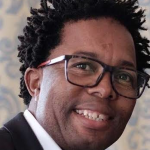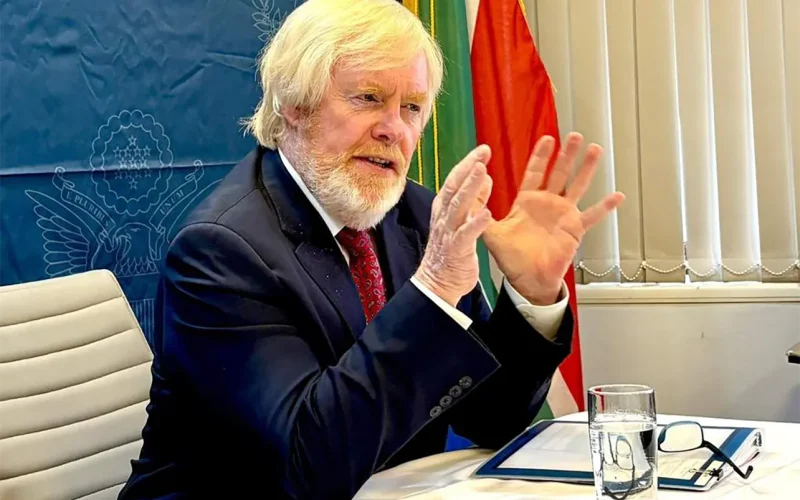
THERE is a particular kind of arrogance that only colonialism could have bred – the kind that walks into another nation’s house, surveys its laws, dismisses its courts, and pronounces itself dissatisfied. That arrogance arrived in the Western Cape wearing a diplomat’s badge. Its name is Bozell, and its title is United States Ambassador to the Republic of South Africa.
At a gathering that should have been an occasion for bilateral goodwill, Ambassador L. Brent Bozell III apparently decided that his host country had tried his patience long enough. He said so, directly and without the faintest blush of diplomatic restraint. He was running out of patience, he declared – with South Africa. With its courts. With its laws. With, it would seem, the very idea that a sovereign African state might be entitled to govern itself.
The Vienna Convention on Diplomatic Relations – ratified and observed by both South Africa and the United States – is explicit on the obligations of diplomats. Article 41 requires that all persons enjoying diplomatic privileges and immunities respect the laws and regulations of the receiving state, and that they not interfere in the internal affairs of that country. It is not ambiguous. It is not subject to exception on the grounds of personal impatience.
Ambassador Bozell did not merely breach this convention in spirit. He did so with the confidence of a man who has never seriously contemplated that international law might apply to him. When he dismissed the findings of South Africa’s courts – courts that determined ‘Kill the Boer, Kill the Farmer’ constitutes constitutionally protected political speech within its historical and performative context – he was not offering an opinion. He was staging an insult. He was telling South Africans that their judiciary, one of the most respected constitutional courts in the world, does not merit his consideration.
This is not diplomacy. This is contempt dressed in a lanyard.
Let us be precise about what South Africa’s courts actually ruled. The Constitutional Court and lower courts have examined the song ‘Dubul’ iBhunu’ – Kill the Boer – within its political, historical, and performative context: as a freedom struggle anthem, as political expression at rallies, as protected speech within the framework of a democratic constitution forged from the ashes of apartheid. One may disagree with that ruling. Constitutional scholars do. But the ruling stands.
For a foreign ambassador to stand on South African soil and announce that he does not care what South African courts have said is an extraordinary act of institutional disrespect. It is the diplomatic equivalent of the raised middle finger – extended not just toward the bench, but toward every South African who has placed their faith in constitutional democracy as the mechanism for national life. Ambassador Bozell has, in one speech, made himself a threat to one of South Africa’s most vital pillars: the independence of its judiciary from foreign pressure.
To dismiss a constitutional court’s ruling is not an opinion. It is an act of aggression against democratic sovereignty.
Summoned — and Unrepentant
The South African government did not look away. Ambassador Bozell was demarched — summoned to explain himself to the Department of International Relations and Cooperation, a formal diplomatic signal that his conduct had crossed from the uncomfortable into the unacceptable. It was the right move. It was necessary. It was overdue.
His response, however, was instructive in all the wrong ways. Bozell offered the explanation that the views he had expressed were personal – not those of the United States government. One is compelled to ask: Does he believe that makes it better? A foreign ambassador, standing on South African soil in his official capacity, using a public platform, attacking the constitutional order of his host country — and his defence is that he was speaking for himself?
The Vienna Convention does not recognise a personal lane for ambassadors. There is no diplomatic immunity from accountability that applies only when the offending views are later inconvenient. An ambassador who stands before a South African audience, in his official capacity as the United States’ representative, and delivers a public dressing-down of that country’s judiciary is doing so as an ambassador – regardless of the caveat he subsequently attaches to the remarks. The damage is the same. The contempt is the same. The violation of diplomatic norms is the same.
The personal disclaimer changes nothing. The insult was delivered in public, in his capacity, to his hosts. That it was later disowned makes it worse, not better – it adds cowardice to contempt.
That Bozell was summoned is welcome. That he remains at his post after offering so thin a defence is not. The demarche was the first step. It cannot be the last. South Africa’s anger — and it is legitimate anger, felt by millions who watched a foreign official lecture them about their own constitutional democracy – deserves more than a diplomatic reprimand filed and forgotten.
A Pattern, Not an Accident
Bozell did not arrive in a vacuum. His predecessor, Ambassador Reuben Brigety, was summoned to the Union Buildings in 2023 after making the extraordinary and evidence-free claim that South Africa had supplied Russia with ammunition for use in the war against Ukraine. The allegation was false. It was retracted. It caused diplomatic damage that took months to repair. Brigety was effectively demarched – a rare and pointed diplomatic signal of South Africa’s displeasure.
One might have expected Bozell’s appointment to come with a lesson attached: South Africa is not a subordinate. It is not a client state. It does not accept false accusations or public lectures from foreign envoys. And yet here we are, with a second American ambassador in as many years standing before South African audiences and conducting himself as though the country’s sovereignty were conditional on Washington’s approval.
This is not a coincidence. This is doctrine. And the doctrine is this: South Africa, as a nation that has refused to join Western sanctions against Russia, that has pursued an independent foreign policy, that has brought a genocide case against Israel before the International Court of Justice, must be brought to heel. If it cannot be sanctioned into compliance, it will be lectured into submission. Bozell is the lecture.
Prime Minister Benjamin Netanyahu has made no secret of his hostility toward South Africa’s leadership on the Gaza genocide case. His government’s response to the ICJ proceedings – contemptuous, dismissive, and increasingly aggressive – has been noted. What has perhaps received less coverage is the evidence of active efforts to destabilise South African social and political structures. Israeli interference targeting traditional leadership structures in the Eastern Cape – using the AbaThembu King to divide the people that he leads – represents exactly the kind of covert destabilisation that historically precedes larger political disruption.
The United States and Israel – an alliance that has in recent years conducted itself as judge, jury, and executioner on questions of international law while being immune from its findings – constitute a genuine threat to African stability. Their alignment against South Africa is not passive. Bozell’s remarks are not isolated rudeness. They are a coordinated signal: fall in line, or face consequences.
South Africa will face those consequences standing upright.
The Disgrace of the Applauding Audience
There are those in the audience in Hermanus, the Western Cape, who clapped. South Africans in that room who heard a foreign official berate their country, their courts, and their constitutional order – and responded with approval. This is a betrayal that demands naming.
One understands the complexity of the diplomatic circuit, the social pressures of such gatherings, the reluctance to make a scene. None of that explains sustained applause. To cheer an ambassador who is dressing down your own country is not sophistication. It is a form of self-abnegation so complete that it merits no polite euphemism. Those who applauded should reflect — or, as the saying goes, make other arrangements. Texas and other remote states in the US are reportedly welcoming South Africans who have convinced themselves of their own victimhood. They will find the reality rather less accommodating than the narrative they have constructed.
The Trump administration fired Ambassador Ebrahim Rasool – South Africa’s envoy to the United States — for the crime of speaking the truth. Rasool’s analysis of the political dynamics driving the MAGA movement was accurate, grounded, and entirely in keeping with the responsibilities of a diplomat who must understand his host country’s internal dynamics. He was expelled for it.
Compare that to Bozell, who violates the Vienna Convention, insults South Africa’s judiciary, and meddles in the internal political discourse of his host nation – and remains at his post, hiding behind a personal disclaimer after being demarched. The standard being applied is transparent: ambassadors may say whatever they wish about South Africa; South Africa’s ambassador may say nothing about America. The asymmetry is not subtle. It is the asymmetry of empire.
South Africa has precedent for exactly this situation. When Israel’s chargé d’affaires made false and inflammatory statements attacking the SA government, his hosts – the country acted. He was summoned to explain himself. The principle was clear: the privileges of diplomatic status do not extend to the privilege of lying about and attacking the government that hosts you.
Ambassador Bozell has now done what that Israeli diplomat did. He has publicly attacked South Africa’s judicial system, inserted himself into the country’s domestic legal debates, and done so with a contempt for the rules of diplomatic engagement that makes his continued presence untenable. He was demarched. He explained himself with a personal disclaimer so inadequate it borders on mockery. The Department of International Relations and Cooperation must go further. Minister Ronald Lamola must act. The government owes its citizens – and owes the international diplomatic order – a firm, proportionate, and decisive response.
Declare him persona non grata. Return him to his natural habitat.
The relationship between South Africa and the United States is too important to be held hostage to one man’s bad manners and worse ideology. Washington will appoint another ambassador. It always does. This time, perhaps, one who has read the Vienna Convention – and understands that a demarche is not an invitation to offer excuses.
South Africa’s Mission: Unmoved, Unintimidated
None of this – not Bozell’s sermons, not his belated personal disclaimers, not Trump’s aggression, not Netanyahu’s threats, not the interference in the Eastern Cape – changes South Africa’s fundamental trajectory. This is a country that faced down apartheid. It did not do so in order to accept a new set of foreign masters.
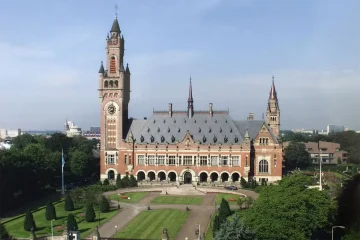
South Africa’s case before the International Court of Justice on the question of Israeli genocide in Gaza is proceeding. The Hague Group – the coalition of nations that has aligned behind international accountability – is growing. History is watching, and history, on this question, is on the right side.
Ambassador Bozell came to the Western Cape and told South Africans he was losing patience. He was demarched, offered a hollow personal disclaimer, and apparently expected that to be sufficient. South Africa should save him the wait. Send him home. And then get back to the business of building a country that needs no foreign approval to know its own worth – a country that humanity, one day, will be proud to have known stood firm.