THERE are lives that are measured not in years, but in the depth of their reach – in the countries touched, the hearts moved, the injustices confronted, the conversations that linger long after the voice has fallen silent. Katlego Sechaba Matsila lived such a life.
He came into this world on the 2nd of December 1982 in Gaborone, Botswana – a child of exile, a child of resistance, a child born into a story already larger than himself. His parents, Francisca and Jerry Matjila, had given everything to the struggle against one of the most brutal systems of racial oppression the modern world had ever known. Katlego did not choose to be born into that fire. But he carried its light with him every single day of his life.
To understand Katlego is to understand where he came from. His father, Jerry, is a veteran of the African National Congress, a man who devoted his years to dismantling apartheid and then – in a free South Africa finally breathing again – devoted the rest of his life to building bridges between his country and the world as a diplomat. His mother, Francisca, steadfast and grace-filled, held the family together across continents and time zones and the particular loneliness of a life lived always in motion. Between them, they gave their son something no school curriculum could ever teach: the understanding that freedom is not a destination. It is a daily act. It is a choice made over and over again, often at great personal cost.
Katlego absorbed this truth into his bones.
He grew up in a world without borders – not because borders did not exist, but because his spirit refused to be contained by them. Gaborone gave him his first breath. Tokyo shaped his early mind. New Delhi expanded his horizon. Mbabane refined his intellect. Cape Town awakened his voice. And Sweden – the home of the great Olof Palme, the prime minister who stood so firmly against apartheid that those who feared justice silenced him forever — Sweden became the country where Katlego planted his flag as a man.
There is poetry in that choice. Palme understood, as Katlego understood, that injustice anywhere is a wound inflicted on humanity everywhere. That the oppression of black South Africans was not a distant African problem to be observed from comfortable European drawing rooms, but a moral emergency demanding a response from every person of conscience on this earth. Katlego chose Sweden not by accident. He chose it because it resonated with who he was – someone for whom justice was not a political position, but a personal calling.
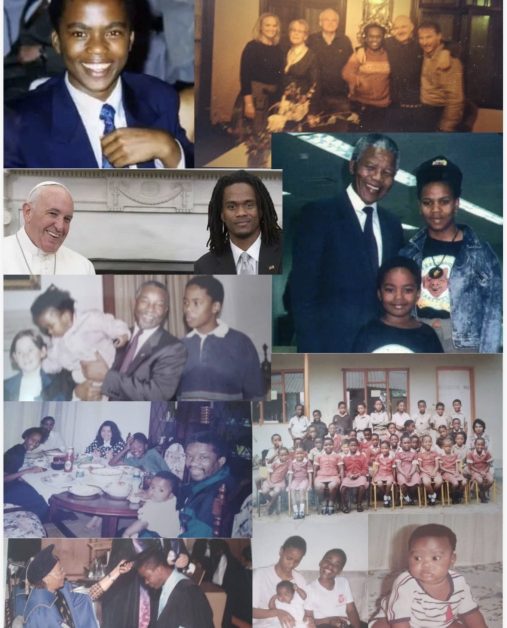
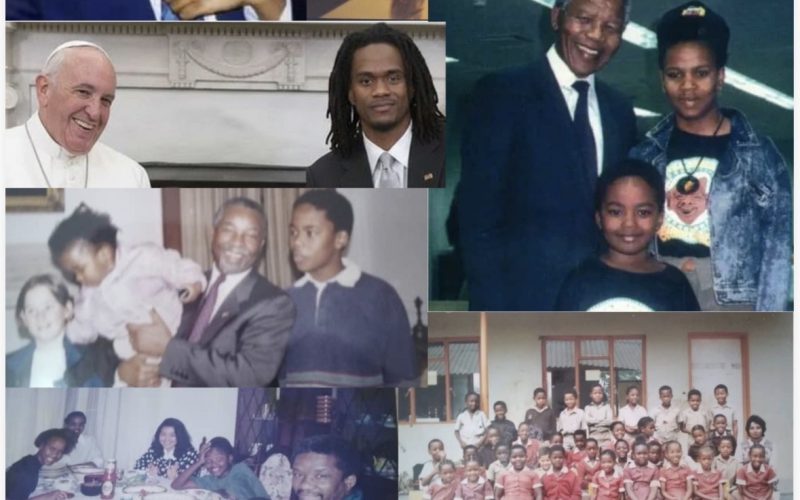
He was ten years old when he first stood in a church in Nerimaku, Tokyo, as an altar boy, drawn to something sacred and larger than himself. He was still a boy when he pulled on a Scout’s uniform and threw himself into karate with the same focused intensity he brought to everything he loved. He was a boy who sat across from Nelson Mandela – a man whose very survival was a miracle – and felt the electricity of that moment crackle through him for years afterwards.
Imagine it. October 1990. Mandela had walked out of Victor Verster Prison only months before, after twenty-seven years. The world was still exhaling in disbelief. And there was young Katlego, barely eight years old, his father’s son, sitting with perhaps the most consequential human being of the twentieth century. Whatever passed between them in that brief conversation – whatever Madiba said, whatever he saw in that small boy’s eyes – it became something Katlego carried like a compass for the rest of his life.
He would need that compass. The world was not going to become just on its own.
He moved through high schools on three continents the way most children move through classrooms down the street. The American Embassy School in New Delhi. Crawford College in Rivonia. And finally, magnificently, Waterford Kamhlaba United World College in Mbabane – one of the most intellectually demanding institutions on the African continent, where the International Baccalaureate programme does not simply test what students know, but who they are becoming. Katlego thrived. Of course he did.
By the time he was a young man, he spoke French, Japanese, English and Setswana with fluency. Four languages. Four windows onto four entirely different ways of being human. It is impossible to move through the world in four languages without developing a particular kind of empathy – a capacity to see from inside perspectives that are not your own. This was Katlego’s gift. He did not just understand the world intellectually. He felt it.
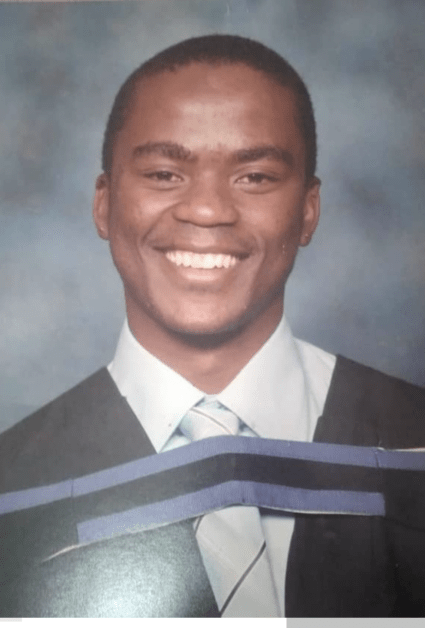
The University of Cape Town – one of Africa’s finest – recognised what it had in him and gave him the space to grow. He graduated with his Bachelor of Arts in 2006, and then, before he turned his face toward Sweden, he worked at the South African Parliament as a researcher, and then for the South African Food and Allied Workers Union, where he wrote speeches for people fighting for dignity on the factory floor. There is something quietly moving about that. A young man of his education, his languages, his connections – and he chose to put his gifts in service of workers. His parents had raised him well.
Lund University received him and Sweden kept him. His Masters in Environmental Economics in 2013 was not simply an academic achievement. It was a declaration. It said: I understand that the fight for human dignity and the fight for a liveable planet are the same fight. That the communities most devastated by environmental collapse are always the communities that have already survived every other form of exploitation. Katlego saw the connections that others missed. He always did.
He became a voice. A prolific, sought-after, compelling voice. Across Sweden and Denmark, he stood before audiences and spoke about the youth, about South Africa, about the grinding injustices that statistics flatten into numbers but that Katlego refused to let become abstract. The Swedish media came to him. Producers and journalists knew that when you wanted someone who could speak to the intersection of race and politics and global inequality with both intellectual rigour and genuine passion, you called Katlego Matsila.
And then came the afternoon of the 31st of October 2016, in Malmö – the city where Olof Palme’s spirit still walks the streets – when Katlego stood before Pope Francis. He wrote to his father about it, the excitement spilling through every line. The Pope speaking about young people. About the world’s wounds. About the responsibility of this generation. Katlego listened, and he recognised himself in those words, and he knew that whatever came next, he was exactly where he was supposed to be.
He held three passports. South African. Botswanan. Swedish. Three countries that together tell the story of who he was: the land of his blood, the land of his birth, the land of his choosing. A man belongs to the places that shaped him. Katlego belonged to all of them.
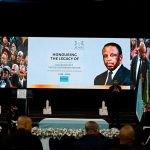
And when the time came to say farewell, the world confirmed what those who loved him already knew. From Japan, where a small boy had once become an altar boy and knelt in a Tokyo church. From Botswana, where he first opened his eyes. From Sweden, where he had found his home and his purpose. From countries across North America, where he had studied and questioned and argued and grown. From Namibia, whose own liberation story is woven into the same fabric as South Africa’s. The tributes came from everywhere – because Katlego had been everywhere, and everywhere he went, he left something of himself behind.
He was laid to rest in Ramokokastad, in the North West – his parents’ ancestral home, the soil that holds the roots of the Matsila family, the ground that connects all of this wandering, all of this beautiful restless purposeful movement, back to something ancient and permanent and deeply African.
Katlego Sechaba Matsila did not live a long life. But he lived a true life.
He lived as his father lived – in service. He lived as Mandela taught – with the courage to confront what is wrong. He lived as Palme believed – with the conviction that justice has no nationality, that the struggle belongs to everyone with the moral courage to join it. He lived as his faith taught – with humility, with community, with something greater than himself always at the centre.
He was a son of the struggle who became a citizen of the world. He was a boy of exile who chose to belong everywhere. He was a quiet revolutionary who fought his battles with education and eloquence and an unshakeable belief that a better world is not only possible – it is necessary.
The languages will be silent now. The speeches will not be written. The altar will stand without him.
But Katlego Sechaba Matsila changed every room he entered, every country he touched, every person who had the privilege of knowing him. That does not disappear. That does not get buried in the red soil of Ramokokastad.
That lives.