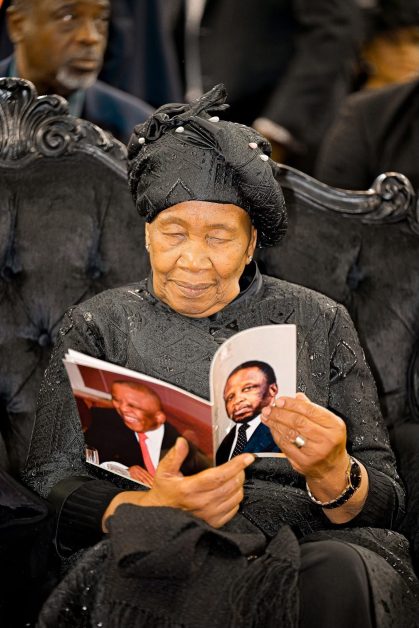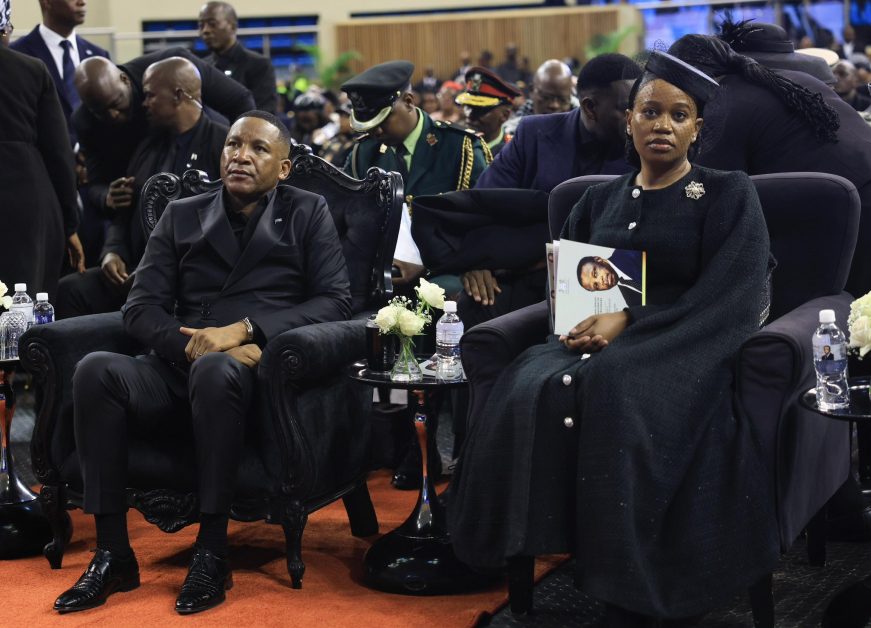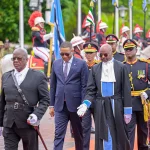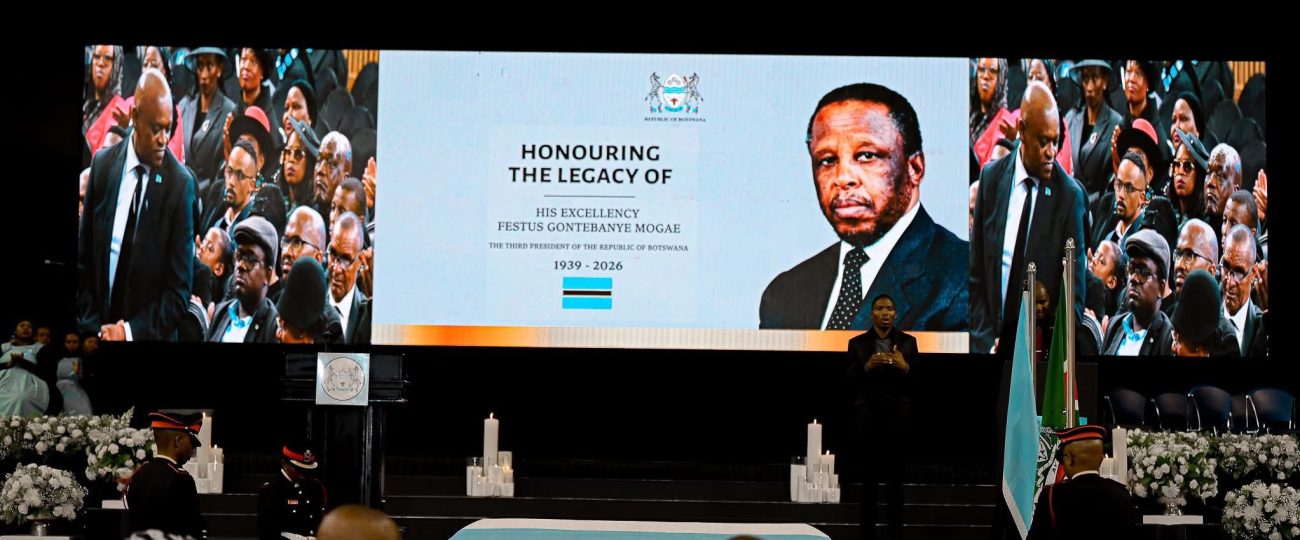

THE University of Botswana Indoor Sports Centre fell into a profound hush as President Advocate Duma Boko rose to deliver the eulogy that a nation had waited a week to hear. When he finally spoke, his voice – at times heavy, at times trembling – carried the full weight of a people saying goodbye to one of their finest.
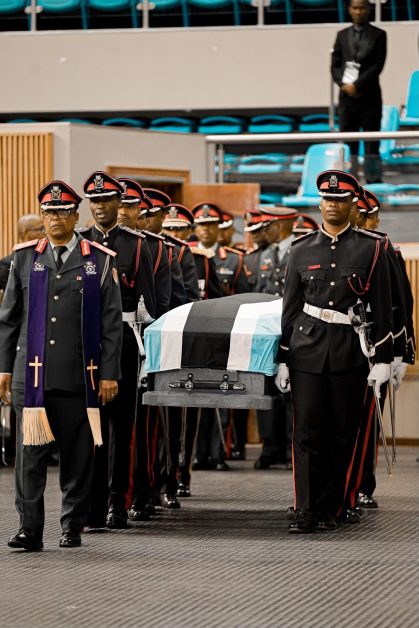
The State Funeral of His Excellency Festus Gontebanye Mogae, Botswana’s third president, marked the culmination of a week-long national commemoration that transformed grief into celebration, and mourning into an act of collective memory. It was, by every measure, a farewell richly deserved.
Mogae died on 8 May 2026 at his Gaborone home at the age of 86, after a period of illness. He had served as president from 1998 to 2008, and in that decade shaped a nation with the quiet authority of a man who never needed to raise his voice to be heard.
‘He Will Not Be Forgotten’: Boko’s Conrad Moment
Those who watched President Boko deliver the eulogy will not easily forget what they witnessed. Drawing on the Polish-British author Joseph Conrad, Boko reached for language equal to the man he was memorialising: that whatever Mogae was, he would not be forgotten – because he was uncommon. He described his predecessor as a leader who had written his name in the flaming fires of eternity.
The moment was all the more striking given its historical undertow. Boko rose to national prominence not in parliament, but in a courtroom – as one of the lawyers representing Basarwa communities in the landmark legal battle against government relocations from the Central Kalahari Game Reserve, a case that placed him in direct confrontation with the Mogae administration. That a man who once argued against that government should stand before its former leader’s coffin and deliver such a tribute speaks to the maturing of Botswana’s democracy, and to Boko’s instinct for nation-building above political division.
Prominent figures from the ruling Botswana Democratic Party praised Boko for presiding over what they described as a dignified and unifying state funeral – one that rose above the political fault lines of the past and placed the national interest at its centre.
When the speech appeared to end abruptly, Boko assured the packed hall that he had merely paused – that the conversation about Mogae’s distinguished service would continue well beyond the day of burial. It was a small moment that said much: the reckoning with Festus Mogae’s legacy is far from over.
A Regional Farewell: Southern Africa Sends Its Own
The presence of senior figures from across the region underscored the continental stature that Mogae commanded long after leaving office. South Africa’s Deputy President Paul Mashatile represented Pretoria at the service, a signal of the depth of bilateral ties and of the personal regard in which Mogae was held across the Limpopo.
Former South African President Kgalema Motlanthe – a veteran of the liberation struggle and a man who knows statecraft at its most exacting – was among those who made the journey to Gaborone to pay final respects. And former Lesotho Prime Minister Pakalitha Mosisili, whose own long career has given him intimate knowledge of the pressures and privileges of southern African leadership, also attended the service, representing the Mountain Kingdom’s enduring ties to Botswana.
Their presence at the funeral service and at the Phomolong Memorial Park in Phakalane – where Mogae was laid to rest in accordance with his own final wishes – was a reminder that the bonds forged in the SADC region run deeper than diplomatic protocol. They are personal, political and historical.
Khama’s Tribute: Restraint as Its Own Form of Respect
Former President Ian Khama – Mogae’s successor and the man to whom he handed power in a transition that became a model for the continent – chose his words with studied care. He said he would not disclose private conversations, citing respect, Botho and compassion for the bereaved family. But what he offered instead was more revealing than disclosure might have been.
Khama described his predecessor as soft-spoken, humble and unifying – a leader who preferred dialogue over confrontation, who listened to citizens and who strengthened democracy through consensus and steady governance. He catalogued an administration that delivered major gains: the HIV and AIDS response, roads, dams, airports, telecommunications expansion, rural electrification, the establishment of BIUST, and the long-term economic foundations on which future generations of Batswana would build their lives.
The restraint was itself a form of tribute. In a political culture where former presidents often speak too much of themselves, Khama spoke almost entirely of Mogae. He urged citizens to uphold his legacy of humility, integrity, unity and service — and said that Botswana must learn from his example.
The Man Who Told the Truth About AIDS
At the heart of every eulogy, every tribute, every letter of condolence from Washington to Brussels to Addis Ababa, lay a single defining act of presidential courage: Festus Mogae told the truth about AIDS when most African leaders could not bring themselves to utter the word.
When Mogae assumed the presidency in 1998, Botswana had one of the highest HIV infection rates on the planet — a statistic that threatened to consume a generation and hollow out the gains of independence. Rather than minimise the crisis or retreat into denial, Mogae confronted it with the blunt precision of the economist he was trained to be.
His administration launched one of Africa’s most ambitious antiretroviral treatment programmes, making Botswana the first African nation to provide free antiretroviral therapy to its citizens. Working with the United States through the PEPFAR partnership, Mogae drove down infection and mortality rates in ways that were once unimaginable. Even after leaving office, he continued to advocate for free treatment and for measures to prevent mother-to-child transmission — carrying the cause long after the crowd had moved on.
The US Embassy in Gaborone, in its message of condolence, described his leadership in confronting the epidemic as courageous — adding that it had put Botswana on the path to self-reliance. The SADC secretariat, in its own tribute, cited his HIV and AIDS response as an example of high-level leadership that continues to inspire the region.
The Ibrahim Prize for Achievement in African Leadership, awarded to Mogae in 2008, recognised precisely this quality — the willingness to govern not for applause but for posterity. He received the prize’s $5 million award and a lifetime annuity, but those who knew him say the recognition mattered less than the result: Batswana alive who might not have been.
Streets Lined With Memory: A Nation’s Farewell Journey
The state funeral was the culmination of a week of national commemoration that began with Boko’s declaration of three days of mourning – flags at half-mast across the republic – and moved through a carefully choreographed series of rituals that allowed every corner of the country to participate in the farewell.
A Home Village Procession of Honour carried Mogae’s remains from Selebi-Phikwe through to Serowe – his birthplace – where a memorial was held at the main kgotla. It was a moment of deep cultural rootedness, a reminder that beneath the economist and the international statesman was a son of the soil, born in Serowe on 21 August 1939.
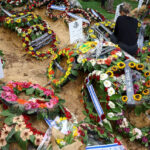
His body lay in state at the National Assembly from the morning of 13 May, and hundreds of Batswana – braving early winter frosty conditions – lined up outside Parliament to pay their last respects. Acting President Ndaba Gaolathe was among the first senior leaders to sign the Book of Condolences, joined by the Speaker of the National Assembly, the Commissioner of Police, the Chief Justice and a stream of cabinet ministers, parliamentarians and ordinary citizens whose quiet devotion spoke louder than any prepared statement.
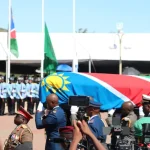
A Gaborone Procession of Honour on 15 May brought citizens out to line the streets as the cortege passed – an image that will endure: a powerful but humble leader making one final, slow journey through the capital he served. And on 16 May, as his own wishes demanded, he was laid to rest at Phomolong Memorial Park in Phakalane.
The Economist Who Built a Nation
Festus Mogae’s greatness cannot be reduced to the AIDS crisis alone, though that alone would justify the tributes. He was, by training and instinct, an economist – schooled in Britain, returned to Botswana in 1968 to serve the young republic, and forged through the disciplines of the IMF, the Bank of Botswana and the Ministry of Finance before ascending to the highest office.
Under his presidency, Botswana’s diamond revenues fuelled an era of rapid economic growth – but crucially, Mogae ensured that the proceeds were channelled into lasting infrastructure: roads, dams, airports, the expansion of telecommunications into rural areas, and the electrification of communities that had long been left in the dark. The Botswana International University of Science and Technology (BIUST) was established under his watch – a long-term investment in human capital that speaks to a leader thinking in decades, not electoral cycles.
SADC paid tribute to Mogae’s role as chairperson of the regional body from 2005 to 2006, noting that he led the organisation during a pivotal period and championed the construction of the SADC headquarters in Gaborone – a building that stands today as a symbol of regional integration. He also launched the Kgalagadi Transfrontier Park – the first cross-border conservation park in southern Africa – demonstrating that shared resources could be a foundation for cooperation rather than conflict.
France awarded him the Grand Cross of the Légion d’honneur in 2008, recognising his exemplary leadership and his role in making Botswana a model of democracy and good governance. The American Academy of Arts and Sciences made him a Foreign Honorary Member in 2016. These were not ornamental honours – they were acknowledgements of a man who had made his small, landlocked country punch far above its weight in the councils of the world.
Written in the Flaming Fires of Eternity
President Boko, in his Conrad-inspired eulogy, described Mogae as a selfless and generous man who always shared with others – and said the nation remains grateful to his family for allowing Batswana to share in his life, leadership and legacy. It was a graceful formulation, and a true one.
What Mogae leaves behind is not merely infrastructure, or an improved public health system, or a better-governed economy. He leaves behind a template for African leadership at its most disciplined and most humane: lead quietly, govern honestly, place country before self, tell hard truths before they become catastrophes, and step down when the constitution demands it.
In an era when African leaders too often cling to power beyond their mandate, Mogae stepped down in April 2008 without drama, transferring authority to Ian Khama in a transition so smooth it became a continental reference point. He could have sought a constitutional workaround. He chose not to. That choice – quiet, unheroic, undramatic – may be the most consequential thing he ever did.
Botswana does not often produce the kind of leaders who make the world take notice. Mogae was one of those rare exceptions – a man who, as Conrad might have said, was not forgotten, because he was uncommon.
As the mourners filed out of the University of Botswana Indoor Sports Centre and the cortege made its final journey to Phomolong Memorial Park, the hush that settled over Gaborone was not the silence of grief alone. It was the silence of a people who understood, fully and without ambiguity, what they had had — and what they had now lost.
At the cemetery, a 17 gun salute marked the nation’s final salute to its hero.