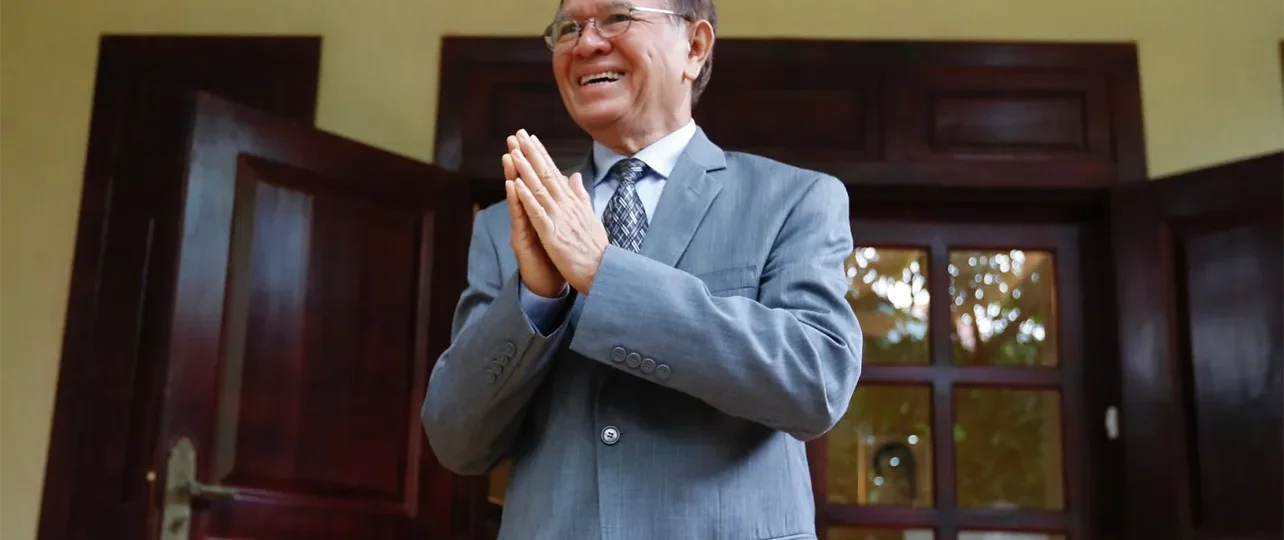

PHNON Penh’s appeals court has upheld a draconian 27-year prison sentence against Kem Sokha, Cambodia’s former opposition leader, alongside convictions for 33 activists, human rights defenders, and social media users – signaling a deepening authoritarian grip that the UN Human Rights Office (OHCHR) brands as a blatant violation of international law.
The rulings, announced this week, stem from politically charged cases. Sokha, head of the dissolved Cambodia National Rescue Party (CNRP), was convicted of treason, espionage, and conspiracy over a 2013 speech in Australia— delivered a full decade before his 2017 arrest. In a parallel first-instance verdict, the Phnom Penh court sentenced the 33 others to terms from 18 months suspended to two years for “incitement to cause social chaos.” Their offense? Public comments in 2024 critiquing the Cambodia-Laos-Vietnam Development Triangle Area project, a contentious infrastructure initiative sparking widespread public debate.
UN Human Rights Chief Volker Türk, speaking through spokesperson Jeremy Laurence, decried the decisions as “clearly inconsistent with international human rights law.” These cases, he argued, amplify the “chilling effects” of Cambodia’s vague, overbroad criminal statutes, arbitrarily wielded to silence civil society, journalists, and ordinary citizens. The convictions not only punish legitimate expression but also erode judicial independence and fair trial standards, hallmarks of democratic backsliding under Prime Minister Hun Manet’s government.
This escalation fits a grim pattern: Since the CNRP’s 2017 dissolution – widely viewed as a maneuver to neutralize opposition ahead of elections – Cambodia has jailed dozens on fabricated charges, shuttered independent media, and curtailed civic space. The Sokha verdict, upheld despite international outcry, underscores how decade-old rhetoric is retroactively criminalized to decapitate political rivals. Meanwhile, the 33 activists’ punishment for debating a regional development project highlights the regime’s intolerance for even economic critique, potentially stifling grassroots accountability in a nation grappling with inequality and foreign influence from Laos and Vietnam.
Türk’s call is unequivocal: Quash these convictions, release Sokha and all arbitrarily detained figures, halt further prosecutions, and overhaul Cambodia’s penal code to align with global norms. Failure risks isolating Phnom Penh further on the world stage, as ASEAN neighbors and Western donors weigh sanctions amid rising scrutiny.
Cambodia’s trajectory demands urgent international pressure—not just condemnation, but targeted measures to restore civic freedoms before dissent becomes a relic.