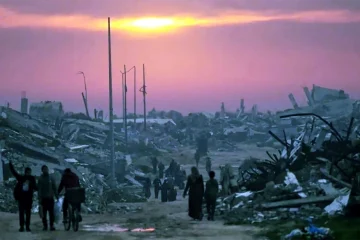
ONE month into what the United States military calls Operation Epic Fury, the Trump administration finds itself ensnared in exactly the kind of open-ended Middle East conflict it promised to avoid. The war against Iran — launched jointly with Israel on 28 February — has not produced the swift, definitive outcome the White House projected. Instead, it has unleashed what the International Energy Agency (IEA) has described as the largest supply disruption in the history of the global oil market.
For African governments, that designation is not an abstraction. It is the reason fuel queues are growing in Nairobi, the Egyptian pound has been allowed to slide, Ethiopia has rushed to introduce fuel subsidies, and Djibouti’s finance minister went on the record, warning that the conflict will bring severe economic consequences for developing countries across Africa. The war is being fought in the Persian Gulf; its casualties extend from Khartoum to Cape Town.
“President Trump has poor options all around to end the war. Part of the challenge is the lack of clarity related to what a satisfactory outcome would be.”
Jonathan Panikoff, former US Deputy National Intelligence Officer for the Middle East
TRAPPED: TRUMP’S STRATEGIC BIND
According to reporting by Reuters, Trump ends the fourth week of the war caught between two equally unappealing choices: negotiate a settlement that risks looking like a capitulation, or escalate toward a ground invasion that American voters — by a margin of 61% to 35% — have already rejected. His overall approval rating has fallen to 36%, the lowest of his second term. Inside the White House, aides are under standing instructions to stress the president’s stated four-to-six week timeline for hostilities, framing the campaign as finite and purposeful. The operational reality contradicts both.
Iran has not flinched. The Strait of Hormuz, through which approximately 20% of the world’s seaborne oil and liquefied natural gas transits, remains effectively closed. Tehran is prosecuting an asymmetric campaign: missile and drone strikes on Gulf infrastructure, a continuing chokehold on shipping, and a cynical willingness to internationalise the cost of the conflict through energy disruption. The logic, as one analyst noted, is elementary — raise the price of escalation until pressure for de-escalation builds from within the coalition arrayed against it.
Trump’s diplomatic outreach has accelerated out of necessity. A 15-point peace proposal was relayed to Tehran through a Pakistani backchannel. Iran has rejected it. On Monday, he backed away from a threat to destroy Iran’s power grid, declaring a five-day pause that was subsequently extended to ten days — a move widely read as a signal to jittery financial markets that Washington was not entirely beyond reason. But backing down from threats without commensurate concessions from Tehran has only underlined the weakness of his position.
ESCALATION ON THE TABLE — BUT AT WHAT COST?
The Pentagon is deploying additional thousands of troops to the region, and scenarios being discussed include a final massed air assault to further degrade Iran’s nuclear and military infrastructure — followed by a declaration of victory and withdrawal. Analysts are sceptical. Any such claim, they note, rings hollow while the Strait of Hormuz remains shut and Iran continues to strike at Gulf energy infrastructure. Another option under consideration is a seizure of Iran’s Kharg Island oil hub or strategic coastline positions — a commitment of ground forces that Trump’s political base, and American public opinion more broadly, would find deeply unwelcome.
Israeli officials have separately signalled unease that Washington might cut a deal that constrains their own freedom to strike Iranian targets. Gulf Arab states that host US forces are equally apprehensive about being left exposed to a wounded and hostile neighbour if Trump withdraws without a durable settlement. Trump’s coalition is fraying at its edges even as he escalates the rhetoric.
The IEA has released 400 million barrels from strategic reserves. It is unlikely to work — because no reserve release addresses a physical blockade.
AFRICA’S BILL FOR A WAR IT DID NOT CHOOSE
The continent’s exposure to this crisis is structural, not incidental. Africa imports most of the petroleum products it consumes, and the closure of the Strait of Hormuz — the artery through which roughly a fifth of global crude and LNG flows — has driven Brent crude above $100 a barrel and sent spot LNG prices in Asia surging by over 140%. Scholars from Nigeria, South Africa, Senegal, Kenya and Ethiopia, surveyed by Wits University’s African Energy Leadership Centre, all reported the same verdict: the oil price spike is hurting their economies.
In Ethiopia, the government has introduced fuel subsidies. In Egypt, President Abdel Fattah el-Sisi warned his country’s economy was in a state of near-emergency, and the central bank has allowed the pound to depreciate in response to capital flight — foreign portfolio investors pulled some $6 billion from Egyptian markets in weeks. In Bangladesh and Sri Lanka, fuel rationing has been imposed. For sub-Saharan Africa’s fuel and food importers, the shock arrives without the buffer of strategic reserves or stabilisation funds that wealthier economies can deploy.
The fertiliser dimension of the crisis has been largely overlooked in mainstream coverage, but it may prove the most damaging for the continent’s food security. The Gulf is a major artery for urea, ammonia and other fertiliser inputs. Urea prices have risen some 30% in a month. The timing, as the World Economic Forum notes, is brutal: Northern Hemisphere spring planting has begun, and farmers across sub-Saharan Africa face price shocks in inputs at precisely the moment they need them most. Soybean oil is at its highest level in two years.
Algeria, which is already producing at full capacity, stands to benefit marginally from elevated prices. Morocco’s calculus is mixed: it is an energy importer, but one of the world’s largest phosphatic fertiliser exporters, giving it a partial offset. For the rest of the continent’s net importers, there is no silver lining — only the prospect of sustained inflationary pressure on currencies already under stress from global rate uncertainty and post-pandemic debt overhangs.
THE AFRICA DIMENSION: AVIATION, DEBT AND DIPLOMATIC SILENCE
Beyond the fuel price shock, the war has restructured African air connectivity. Airspace closures across key Middle East corridors have forced airlines to reroute around the conflict zone, adding hours and fuel costs to flights between Africa, Asia and Europe. Several major Middle Eastern airports — which collectively handle some 15% of global air traffic — have been shut for extended periods. The aviation disruption compounds the losses already accruing to Suez Canal transit revenues, a major foreign currency earner for Egypt.
For economies already navigating debt crises, the war is compounding fiscal pressures into balance-of-payments emergencies. Countries dependent on Gulf remittances — Egypt, Ethiopia, Kenya, Uganda — face the additional risk of reduced transfers from diaspora communities caught in the disruption. The African Union has been conspicuously quiet on the geopolitical dimensions of the conflict, its institutional bandwidth consumed by internal procedural disputes. That silence carries its own diplomatic cost at a moment when Global South solidarity demands articulation.
ANALYSIS: THE GLOBAL SOUTH CANNOT AFFORD WASHINGTON’S INDECISION
What the Reuters analysis published this week makes clear — and what the African Mirror’s reading amplifies — is that Trump’s inability to define a clear, achievable war objective is not merely a domestic American political problem. It is a structural threat to the economic stability of the developing world. Every day the Strait of Hormuz remains blocked, every day negotiations founder without a framework, and every day Trump oscillates between escalation and back-channel diplomacy, the fiscal and inflationary costs fall disproportionately on nations with the fewest instruments to absorb them.
Africa’s governments have largely refrained from formally condemning the war, calculating — reasonably enough — that Washington is not a power to antagonise lightly. But the continent cannot afford to treat this as a spectator event. The African Union, individual oil-importing states, and the organisations representing them have a material interest in demanding clarity about the war’s trajectory and a timeline for reopening the Strait. The longer the conflict continues without resolution, the deeper the structural scarring to African economies already navigating the residual shocks of pandemic debt and Western rate cycles.
Trump says he wants to avoid a forever war. Africa needs that exit — but on terms that actually reopen the world’s most critical energy chokepoint. At present, neither the White House nor Tehran has credibly offered one.