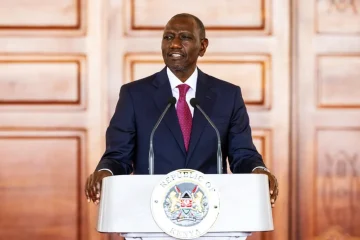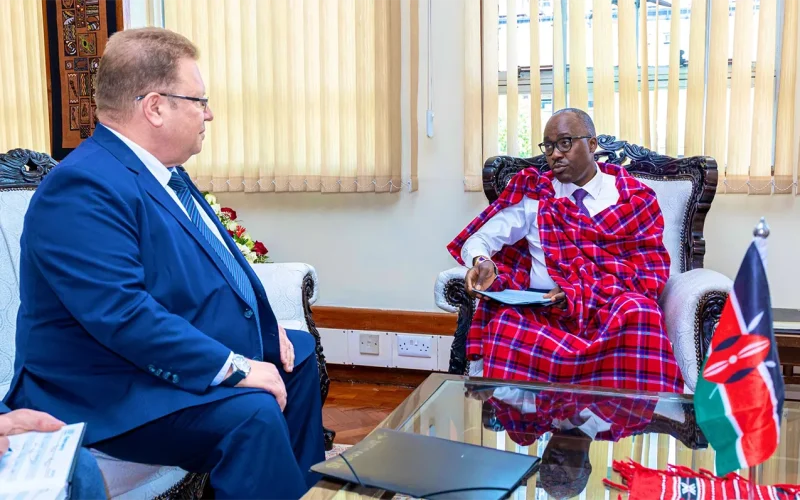
WHEN Kenya’s Principal Secretary for Foreign Affairs, Korir Sing’Oei, sat down with Russian Ambassador Vsevolod Tkachenko in Nairobi recently, the agenda was framed in the careful language of bilateral diplomacy. But the substance was anything but routine. Sing’Oei told the ambassador directly that the Kenyan government had “grave concern” about its nationals caught up in the Russia-Ukraine war, and demanded “unimpeded consular access” to citizens trapped on the front lines, along with “clear, transparent protocols” for the repatriation of prisoners of war and the remains of the dead.
“Our priority remains the safety and dignity of every Kenyan abroad,” Sing’Oei said in a statement after the meeting.
It was a moment that encapsulated a widening crisis stretching from Nairobi to Pretoria, Accra to Abuja — one that is forcing African governments to engage the Kremlin on some of the most fraught terrain in modern diplomacy: how to bring their sons home from a war they never chose to fight, and how to reclaim those who did not survive it.
A Crisis Years in the Making
The scale of African involvement in Russia’s war against Ukraine has taken years to come into full view, but recent data has sharpened the picture dramatically. A report released in February 2026 by the OSINT Accountability Project documented at least 1,417 African men recruited into Russian forces from 35 countries between 2023 and mid-2025. The numbers have risen sharply, from 177 recruits in 2023 to 647 by 2025, with fatalities highest among Cameroonian, Ghanaian, and Egyptian nationals — at least 316 deaths recorded across 37 units.
Ukraine’s Foreign Minister Andrii Sybiha has been blunter still, saying that Moscow’s recruitment contracts were “equivalent to a death sentence,” with most foreign fighters immediately dispatched to what he called “meat assaults” — high-attrition frontal charges designed to exhaust Ukrainian defences with human bodies. Sybiha accused Moscow of enticing Africans into joining the war and signing military contracts that were equivalent to a death sentence, warning that foreign citizens in the Russian army have “a sad fate.”
In Kenya, the situation has escalated faster than officials anticipated. Kenya’s principal intelligence agency told parliament that over 1,000 nationals are fighting for Russia — an increase from the roughly 200 cited by Foreign Affairs Minister Musalia Mudavadi in November. The updated figures triggered the urgent meeting with the Russian ambassador and have put the forthcoming official visit by Prime Cabinet Secretary Mudavadi to Moscow in March under an entirely different light. What was planned as a bilateral relations trip is now also a mission to negotiate the return of the living and the dead.
In September, Kenyan authorities arrested a Russian embassy employee, Mikhail Lyapin, accused of recruiting local men as mercenaries, and a Kenyan accomplice helping channel recruits to the Russian army. Police questioned at least 21 suspected recruits. Sing’Oei, in his meeting with Ambassador Tkachenko, explicitly “welcomed the cooperation of the embassy in staving off any illegal recruitment of Kenyans” — a pointed reference to the fact that recruitment had been running, in part, through Russian diplomatic infrastructure.
Ramaphosa Calls Putin
South Africa’s engagement has reached the highest levels of government. President Cyril Ramaphosa raised the return of South Africans fighting with Russian forces during a phone call with President Vladimir Putin, with the South African presidency saying that “teams from both sides will continue their engagements towards the finalisation of this process.”
The catalyst was a distress call that shook the country. The South African government said it was investigating how 17 of its nationals became involved with mercenary groups after the men issued distress calls seeking help to return home. Ramaphosa said the men, aged between 20 and 39, were lured under “the pretext of lucrative employment contracts” and had become trapped in the Donbas area.
International Relations Minister Ronald Lamola has indicated that some of those men are already on their way back. “President Ramaphosa is closing in on talks with the Russian President to work together to bring back children who were sold to a private security company in southern Russia,” Lamola said. “As I speak, some of them have already returned.”
The South African case has been further inflamed by a domestic political scandal. Duduzile Zuma-Sambudla, the daughter of former President Jacob Zuma, is facing several lawsuits accusing her of recruiting South African men to fight in the war on Ukraine. Her sister, Nkosazana Zuma-Mncube, is among those who filed a criminal complaint. The allegations cast a shadow over the country’s already complicated posture toward the war and have intensified domestic pressure on Ramaphosa to deliver results from his talks with Moscow.
Nigeria: A Man Who Didn’t Know He’d Joined an Army
Nigeria’s experience puts a human face on the legal and consular chaos these governments are navigating. A Nigerian man, Abubakar Adamu, appealed to the Nigerian government for urgent repatriation from Russia, claiming he travelled to Moscow on a tourist visa believing he would work as a security guard, only to have his travel documents confiscated and to be compelled to sign enlistment papers written in Russian without an interpreter. His lawyers invoked the legal doctrine of Non Est Factum — that he did not understand the nature of what he signed — in a formal petition to Nigerian authorities.
Among confirmed Nigerian fatalities are Abdoulaye Issaka Ismael, 27; Agbo Moses Omale, 43; Adamu Abdulai Ismail, 25; and Fajobi Taiwo Omoniyi, 50. The Russian Ambassador to Nigeria, Andrey Podyolyshev, denied claims that Moscow was recruiting Nigerians — a denial that Nigerian officials and families of the dead have received with open scepticism.
Cameroon: A Military Depleted From Within
Of all the African nations caught in this crisis, Cameroon’s predicament may be the most structurally alarming. The country is fighting on multiple internal fronts — against Boko Haram in the north, English-speaking separatists in the south, coastal pirates, and Central African rebels in the east. It cannot afford to lose soldiers, let alone its most skilled ones.
So many Cameroonian troops had joined Russian forces that the Cameroonian Defence Ministry ordered its officers to “immediately take appropriate measures against desertion” and banned all men in uniform from travelling abroad without special permission. That a sovereign military had to issue such an order speaks to the reach of Russia’s recruitment networks, which targeted trained Cameroonian soldiers for their battlefield competence.
The French Institute of International Relations estimated that combat has killed roughly 150 Cameroonians — approximately 30 percent of all Cameroonians who joined Russian forces. Yaounde has not publicly announced high-level diplomatic engagement with Moscow comparable to Kenya’s or South Africa’s, but the military decree signals a government alarmed enough to act unilaterally against the drain.
Ghana: Students on the Front Line
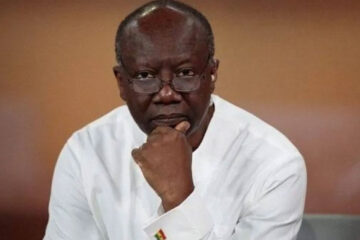
Ghana’s case adds a troubling dimension involving students. Reports indicate that African students in Russia, including many Ghanaians, face pressure or threats of visa non-renewal and potential deportation if they refuse military contracts — turning the pursuit of education into a risk of forced conscription. Ghana’s Foreign Minister Samuel Okudzeto Ablakwa confirmed the government was investigating reports of 14 Ghanaian nationals allegedly caught on the front lines, and Accra has called on Russia to stop the war. But like many smaller nations on the list, Ghana has fewer diplomatic levers to pull in Moscow.
The Recruitment Machinery
Across all these cases, investigators have identified a consistent pattern. The use of travel agencies operating as logistical intermediaries, the involvement of local pro-Russian individuals, and recruitment networks based on co-optation — in which former recruits become recruiters themselves — are the three recurring structural features of Russia’s Africa-focused campaign. The schemes rely heavily on bogus job offers, promises of education or administrative regularisation, and irregular immigration channels.
Russia has also turned the threat of deportation into a recruitment tool. In one documented case, Gambian national Lamin Jatta was arrested and told directly: sign a contract with the Russian Ministry of Defence or be deported. He later died in Ukraine.
A December 2025 report by the French Institute of International Relations described Russia’s recruitment practices as a form of human trafficking, noting that campaigns target “poor urban youth” who see Russia as a gateway to Europe — a destination now increasingly closed to them through legal migration channels. Recruiters promise signing bonuses of up to $30,000, monthly salaries of $2,200 to $2,500, fast-track visas, and citizenship. In practice, recruits report minimal training, high-risk deployments, and contracts written in a language they cannot read.
Diplomacy Without Leverage
What makes these diplomatic interventions so delicate is that African governments are negotiating from a position of limited leverage. Russia is not a country where consular pressure easily translates into results, and the men in question — regardless of how they were recruited — are technically serving under Russian military contracts. Moscow’s standard line, repeated by its embassies in Nairobi and Abuja, is that foreign nationals legally present in Russia may voluntarily enlist, and that Russia is not responsible for their individual choices.
Yet the weight of evidence — criminal arrests of Russian diplomatic staff involved in recruitment, documented cases of contract coercion, and a Togo government warning about “bogus scholarships” used to lure students into military service — has made that position increasingly untenable to sustain publicly.
African governments, including Kenya and South Africa, have requested repatriation of their nationals and launched investigations into recruitment networks, increasing diplomatic pressure on Moscow. But investigators and analysts warn that the diplomatic effort remains fragmented. Nations are negotiating individually, without a coordinated continental framework, and Russia has little incentive to make the process easy.
The Stakes
The human cost is not abstract. In Kenya, a mother named Bibiana Wangari has been photographed holding a picture of her son, killed on a Ukrainian battlefield. Families across Cameroon, Ghana, Senegal, and Uganda scroll social media, posting images of missing men, hoping someone, somewhere, will recognise them — alive or dead.
Ukraine’s ambassador to South Africa, Olexander Scherba, captured the historical irony grimly: “They were fooled to fight in a terrible, barbaric war that Africa has nothing to do with. And it’s a colonial war, so seeing Africans fighting a colonial war against a free country is especially insane.”
As Sing’Oei prepares the ground for Kenya’s March visit to Moscow, and Ramaphosa’s teams continue bilateral engagements with the Kremlin, the question being asked in foreign ministries from Nairobi to Pretoria is no longer whether Africa has a stake in this war. It clearly does — paid for in African blood, and pressed upon African soil by networks the continent’s intelligence agencies are only now fully mapping.
The question now is whether Moscow will help bring the survivors home and render an account for the dead.