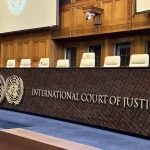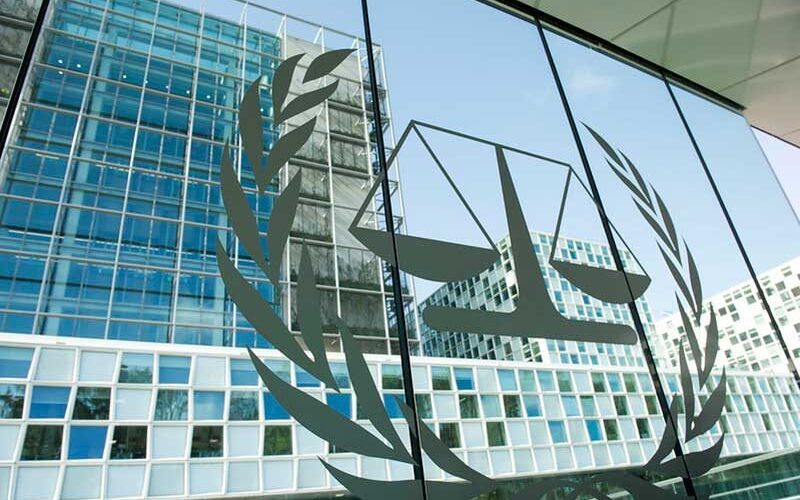
TWO more Western nations have formally stepped into the most consequential genocide case before the International Court of Justice in a generation. On 11 March 2026, the Netherlands and Iceland each filed declarations of intervention in the proceedings brought by South Africa against Israel — moving the case from a Global South-led initiative into unmistakably broader international terrain and putting Western allies of Israel on record on opposite sides of the same dispute.
Both states invoked Article 63 of the ICJ’s Statute, which confers an unconditional right of intervention on any party to the convention under consideration — in this instance, the 1948 Genocide Convention. The mechanism requires no permission from the court or the disputing parties. By exercising it, the Netherlands and Iceland have accepted that any construction of the Genocide Convention handed down by the court in this case will be equally binding upon them. The legal self-implication is significant: it transforms intervention from a political statement into a binding juridical commitment.
A Coalition That No Longer Looks Peripheral
The two new filings bring to 18 the number of states that have sought to participate in the proceedings since South Africa opened the case on 29 December 2023. The roster, which now includes Colombia, Libya, Mexico, Palestine, Spain, Türkiye, Chile, the Maldives, Bolivia, Ireland, Cuba, Belize, Brazil, the Comoros, Belgium and Paraguay, spans every major developing-region bloc as well as several European Union member states. The presence of the Netherlands — the host state of the court itself, and a founding NATO ally — alongside Ireland, Belgium and Spain produces a notable intra-Western fault line.
For Israel and its principal Western backers, the composition of this coalition is strategically significant. These are not, in the main, adversarial states acting from regional enmity. Several are close trade and security partners of both Israel and the United States. Their intervention signals that the legal arguments around Israel’s conduct in Gaza have gained traction in capitals where they might otherwise have been dismissed as politically motivated.
The Mechanism and Its Obligations
Article 63 interventions are distinct in character from Article 62 applications, under which a state must demonstrate a legal interest likely to be affected by the court’s decision and must seek the court’s leave to participate. Article 63 is an entitlement. Its trigger is membership in the relevant convention, not proof of injury. Its cost is automatic acceptance of the court’s eventual interpretation.
This distinction matters enormously for international law’s long arc. A decision in South Africa v. Israel will not merely resolve a bilateral dispute — it will authoritatively interpret what the Genocide Convention requires of state parties: whether the obligation to prevent genocide is triggered by knowledge alone or requires something more, and how the prohibition on complicity operates in relation to arms transfers and diplomatic support. All 18 intervening states will be bound by that interpretation. All 153 other parties to the Genocide Convention will face strong precedential pressure from it.
Provisional Measures and the Road Ahead
The case has already generated three rounds of provisional measures orders — on 26 January 2024, 28 March 2024, and 24 May 2024 — in which the court affirmed and successively expanded its directives to Israel. Merits proceedings are proceeding on a separate track, with South Africa and Israel now invited to file written observations on the two newest declarations.
The steady accumulation of intervening states throughout 2024 and into 2026 suggests a considered, coordinated effort to build a record of international legal solidarity with the Palestinian cause — one that will register in the final judgment regardless of outcome. Whether the court ultimately finds that Israel has breached the Genocide Convention, the legal architecture being constructed around this case is reshaping the norms of state responsibility for atrocity, and doing so with the active participation of states that Israel once counted among its reliable diplomatic anchors.