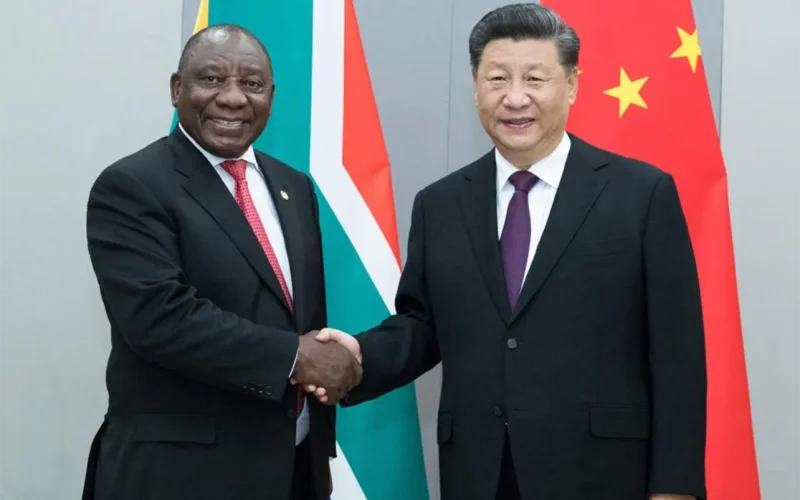
DURING his fourth state visit to South Africa last August, Chinese President Xi Jinping famously described bilateral relations between the two allies as having entered the “golden era.” In September, South African President Cyril Ramaphosa reciprocated by undertaking a state visit to China, where he was received with great pomp and ceremony.
The September meeting ushered in a new phase in the bilateral relations between the two countries, elevating their ties to “an all-round strategic cooperative partnership in the new era.” These ties continue to yield golden opportunities for both sides.
When it comes to South Africa, China truly delivers on its promises. For instance, China has been South Africa’s largest trading partner for 14 consecutive years. As the first African country to sign the Belt and Road cooperation document with China, South Africa stands as one of China’s most important investment destinations on the continent. The economic and trade structures of the two nations are highly complementary, making the enhancement of trade and investment cooperation a matter of visible and practical mutual benefit, grounded in mutual respect.
The flourishing bilateral ties between the two nations have been marked by a significant increase in commodity exchange, people-to-people diplomacy, and technological exchanges—evidence of the win-win cooperation between Pretoria and Beijing. In fact, since 2010, China has elevated relations with South Africa to a Comprehensive Strategic Partnership.
This week, South Africa’s Deputy President Paul Mashatile addressed the launch ceremony of the Corporate Social Responsibilities (CSR) Report of Chinese-Funded Enterprises in South Africa.
Social responsibility is of great significance in a society constantly described as the world’s most unequal. Close allies like China are consciously aware of the legacy of apartheid and the persistent race-based economic development that has historically favored the white minority.
The fact that South Africa sent such a high-ranking official to this auspicious Chinese event confirms the highest regard in which Pretoria holds Beijing.
The launch of the CSR was hosted by the South Africa-China Economic and Trade Association (SACETA), a non-profit entity voluntarily established by Chinese-funded enterprises in South Africa. According to the Chinese Embassy in South Africa, more than 200 Chinese enterprises are currently operating in the country, with total investments exceeding R170 billion across sectors including mining, energy, manufacturing, infrastructure, finance, and information and communication technology (ICT).
Since its formation, SACETA has played a pivotal role in advancing mutually beneficial economic and trade cooperation. The organization has enhanced communication with various government departments in pursuit of a shared future. SACETA also strictly monitors the compliance and development of its members. Their social contributions and enhancement of win-win cooperation, in line with China’s foreign policy, have been remarkable.
Moreover, SACETA plays a crucial role in South Africa’s economic development and job creation, especially among young graduates.
Unsurprisingly, Deputy President Mashatile reflected on the historical ties that continue to bind Beijing and Pretoria. “The Republic of South Africa and the People’s Republic of China share a strong and long-standing relationship,” Mashatile said, highlighting that China’s foreign policy, based on the notion of a “shared future,” has long been at the center of diplomatic relations with South Africa.
Mashatile emphasized the importance of collaboration with China: “It is crucial for poverty eradication, inequality elimination, and fighting unemployment.”
Chinese Ambassador to South Africa, Wu Peng, who has approached his role with renewed vigor, highlighted the strategic role of Chinese enterprises in South Africa’s developmental agenda of job creation, poverty alleviation, and securing a better environment.
“I pay high tribute to all Chinese enterprises that have actively fulfilled their social responsibilities and served local development,” Ambassador Wu said. This CSR launch marked the second edition since its first release in 2018.
The substantial contributions by Chinese-funded enterprises to local development included efforts to improve local community livelihoods, protect the environment, and support various sectors, according to Ambassador Wu.
He viewed these positive contributions as a “faithful implementation of the principle of sincerity, real results, amity, and good faith, as proposed by President Xi Jinping.”
Using poetic language, Ambassador Wu compared the practice of Chinese enterprises to “the flowers of Namaqualand,” describing the close economic and trade ties between China and South Africa as the fertile soil nurturing these beautiful flowers.
Ambassador Wu concluded with optimism about the bilateral relations, stating that the Chinese Embassy in South Africa will continue to serve, build, and maintain the development of bilateral relations, working with Chinese-funded enterprises to write a new chapter for both countries and peoples.
His message aligned perfectly with President Xi’s consistent emphasis that South Africa is China’s key destination of choice on the continent, within BRICS, and in South-South relations amid a rapidly changing international world order.
*Abbey Makoe is Founder and Editor-in-Chief of Global South Media Network