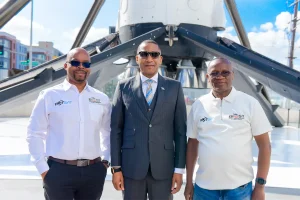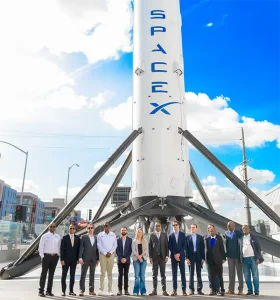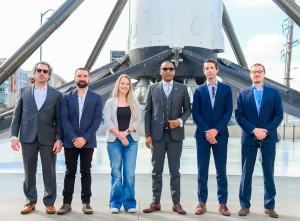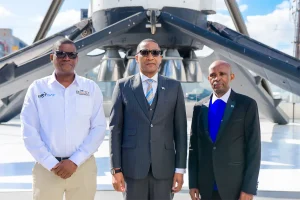

THE skies above California blazed with promise as the SpaceX rocket thundered upward, carrying with it not just a satellite, but the dreams and aspirations of an entire nation. BOTSAT-1 soared into the heavens, and with it, Botswana claimed its place among the stars and firmly established its entry into the global space community.
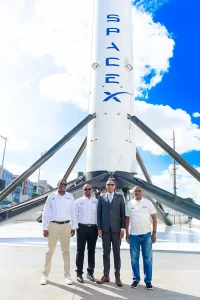
Those gathered at the SpaceX facilities erupted in cheers as President Duma Boko watched the fiery ascent with pride gleaming in his eyes. Several million kilometres away, engineers from the Botswana International University of Science and Technology (BIUST), who had poured their hearts and minds into this national space engineering endeavour, clasped hands and embraced as their creation disappeared into the blue expanse, destined for orbit 600 kilometres above Earth.
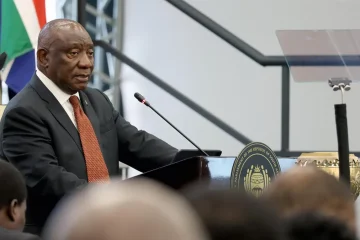
“Today, we are not just launching a satellite,” President Boko declared, his voice resonant with emotion. “We are launching Botswana’s future, one that aligns perfectly with our Vision 2036 for digital transformation and knowledge-based economic growth.”
The diamond-rich nation had long depended on its mineral wealth, but now it was mining something far more precious – the intellectual capital of its people. BOTSAT-1 represented a bold pivot toward innovation, one that would ripple through generations to come.
The journey to this historic moment began with the steadfast support of the Ministry of Communication and Innovation (MCI), which generously sponsored the project, and the Ministry of Higher Education, which entrusted BIUST with its implementation. In the absence of a formal space agency, BIUST stepped up to play this crucial role, leading research, engineering, and capacity-building efforts that made BOTSAT-1 a reality.
This leadership proved that with dedicated institutions, nations can drive space innovation without waiting for traditional bureaucratic structures.
As night fell across the southern African plains later that day, families gathered outside their homes, eyes turned skyward, searching for a glimpse of their nation’s newest ambassador as it made its first of six daily orbits around the planet.
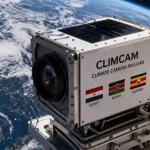
In the control room at the newly established ground station, young technicians – some of the ten postgraduate students working on satellite data applications – monitored streams of incoming data. The hyperspectral camera aboard BOTSAT-1 was already capturing high-resolution images of Botswana’s diverse landscapes – from the lush Okavango Delta to the vast Kalahari Desert.
Minister of Communications and Innovation David Tshere said as the custodian of Botswana’s national research mandate and special projects, the ministry has placed strategic investment in advanced technologies, digital infrastructure, and research-driven solutions at the centre of national development.
The satellite’s capabilities would transform how the country approached environmental conservation, allowing rangers to track wildlife movements across vast protected areas. Farmers would receive precise data on soil conditions and weather patterns, revolutionizing agricultural practices and enhancing food security. When floods threatened villages, authorities would now have critical early warning information. Urban planners would have access to geospatial intelligence for infrastructure development.
The success of BOTSAT-1 was made possible through extensive collaboration. Beyond BIUST’s national partnership with Botswana University of Agriculture and Natural Resources (BUAN), University of Botswana (UB), Okavango Research Institute (ORI), and various government ministries, BIUST fostered relationships with international partners such as EnduroSat, SpaceX, Dragonfly Aerospace, Exco Launch, and Malakana Enterprises.
Recently, BOTSAT engineers joined the EnduroSat team for Assembly, Integration, and Testing (AIT), gaining hands-on experience in satellite development – a significant step toward Botswana’s self-sufficiency in space engineering.
In the capital of Gaborone, at a small primary school, a teacher wheeled a television into a classroom of wide-eyed children. “That,” she said, pointing to news footage of the launch, “was built by people just like you.” The children watched in awe, minds racing with possibilities previously unimagined. For Botswana wasn’t just launching a satellite; it was building a generation of space scientists and engineers.
The new administration, barely three months into its term, had already announced plans for a second satellite that would deliver faster internet to remote areas. The government was actively engaged in conversations around space policies and regulations, particularly regarding the management, dissemination, and utility of data that would be collected by BOTSAT-1.
This aligned with broader African initiatives, as the African Union had approved the implementation of the African Space Policy and the African Space Strategy, aiming to develop space products and services to address the continent’s economic, political, social, and environmental challenges.
As BOTSAT-1 silently traced its path across the starlit African sky, it carried more than scientific instruments. It carried a powerful message: that a small nation with big dreams could reach beyond horizons, that innovation knows no boundaries, and that Botswana’s future would be written not just in the sand and soil of its beautiful land, but in the infinite canvas of space.
In the quiet village of Letlhakane, an elderly man who had once mined diamonds from the earth pointed to the heavens and told his grandchildren, “Our greatest treasures are no longer just beneath our feet. Now they are also above our heads.”
And as the children gazed upward, their eyes reflected the same brilliant stars that had guided their ancestors for countless generations – now joined by a new light, one created by their own people, blinking with promise for a brighter tomorrow. While BOTSAT-1 was Botswana’s first mission, BIUST’s commitment to research and problem-solving ensured it would not be the last. The groundwork had been laid for future satellite missions, stronger international partnerships, and potential collaborations that would continue to transform Botswana into a regional leader in space science.