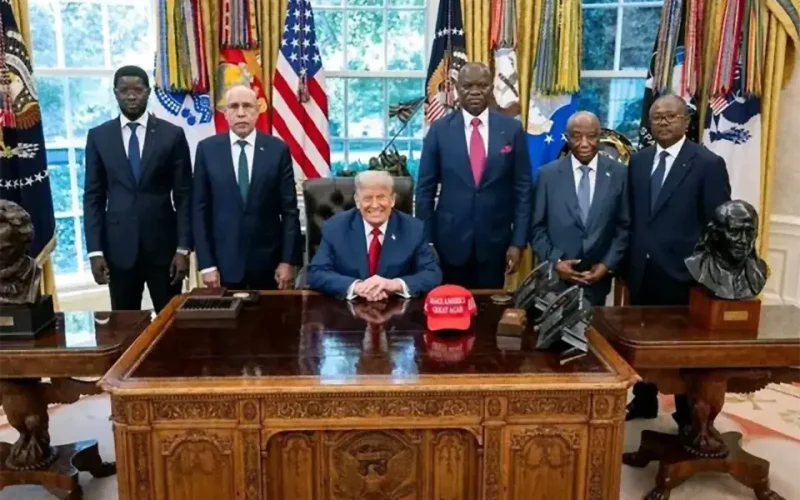
THE autumn sun cast long shadows through the towering windows of the State Dining Room, where crystal chandeliers caught the light like frozen tears. Around the mahogany table sat six men – one American president and five African heads of state – each carrying the weight of nations on their shoulders, each representing millions of voices that had travelled centuries to reach this moment.
The room itself seemed to hold its breath. Here was diplomacy in its most visible form: the careful choreography of place settings, the whispered consultations of translators, the measured cadence of international protocol. Headsets lay scattered across the table like technological olive branches, ready to bridge the linguistic chasms between Swahili and English, French and Arabic, the polyglot symphony of a continent.
But when President Joseph Boakai of Liberia spoke, his words cut through the air with crystalline clarity. No translator needed. No hesitation. His English flowed like a river that had carved its path through generations – confident, articulate, steeped in the peculiar dignity of a man who had spent decades in the corridors of power. This was not the tentative English of a second language, but the assured voice of a leader whose nation had been founded by freed American slaves, whose constitution bore the DNA of the Declaration of Independence, whose capital city was named for an American president.
President Trump, perhaps genuinely surprised by the eloquence before him, leaned forward with the enthusiasm of a man making a discovery. “Such good English,” he said, his voice carrying that particular American amazement reserved for the unexpected. “Where did you learn to speak so beautifully? Where? Were you educated? Where?”
The question hung in the air like smoke from a snuffed candle. President Boakai, with the grace of a man who had navigated worse storms, offered his thanks. But around the table, something had shifted. The other African leaders – men who had built nations from the ashes of colonialism, who had negotiated with world powers, who spoke multiple languages with the fluency of necessity – felt the familiar sting of condescension dressed as a compliment.
“In Liberia?” Trump continued, his wonder undiminished. “Well, that’s very interesting. That’s beautiful English. I have people at this table that can’t speak nearly as well.” The laughter that followed was the uncomfortable kind – the sound of diplomats trying to smooth over a moment that had already carved itself into memory.
What Trump didn’t seem to grasp was the exquisite irony of his amazement. He was praising the President of Liberia for speaking English well – the same English that had been the official language of Liberia since its founding in 1847, the same English that echoed through the halls of the University of Liberia, the same English that had carried the dreams of African-Americans back to African soil more than a century and a half ago.
Beyond the gilded walls of the White House, the reaction was volcanic. Social media erupted with indignation. African intellectuals, diplomats, and ordinary citizens found themselves explaining what should have been obvious: that Africa was not a monolith of linguistic confusion, that many African nations had adopted European languages not as foreign imports but as tools of governance, education, and international discourse.
Representative Jasmine Crockett of Texas captured the collective frustration: “Asking the President of Liberia where he learned English when it’s literally the official language is peak ignorance,” she told the New York Times. Her words became a rallying cry for those who saw in this moment not just a diplomatic gaffe, but a symptom of a deeper malady – the persistent American tendency to view Africa through the lens of charity rather than equality, of surprise rather than respect.
The incident revealed more than cultural insensitivity; it exposed a chasm in understanding that stretched far beyond language. Here was a continent that had produced Nobel laureates, groundbreaking scientists, visionary leaders, and revolutionary thinkers – a continent whose children had been speaking English, French, Portuguese, and Arabic for generations, not as conquered subjects but as global citizens. Yet the surprise in Trump’s voice suggested he had expected something else entirely.
In the days that followed, the White House luncheon became a case study in the perils of assumption. African newspapers ran editorials about the “colonial gaze” that still coloured American perceptions. Diplomatic cables buzzed with careful language about “cultural sensitivity” and “mutual respect.” The incident became a teaching moment – not just about geography or history, but about the dangerous art of looking at the world and seeing only what you expect to see.
President Boakai, for his part, handled the moment with the quiet dignity that had marked his rise to power. He understood that this was not about him personally – it was about the broader question of how Africa was perceived on the world stage. His English was not remarkable because it was unexpected; it was remarkable because it was the voice of a leader who had earned his place at that table through decades of service, struggle, and statecraft.
As the luncheon concluded and the leaders departed, the lesson lingered in the air like the scent of expensive cologne. Respect, it seemed, was indeed the universal language of diplomacy – but it was a language that required more than words. It demanded understanding, humility, and the recognition that in a room full of world leaders, surprise at competence was perhaps the most revealing response of all.
The White House had hosted thousands of diplomatic meetings, but this one would be remembered not for what was accomplished, but for what was revealed – about assumptions, about respect, and about the long road still ahead in the journey toward genuine equality on the world stage.