
THE night air hung heavy over Capital Hill as the lights burned late in the Office of the President and Cabinet. Inside, history was being written – not in the hesitant, faltering script of the administration that had come before, but in bold, decisive strokes that would ripple across every corner of the Republic of Malawi.
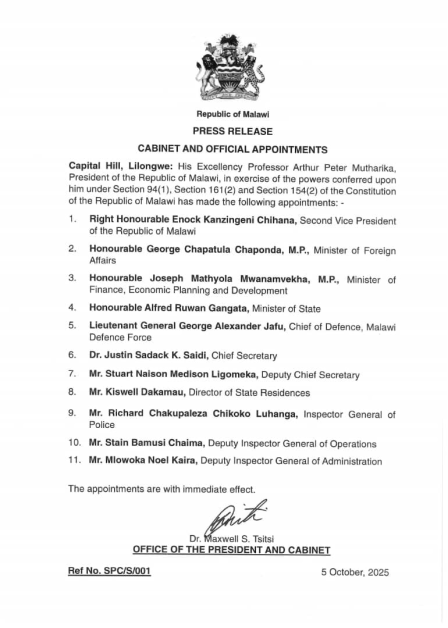
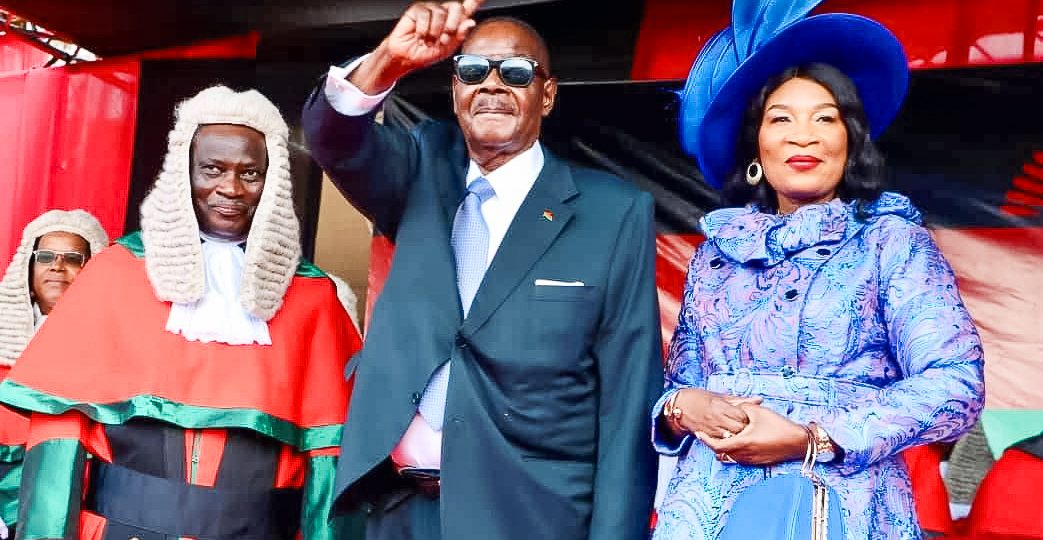
When President Arthur Peter Mutharika’s appointments were finally released into the Lilongwe night, they carried the weight of a mandate and the urgency of a nation that had waited too long for leadership.
At the heart of the announcement stood one name that resonated through Malawi’s political corridors like a thunderclap: Enoch Kanzingeni Chihana. His appointment as Second Vice President marked more than a political calculation – it was a homecoming. A seasoned leader returned to the center of executive power, bringing with him decades of experience and the gravitas of someone who had weathered Malawi’s political storms.
For those who remembered the paralysis of the previous administration under Lazarus Chakwera—the agonizing delays, the vacant ministries, the rudderless drift – Mutharika’s swift action felt like oxygen rushing back into suffocated lungs.
The President moved with surgical precision. George Chaponda took the helm of Foreign Affairs, positioning Malawi to reclaim its voice on the continental and global stage. Joseph Mwanamvekha received perhaps the most daunting portfolio: Finance, Economic Planning and Development – the beating heart of any administration’s success or failure. In his hands would rest the economic recovery of a nation.
Lieutenant General George Jafu’s appointment as Chief of Defence signaled stability and strength, while Alfred Ruwan Gangata’s dual role as Minister of State and DPP Vice President for the Central Region demonstrated Mutharika’s understanding that politics and governance must work in concert, not conflict.
The security and administrative appointments told their own story. Justin Saidi, as Chief Secretary, would serve as the engine of government machinery. Richard Luhanga took command of the Police Service, with Stain Chaima and Mlowoka Kaira flanking him as his deputies – a triumvirate tasked with restoring law, order, and public confidence.
What makes Mutharika’s approach particularly striking is its deliberate pacing. This is merely the first batch—Agriculture, Education, Trade and Industry, and Rural Development remain vacant, waiting for the right leaders. Political insiders describe it as a “phased rollout,” but it reads more like a chess master making opening moves with calculated patience.
Each appointment was made under the constitutional authority of Sections 94(1), 161(2), and 154(2)—not just legally sound, but politically unassailable. This was governance by the book, executed with the speed of necessity.
The ghost of the Chakwera administration haunts these appointments. Where the previous government stumbled through delayed Cabinet formations, leaving ministries adrift and citizens bewildered, Mutharika has moved with the urgency the moment demands. The contrast could not be starker, nor the implicit criticism more cutting.
A Nation Holds Its Breath
As dawn breaks over Malawi, the nation finds itself at an inflection point. Mutharika has not just filled positions—he has sent a message. This is an administration that will not delay, will not equivocate, will not allow the machinery of government to seize up while the people wait.
The revamped ministerial titles and restructured portfolios hint at something larger: a president who understands that transformation requires more than new faces—it demands new frameworks, new thinking, and the courage to break from the patterns that have held Malawi back.
Now comes the harder part. Appointments are made in offices; their success is measured in villages, markets, hospitals, and schools across the nation. Mutharika has assembled his team. The question that will define his presidency is simple and unforgiving: Can they deliver?
The people of Malawi, weary from disappointment but hungry for hope, are watching. The world is watching. And somewhere in Capital Hill, as the sun rises over Lilongwe, the real work begins.