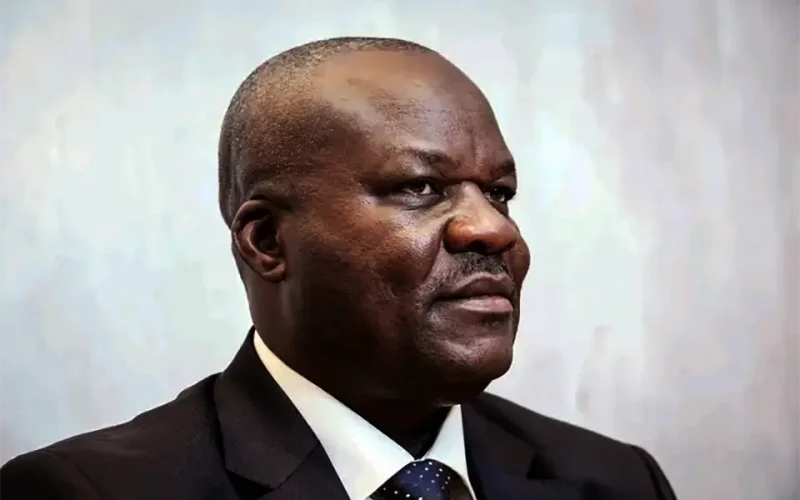
WHEN Pisco Paluku Sirikivuya walked into a Paris courtroom last month, he carried with him memories that had haunted him for two decades: the screams of his uncle being killed, the violation of his friend’s wife, the bullet wound that still aches in his own body. A 50-year-old nurse from Mambasa in eastern Democratic Republic of Congo (DRC), he had travelled thousands of miles to face the man accused of orchestrating the terror that shattered his community.
On Monday, he finally heard the words he’d been waiting for since 2002.
Roger Lumbala, once known as the “Butcher of Ituri” for his role commanding forces during the Second DRC War, was sentenced to 30 years in prison by a French court after being convicted of complicity in crimes against humanity. The verdict marks a watershed moment in the pursuit of justice for a conflict that claimed more than five million lives – yet it arrives as the DRC’s eastern provinces remain trapped in a cycle of violence that shows no sign of ending.
“I am moved and very satisfied with this verdict. We have waited so long,” Sirikivuya told reporters outside the courthouse, his voice breaking with emotion. “We hope that this will serve as a lesson to those who continue to bring grief to the people of Congo, and particularly to Ituri.”
The Weight of History
The 67-year-old Lumbala stood silent as Court President Marc Sommerer read the guilty verdict, convicting him of ordering or aiding torture, summary executions, rape as torture, sexual slavery, forced labour, theft, and pillage. Prosecutors had sought a life sentence, but the three-decade prison term nonetheless represents one of the most significant convictions related to the deadliest conflict since World War II.
The charges centred on Operation “Erasing the Board”—a chillingly named military campaign carried out between 2002 and 2003 by the Movement for the Liberation of Congo and the Rally for Congolese Democracy-National, a Uganda-backed rebel group that Lumbala led through the resource-rich and violence-scarred Ituri province. The operation systematically targeted members of the Nande and Bambuti ethnic groups, whom Lumbala’s forces accused of supporting rival militias.
The Second Congo War, which raged from 1998 to 2003, drew in nine African nations and left a death toll so staggering that most victims perished not from bullets but from hunger and disease as conflict shredded the social fabric of entire regions. Yet accountability has been elusive. While the International Criminal Court has prosecuted a handful of individuals, Lumbala’s trial represented the first time a Congolese national faced justice in a national court for crimes committed during the war.
Universal Jurisdiction: A New Tool for Justice
Lumbala’s arrest in January 2021 came through France’s universal jurisdiction law, which empowers French courts to prosecute crimes against humanity regardless of where they occurred or the nationality of the perpetrator. It’s a legal principle that has gained traction in Europe as advocates push for expanded avenues to hold war criminals accountable beyond the limited reach of international tribunals.
“With universal jurisdiction, you sort of tighten the net and make it so that there are lots of different options for people, victims, and nowhere for perpetrators of these crimes to go,” explained Yasmine Chubin, legal director of the Clooney Foundation for Justice, which participated in the trial as a civil party.
The case has been hailed by international justice advocates as a potential template for future prosecutions. Unlike the ICC, which can only pursue those most responsible for atrocities and operates under significant resource constraints, national courts exercising universal jurisdiction could theoretically pursue a far wider circle of perpetrators living abroad.
Throughout the trial, which began in November, Lumbala refused to testify, questioning the legitimacy of the French court to judge him. His defence lawyer, Hugues Vigier, declined to comment after Monday’s verdict. But Lumbala’s silence could not drown out the voices of survivors like Sirikivuya, whose testimonies painted a harrowing picture of systematic brutality.
The Unfinished War
Yet even as justice was served in a Paris courtroom, the irony was not lost on observers: violence in eastern Congo continues unabated, trapping millions in a humanitarian catastrophe that the international community seems powerless – or unwilling – to stop.
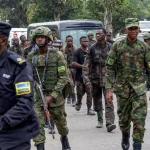
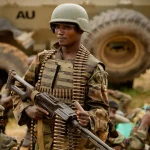
The provinces where Lumbala’s forces once operated remain among the most dangerous places on Earth. Armed groups number in the dozens, many fighting over control of the region’s vast mineral wealth – coltan, gold, diamonds – that fuels global electronics and jewellery industries. The M23 rebel group, backed by Rwanda according to UN experts, has gained significant territory in recent years, displacing hundreds of thousands and sparking fears of a broader regional conflict.
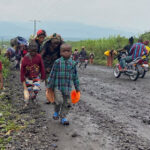
The quest for lasting peace in the DRC faces formidable obstacles. Weak governance, endemic corruption, and the failure of successive peace agreements have created a vacuum filled by armed factions. International peacekeeping missions have proven inadequate, and regional diplomatic efforts have repeatedly collapsed. Meanwhile, the civilian population pays the price: mass displacement, widespread sexual violence, child soldier recruitment, and chronic instability that makes development nearly impossible.
For survivors like Sirikivuya, Lumbala’s conviction offers something precious but incomplete: acknowledgement of their suffering and a measure of accountability. But they return to a homeland where the machinery of violence grinds on, where new warlords have replaced old ones, and where justice for ongoing atrocities remains a distant dream.
A Message for Today’s Perpetrators
The significance of Monday’s verdict extends beyond one man’s punishment. It sends a signal to current and future warlords that impunity may not last forever, that borders cannot always shield them from justice, that victims’ testimonies matter and will be heard.
Whether that message can penetrate the logic of violence that still grips eastern Congo remains uncertain. The path from court verdicts in European capitals to peace in Congolese villages is long and treacherous, requiring political will, sustained international engagement, and fundamental reforms within the DRC itself.
But for Pisco Paluku Sirikivuya, standing outside the Paris courthouse on a cold December day, the verdict represented something that had seemed impossible two decades ago when armed men destroyed his world: the possibility that truth could triumph over terror, that survivors could reclaim their dignity, that history would remember not just the perpetrators but also their victims.
“We have waited so long,” he said. His words carried the weight of countless others who still wait – or justice, for peace, for a future where such horrors belong only to history.