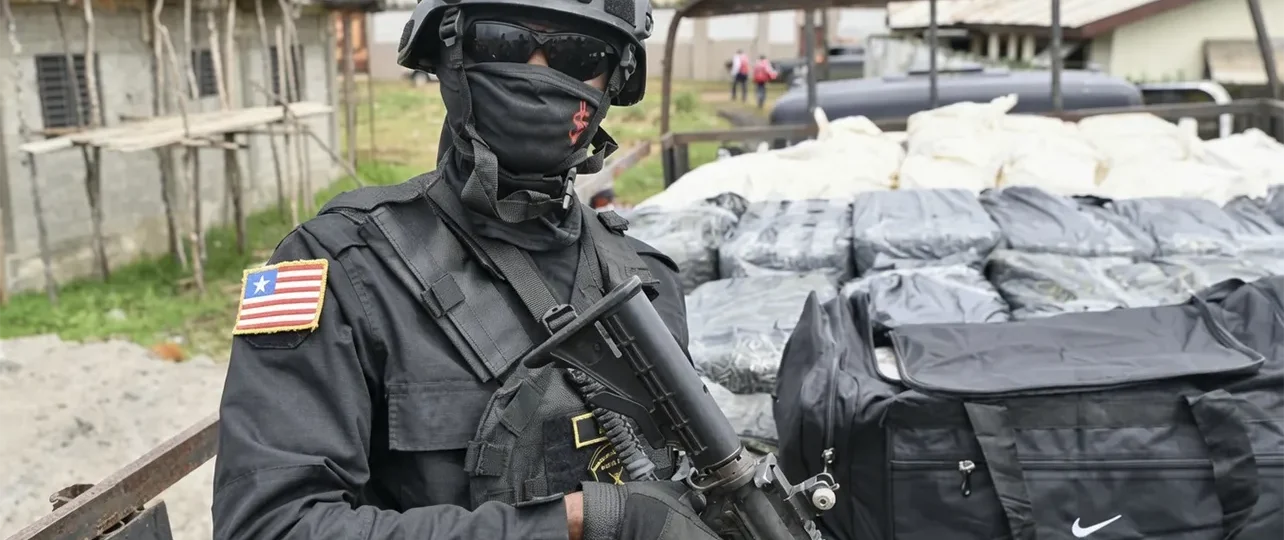

TWICE in the space of two weeks, Liberian security forces have pulled apart what officials now concede is one of the largest narcotics operations ever uncovered on the West African coast. On 21 July, a joint task force raided a nondescript property in Duazon, Margibi County, and hauled out 3,971 kilograms of cocaine, valued by the Justice Ministry at $317.7 million and by police at closer to $370 million on the street. It followed a June seizure of 237.6 kilograms at Roberts International Airport, cocaine disguised as ordinary commercial cargo and believed bound for Europe, which led to charges against five men and a logistics company. Two foreign nationals, holding Colombian and Spanish passports, were arrested at the Duazon warehouse alongside several Liberians. Liberia’s Justice Minister, Oswald Tweh, has since told the nation that the network behind the haul is “organised, sophisticated, complex, and well-funded” and may have operated inside the country for years.
The Liberian busts have not occurred in isolation. In the same window, Nigeria’s National Drug Law Enforcement Agency (NDLEA) has dismantled two industrial-scale methamphetamine laboratories run by Nigerian-Mexican syndicates in Ogun and Oyo states – the Ogun facility alone yielding product and precursor chemicals valued at roughly ₦480 billion — intercepted a 67-year-old Nigerian-British grandmother carrying 13 kilograms of cocaine moulded into fake plantains at Lagos’s Murtala Muhammed Airport, and frozen almost ₦10 billion in the accounts of a fugitive drug kingpin. In Botswana, six Mexican nationals were arrested in November 2025 after allegedly slipping into the country through an ungazetted border post from South Africa, a case now cited by regional security analysts as evidence that cartel operatives are treating the Southern African hinterland as a single operating theatre. And in South Africa itself, the Border Management Authority intercepted a truck at Beitbridge in May carrying methaqualone worth almost R1 billion, months after police in Mpumalanga, Limpopo and Gauteng broke up a string of Mexican-run crystal-meth super-labs worth a combined R2.45 billion.
A PATTERN, NOT A COINCIDENCE
Taken individually, each bust reads as a law-enforcement success story – and, on its own terms, each is. Taken together, they trace the outline of something larger: a structural redirection of the global cocaine trade through African territory, and a parallel, more troubling development in which the manufacture of synthetic drugs is being relocated onto African soil rather than merely trafficked across it.
The data underpinning this shift is now well established. Research compiled by the Global Initiative Against Transnational Organized Crime (GI-TOC) through its West Africa Observatory found that cocaine trafficking was the fastest-growing criminal market in the region between 2019 and 2025, and that at least a third of the cocaine reaching European consumers now transits West Africa — a share GI-TOC analysts believe could rise to half by 2030. The same research identifies Montenegro’s Kavač and Škaljari clans as having built durable partnerships with Latin American producers, chiefly Brazil’s Primeiro Comando da Capital, using West African ports as a warehousing and redistribution platform beyond the reach of tightening European and direct-route enforcement.
“Between 2018 and 2023, apparently there was a resurgence of major trafficking and transit activities in Liberia. Over the last one-and-a-half years, we’ve been surveilling them.”
Gregory Coleman, Inspector General, Liberia National Police
WHY WEST AFRICA, WHY NOW
The logic drawing traffickers toward Africa is neither mysterious nor new, but it has accelerated sharply. Record coca cultivation and cocaine production across Latin America have created a supply glut producers must move somewhere. European demand has climbed steadily. And as European navies and coast guards have tightened surveillance of the traditional Caribbean and direct mid-Atlantic routes, criminal logistics chains have simply lengthened, routing product through West African ports where containerisation capacity has expanded, oversight remains thin, and corrupt officials can be bought at a fraction of the cost of running the gauntlet into Rotterdam or Antwerp directly.
That is the coastal story. Inland and southward, a second and distinct pattern is emerging: production, not merely transit. Nigerian authorities describe Nigerian-Mexican partnerships in which foreign chemists are flown in to operate meth laboratories on Nigerian soil, turning the country from a pass-through corridor into a manufacturing base. In South Africa, retired Interpol ambassador and security strategist Andy Mashaile has pointed to the same shift, arguing that cartels are increasingly smuggling raw precursor chemicals into the country and manufacturing finished narcotics in remote, lightly policed rural areas rather than importing the finished product — a strategy that trims the risk of interdiction at any single border crossing while embedding criminal infrastructure permanently inside African economies.
SOUTH AFRICA’S WIDENING FRONT
The South African caseload over the past two years reads like a slow-motion escalation. In July 2024, the Hawks broke up a R2 billion crystal-meth laboratory on a remote farm near Groblersdal in Limpopo, arresting three Mexican nationals. In November 2024, an undocumented Mexican national was arrested running a R100 million laboratory in Rietfontein, Pretoria. In September 2025, five Mexicans and one South African were arrested at a R350 million laboratory in Volksrust, Mpumalanga. This May, the Border Management Authority’s intelligence-driven interception at Beitbridge recovered 713 kilograms of methaqualone – the active ingredient in mandrax – worth just under R1 billion, hidden in a false compartment of a truck routed through Zimbabwe; three Malawian nationals were arrested. Weeks earlier, customs officers found cocaine bricks worth more than R13 million concealed in an imported bus at Durban Harbour, shipped directly from a South American port.
South Africa’s own accountability institutions are, meanwhile, wrestling with the domestic corruption this trade generates. The Madlanga Commission of Inquiry has spent recent sessions probing the so-called Aeroton cocaine bust, worth an estimated R300 million, with a self-described police informer, Tumelo Nku, facing allegations — which he denies — that intercepted phone messages tie him to trafficking rather than to legitimate intelligence work. The proceedings have already implicated senior figures in the police’s crime intelligence structures, underscoring a point GI-TOC researchers make repeatedly: it is corruption, not violence, that is the primary enabler of narcotics trafficking on this continent.
“The interconnected nature of these networks enables them to adapt quickly, smuggling illicit goods and people across borders.”
Organised Crime Index, Botswana Country Profile, 2025
Botswana’s role in this picture is subtler but no less instructive. When six Mexican nationals were arraigned in Gaborone in December 2025 on charges of entering the country through an ungazetted point of entry – alongside a Nigerian national charged with helping them cross – the case drew attention less for its scale than for its geography. The men are alleged to have been living illegally just across South Africa’s border since mid-November, a detail South African security analysts have read as confirmation that cartel operatives now treat Southern Africa’s porous, thinly policed frontiers – the Trans-Kalahari Corridor chief among them – as a single logistical space rather than a set of separate national jurisdictions. Botswana’s own organised-crime profile notes that its synthetic-drug market, while still small, is showing clear signs of growth, with methamphetamine supply routes extending from Johannesburg and Cape Town through the Pioneer Gate border post into Gaborone.
IS THIS TARGETING, OR OPPORTUNISM?
The question this masthead set out to answer — whether Africa is being deliberately targeted by cartels headquartered thousands of kilometres away — deserves a precise answer rather than a sensational one. The evidence assembled by GI-TOC, national law-enforcement agencies and regional analysts does not describe a single command structure choosing Africa as a battlefield. It describes something arguably more dangerous: a rational, decentralised, market-driven migration of criminal capital toward the continent’s weakest points of friction. Latin American production cartels, Balkan logistics networks and homegrown Nigerian, South African and West African intermediaries are converging on Africa for the same reasons investors converge on any underpriced market – cheap entry, thin regulation, corruptible officials, and geography that happens to sit conveniently between the coca fields of the Andes and the consumer markets of Europe.
That distinction matters for policy. A continent under deliberate cartel siege might look to fortified borders and military solutions. A continent whose institutional and governance gaps are being systematically exploited needs something different: the sustained, resourced, corruption-resistant law-enforcement cooperation that Liberia’s Justice Ministry, Nigeria’s NDLEA and South Africa’s Border Management Authority have each, in their own recent successes, shown is possible when intelligence-led policing is allowed to function without political interference.
The record hauls in Monrovia, the dismantled meth kitchens in Ogun and Oyo, the Mexican nationals moving through Gaborone, and the billion-rand interceptions on South Africa’s northern border are not disconnected news items. They are data points in a single continental story: Africa has become indispensable to the architecture of global narcotics trafficking — not as a victim chosen by design, but as a frontier discovered by criminal enterprise and now being colonised with the same patience, capital and corrupting reach that built the trade in Latin America and the Balkans in the first place. Whether the continent’s states can out-organise that capital — through clean institutions, cross-border intelligence-sharing and courts insulated from the very money the traffickers are offering — will determine whether Africa remains a transit point or becomes, as some of its own police chiefs now fear, a permanent production floor.