IN the hushed courtroom of Justice Rahman Oshodi’s Special Offences Court, a dramatic reversal unfolded that speaks volumes about the challenges facing Nigeria’s fight against elite corruption. What began as explosive allegations of prosecutorial misconduct by the Economic and Financial Crimes Commission (EFCC) ended with those very claims crumbling under the weight of cross-examination.
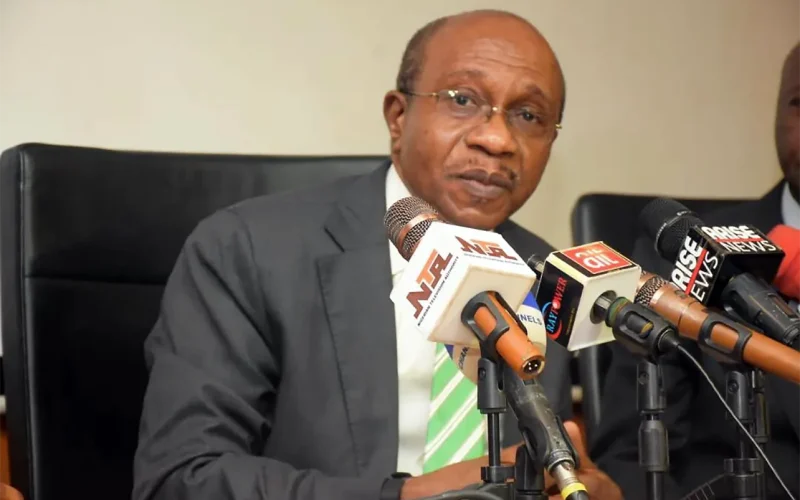
At the centre of this legal storm sits Godwin Emefiele, the former Governor of Nigeria’s Central Bank, facing 19 counts of receiving gratification and making corrupt demands during his tenure overseeing Africa’s largest economy. The charges relate to a staggering $4.5 billion in alleged fraud – a sum that dwarfs the annual budgets of several Nigerian states and represents roughly 1% of the nation’s GDP.
The Allegation That Wasn’t
The case took a remarkable turn when Nnmadi Offia, counsel to co-defendant Henry Omoile, made serious accusations against EFCC investigators. He claimed they had offered his client bail and immunity from prosecution in exchange for incriminating evidence against Emefiele. Such allegations, if true, would have struck at the heart of the investigation’s integrity and potentially imperilled the entire prosecution.
Offia painted a picture of coercive interrogation tactics: investigators allegedly restricting his client’s responses, conducting questioning behind the lawyer’s back, and an EFCC officer named David physically removing him from the premises. He described a 21-day detention period and claimed his client was only allowed to write down answers that “conformed to what the interrogators wanted him to say.”
These are not trivial accusations. They invoke the spectre of prosecutorial overreach that has long plagued anti-corruption efforts in Nigeria, where the line between zealous investigation and rights violations has sometimes blurred.
The Unraveling
But under cross-examination by senior prosecution counsel Rotimi Oyedepo, the narrative collapsed with striking swiftness.
Offia admitted he had never filed a formal complaint or petition about the alleged misconduct. He acknowledged that his client was properly cautioned in his presence and that he, as counsel, signed off on the process. Most tellingly, he conceded that Justice Muslims Hamza, who heard Omoile’s fundamental rights enforcement case at the Federal High Court, found no evidence of EFCC misconduct. The lawyer confirmed that his client “was never harassed in his presence.”
These admissions, extracted methodically during cross-examination, paint a very different picture from the initial allegations. They suggest either a defence strategy gone awry or a lawyer caught between zealous advocacy and factual accuracy.
The Trial-Within-a-Trial
This courtroom drama unfolded during what lawyers call a trial-within-trial—a mini-proceeding to determine whether Omoile’s statements to investigators were made voluntarily or under duress. Such proceedings are critical safeguards in criminal law, ensuring that confessions or statements aren’t the product of coercion.
The EFCC’s position, articulated through operative Alvan Gurumnaan in December 2024, has been consistent: Omoile was not compelled to make statements. The agency’s case relies partly on Omoile’s alleged role as an intermediary who received cash dollars from various individuals on Emefiele’s orders—a claim made by prosecution witnesses describing a pattern of routine transactions.
The Larger Stakes
Beyond the courtroom theatrics lies a case with profound implications for Nigeria’s economic credibility and governance. Emefiele helmed the Central Bank during a tumultuous period marked by controversial currency redesign policies, foreign exchange management decisions that devastated businesses, and a naira that plummeted against major currencies.
The $4.5 billion at the centre of these charges represents more than just numbers on an indictment sheet. It symbolises the scale of alleged malfeasance at the apex of Nigeria’s financial system—misconduct that, if proven, would have rippled through every sector of an economy already struggling with inflation, unemployment, and investor confidence.
For President Bola Tinubu’s administration, which has made anti-corruption a rhetorical centrepiece of its agenda, the Emefiele prosecution serves as a test case. Will Nigeria’s institutions demonstrate the capacity to hold even the most powerful accountable, or will this trial dissolve into the familiar pattern of protracted proceedings that fade from public memory without resolution?
Questions of Process and Justice
The contradictions in Offia’s testimony raise uncomfortable questions. If EFCC investigators truly engaged in the misconduct alleged, why would experienced legal counsel fail to document it through formal complaints? Why would a judge hearing fundamental rights claims find no evidence of harassment?
Conversely, the EFCC’s handling of high-profile defendants has historically invited scrutiny. The agency operates in an environment where allegations of selective prosecution and political weaponisation of anti-corruption machinery are commonplace. Even when following proper procedures, the perception of impropriety can be as damaging as actual misconduct.
What emerged clearly from Thursday’s proceedings is that serious allegations require serious evidence. In a legal system where due process protections remain fragile and public trust in institutions wavers, unsubstantiated claims of prosecutorial abuse serve neither justice nor accountability.
The Road Ahead
As Justice Oshodi adjourned proceedings until January 16 for continuation of the trial-within-trial, the immediate question is whether Omoile’s statements will be admitted as evidence. If deemed voluntary, they could prove crucial to the prosecution’s case against Emefiele. If excluded, the EFCC must rely more heavily on other evidence and witness testimony.
But the larger question transcends this individual case: Can Nigeria’s anti-corruption infrastructure deliver justice at the highest levels? The Emefiele trial will ultimately be judged not just on its outcome, but on whether it demonstrates that the country’s institutions can investigate, prosecute, and adjudicate cases of elite corruption with both vigour and fairness.
For now, what remains clear is that in Nigeria’s courts, as elsewhere, allegations must withstand the crucible of cross-examination. On Thursday, one lawyer’s dramatic accusations met that test and were found wanting. Whether the underlying case against Emefiele will fare better remains to be seen—but the integrity of that process just became marginally more credible.
The proceedings continue, with a nation watching to see if this time, accountability might actually mean something.