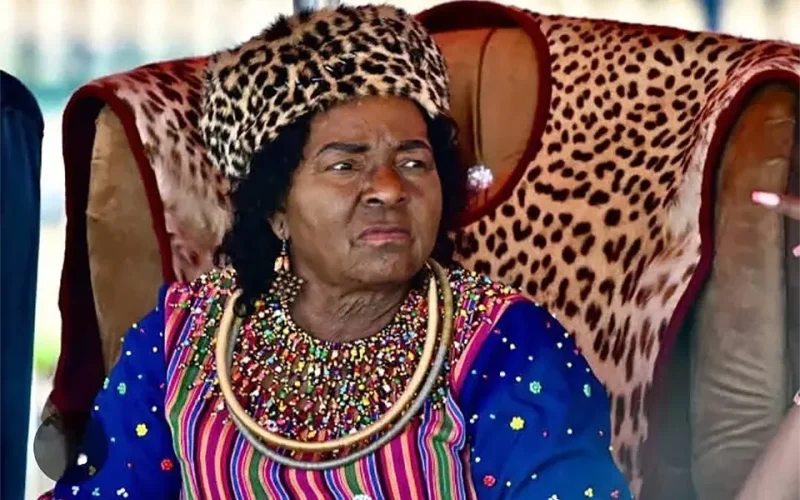
| “It’s not for girls, it’s for boys.” These were the words young Tinyiko heard throughout her childhood. But she would spend her life proving them wrong. |
SOUTH Africa mourns the loss of a true giant among women, a trailblazer who shattered centuries-old traditions and rewrote the narrative of African leadership. Her Royal Highness Hosi Phylia Tinyiko Lwandlamuni Nwamitwa II did not merely break through the glass ceiling—she demolished it with the force of her conviction, the power of her intellect, and the unwavering courage of her spirit.
At 85 years of age, Hosi Nwamitwa leaves behind a legacy that will echo through the corridors of history for generations to come. She was not born into an era that welcomed female leadership—she created one. She did not wait for permission to claim her birthright—she fought for it in the highest court of the land. And she did not simply lead her people—she transformed them, uplifted them, and showed them what true servant leadership looks like.
A Princess Denied Her Crown
Born the only child of Hosi Fofoza Nwamitwa and his principal wife, Nkosikazi Favazi Nwamanave, young Tinyiko was a princess in every sense of the word. She grew up in the village of Nwamitwa near Tzaneen, in the verdant hills of Limpopo, where the traditions of the Valoyi people ran deep. But in 1968, when her beloved father died without a male heir, the unthinkable happened—she was passed over.
The throne that was rightfully hers by blood went instead to her uncle, Richard Nwamitwa, who served as regent. Why? Simply because she was a woman. Ancient customary law, steeped in male primogeniture, had no place for a female heir, no matter how qualified, no matter how royal her lineage. For 33 years, Tinyiko watched as the throne that should have been hers remained in the hands of her uncle’s family.
But Tinyiko was not one to accept injustice quietly. Even as a child, she had defied the limitations placed on her gender. When told that riding calves was “not for girls,” she climbed on anyway—an act of rebellion that left her with a slipped disc but also with an unbreakable spirit. That same spirit would carry her through decades of waiting, learning, and preparing for the moment when justice would finally prevail.
The Long Walk to Justice
When Hosi Richard died in 2001, the royal family of the Valoyi faced a moment of reckoning. South Africa had been transformed by the 1994 Constitution, which enshrined gender equality as a fundamental right. The Valoyi traditional authorities, including Hosi Richard himself before his death, had come to recognise the injustice that had been done to Tinyiko. In a unanimous resolution in December 1996, the royal family decided to restore the chieftainship to Hosi Fofoza’s bloodline and recognise Tinyiko as the rightful heir.
But not everyone was ready for change. Her cousin, Sidwell Nwamitwa—the eldest son of Hosi Richard—took her to court in September 2002, arguing that the royal authorities had no right to alter the traditions of the Valoyi people. He claimed that crowning a woman would bring “chaos and confusion” to the community. The case wound its way through the Pretoria High Court and the Supreme Court of Appeal, both of which ruled against her.
Lesser spirits would have given up. But not Tinyiko. With the backing of her people, who travelled in buses from Limpopo to support her at every hearing, she took her case to the Constitutional Court of South Africa—the highest court in the land.
A Historic Victory: Shilubana v. Nwamitwa
On June 4, 2008, the Constitutional Court delivered a verdict that would change South African history. In the landmark case of Shilubana and Others v. Nwamitwa (Case CCT 3/07), the court ruled in favour of Hosi Nwamitwa, declaring that the 1994 Constitution guaranteed her dignity and status as a citizen of no less value than any male citizen.
The court’s reasoning was revolutionary. It recognised that customary law was not static but dynamic, capable of evolving to reflect constitutional values. It affirmed that traditional authorities had the power to develop their own customs in accordance with the principle of gender equality. And it declared that Tinyiko’s exclusion from the chieftainship in 1968 had been an act of gender discrimination that needed to be remedied.
Legal scholars hailed the decision as “extremely revolutionary” and “transformational.” Women’s rights activists celebrated it as a victory over patriarchal traditions. Constitutional law experts called it a “huge, huge development.” The case became required reading for law students across the nation, a testament to its enduring significance.
“A Hosi Is Truly Born”
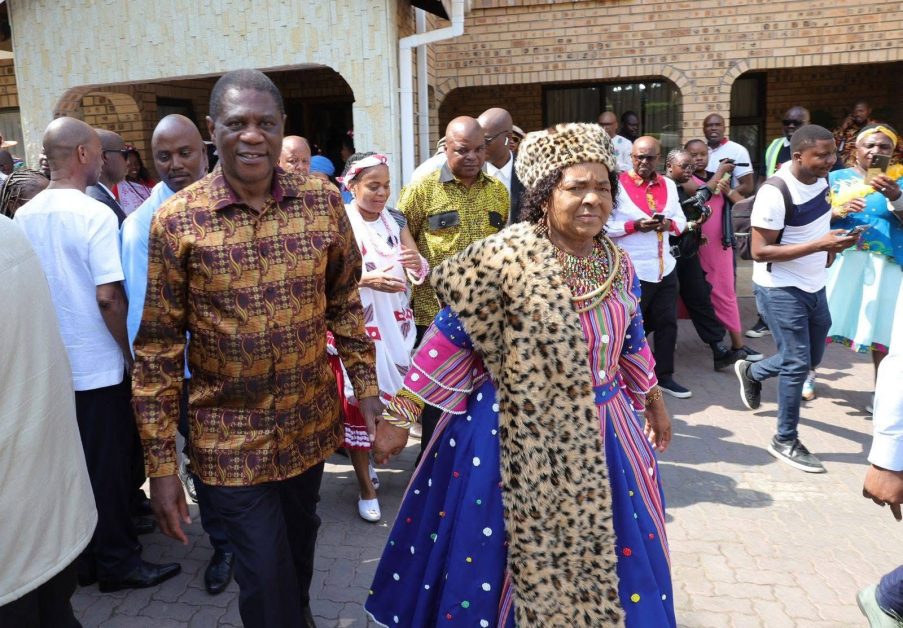
On September 4, 2008—fittingly at the end of Women’s Month—Hosi Phylia Tinyiko Nwamitwa II was finally installed as the first female traditional ruler of the Vatsonga people and the first woman in South African history to be appointed as Hosi. The ceremony drew scores of villagers, dancers, and dignitaries from across the nation. The pot-holed dusty roads leading to her kraal were freshly tarred. The village buzzed with celebration.
She took her seat wearing a masterfully beaded black and red suit and orange slip-ons made from plastic shopping bags—the work of village women in a job creation project she had established. Everything she wore was “100% locally designed and made,” she said with pride. Her shoes spoke volumes about her philosophy: a leader who walked among her people, who understood their struggles, who worked tirelessly to create opportunities for them.
As Hosi of the Valoyi—a community of approximately 500,000 people—she presided over 32 indunas and countless subjects who looked to her for guidance, justice, and vision. And she delivered, with a mother’s instinct and a leader’s determination.
A Life Devoted to Service and Empowerment
Long before she became Hosi, Tinyiko Nwamitwa had dedicated her life to education and public service. Her forward-thinking father, Hosi Fofoza, had defied Tsonga and Shangaan custom by enrolling his daughter in a missionary school in another district at a time when girls were rarely educated. “Take this girl and give her an education,” he told Father Schneider, “and treat her like everyone else.”
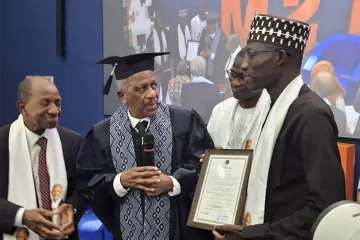
She seized that opportunity with both hands. After completing her secondary education in 1959, she enrolled at Lemana Training College to become a teacher. While working as an educator, she earned a Bachelor of Arts degree in Anthropology from the University of South Africa. Her commitment to learning and excellence earned her an honorary doctorate in Law from the same institution—a recognition of her groundbreaking legal victory and her contributions to constitutional jurisprudence.
From 1989 to 1994, she served as an Inspector of Education, ensuring quality teaching across her region. In 1994, as South Africa transitioned to democracy, she was elected as a Member of Parliament for the African National Congress—one of the historic members who were sworn in on May 9, 1994, and had the profound honour of electing Nelson Mandela as the first president of a united, non-racial, non-sexist, democratic South Africa.
For 15 years, from 1994 to 2009, she served in Parliament with distinction, sitting on the Portfolio Committees on Arts and Culture, Public Works, and Provincial and Local Government. Colleagues remembered her outstanding leadership and the visible mark she made wherever she served. Even while in Parliament, she never forgot her community, continuing to play a leading role in the development and affairs of the Valoyi people.
A Vision for Development and Dignity
As Hosi, she transformed the Nwamitwa village from a rural outpost into a beacon of development. Under her leadership, the Administrative Centre, the Cultural Village, and the Guest Lodge were established. Roads were paved. Electricity reached homes that once relied on candlelight. Water, once delivered by truck once a week, became more accessible through a new dam project she championed.
She prioritised the development of her rural area, where joblessness and HIV/AIDS rates were high. She created job training programs and life-skills initiatives specifically for women, empowering them to believe they were as capable of leadership as men. She worked tirelessly through non-governmental organisations dedicated to women’s empowerment.
“Women, generally, they take these issues very seriously,” she once said. “You have that mother’s instinct.” That instinct guided every decision she made, every partnership she forged, every project she championed.
A Leader Studied, Celebrated, and Honoured
Hosi Nwamitwa’s impact extended far beyond the borders of Valoyi territory. She served as Deputy Chair of Huvu ya Valoyinkulu, Chairperson of the Mopani House of Traditional Leaders, and an executive member of the Limpopo House of Traditional Leaders. Her exemplary leadership in forging partnerships between traditional authorities and government at all levels demonstrated how traditional leadership could bring services and development to communities.
Her leadership became a subject of academic study. The University of Ghana included her in a major research project titled “Women and Political Participation in Africa: A Comparative Study of Representations and Roles of Female Chiefs,” funded by the Andrew W. Mellon Foundation. Scholars studied how her leadership influenced women’s rights and wellbeing, not just in South Africa but across the African continent.
Dr. Reuel Khoza, an esteemed thought leader, described her accomplishments perfectly: “Your valour in demolishing discrimination in African royalty is legendary.” And indeed, it was. Her courage had opened doors that had been locked for centuries.
Nwamitwa Day: A Living Legacy
Each year, Nwamitwa Day brought together thousands of people from across South Africa to celebrate her coronation and honour her contributions to the nation. Deputy Ministers, Members of Parliament, traditional leaders, business people, and ordinary citizens gathered at the Valoyi Vatsonga Cultural Village to pay tribute to her vision. The celebration, held at the end of Women’s Month and the beginning of Heritage Month, embodied everything she stood for: unity, cultural pride, gender equality, and development.
A Devoted Mother and Grandmother
Beyond her public achievements, Hosi Nwamitwa was a devoted mother and grandmother. She was married to Thompson Shilubane, a member of the Nkuna/Shilubane royal family, until his death in 1979. Together, they raised four children. She delighted in her role as grandmother to ten grandchildren, though she often joked that the slipped disc from her childhood calf-riding adventure prevented her from carrying her daughters on her back as mothers traditionally did.
A Precedent Set, A Path Illuminated
The significance of Hosi Nwamitwa’s victory cannot be overstated. Before her, no woman had ever been appointed as Hosi in South Africa. Ancient African cultural practices that violated the rights of women heirs to traditional thrones went unchallenged. But she challenged them—and she won.
The Constitutional Court’s ruling in her favour set a precedent that will echo through generations. It established that customary law must evolve to align with constitutional values. It affirmed that traditional communities have the authority to develop their own customs to promote gender equality. It declared that women are no less worthy of leadership than men.
Because of her courage, countless daughters of traditional leaders now have a path to claim their rightful inheritance. Because of her sacrifice, communities across South Africa can embrace female leadership without fear of violating tradition. Because of her vision, the institution of traditional leadership has been strengthened, not weakened, by its embrace of gender equality.
“Hosi i hosi hi vanu. Vanu vukosi.”
“A chief is a chief through the people. The people are royalty.”
This Tsonga proverb guided every decision Hosi Nwamitwa made. She never forgot that her authority came from the people she served. She never lost sight of their needs, their dreams, their potential. She led with humility, served with dedication, and transformed with vision.
As we bid farewell to this remarkable woman—this pioneering leader, this fearless advocate, this loving mother and grandmother—we do not mourn in despair. We celebrate a life lived with purpose. We honour a legacy that will never die. We draw strength from her example.
To the young girls growing up in the villages of Limpopo and across South Africa, Hosi Nwamitwa’s message is clear: You are not limited by your gender. You are not bound by outdated traditions. You are as capable of leadership, as worthy of respect, as deserving of opportunity as anyone else. Claim your birthright. Fight for your rights. Transform your world.
| May her soul rest in eternal peace. May her legacy inspire generations yet unborn. May her courage light the path for all who follow. |
Hamba kahle, Hosi Nwamitwa.
Go well, great leader.
Your work is done. Your legacy endures forever.
HISTORIC ACHIEVEMENTS ✦ First female traditional ruler (Hosi) in South African history ✦ First female traditional ruler of the Vatsonga people ✦ Won landmark Constitutional Court case (Shilubana v. Nwamitwa, 2008) establishing gender equality in traditional leadership ✦ Member of Parliament (1994-2009), present at the election of President Nelson Mandela ✦ Honorary Doctor of Law from the University of South Africa ✦ Chairperson of Mopani House of Traditional Leaders ✦ Leader of approximately 500,000 Valoyi people with 32 indunas under her authority |