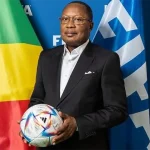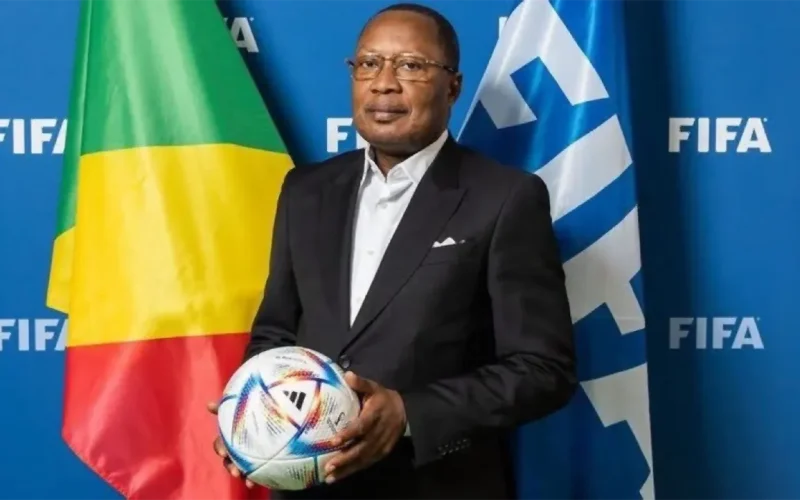
A Brazzaville court delivered one of the most severe judicial verdicts ever handed down against an African football official on Tuesday, sentencing the president of the Congolese Football Federation (FECOFOOT), Jean-Guy Blaise Mayolas, to life imprisonment following his conviction on charges of money laundering, embezzlement and forgery. The ruling, which also ensnared Mayolas’s wife and son – both sentenced to life – as well as two senior federation officials, handed five-year terms, brings to a judicial close a scandal that has convulsed football governance in the Republic of the Congo for nearly two years.
Prosecutors built their case around the alleged misappropriation of approximately $1.3 million in FIFA development funds that passed through FECOFOOT between 2018 and 2025 – money intended to grow the game at the grassroots, fund the women’s national programme and construct a national training centre. Instead, the court found, those funds were systematically siphoned through falsified financial records, with investigators tracing transactions through a network of shell companies registered in Congo.
Mayolas was tried in absentia, having failed to appear before the tribunal – a detail that underscores the contested and chaotic circumstances that have surrounded his tenure. The federation’s general secretary, Badji Mombo Wantete, and treasurer Raoul Kanda, both arrested in late February, received five-year custodial sentences after being found guilty of their roles in the financial irregularities.
“Prosecutors described a deeply entrenched system of fraudulent financial management — the funds were not misallocated by accident; they were stolen by design.”
A DECADE OF RED FLAGS
Tuesday’s verdict is not the first time Mayolas has faced FIFA’s disciplinary machinery. In 2015, both he and Wantete were handed six-month bans by FIFA’s independent ethics committee for accepting improper gifts at the FIFA Congress – violations of the code of conduct governing the conduct of football officials. Mayolas was then vice-president of FECOFOOT. He ascended to the presidency in 2018, running unopposed, and the red flags multiplied from there.
Investigators and women’s club presidents have described how $500,000 in FIFA funds earmarked specifically for the women’s national team programme – part of the global distribution during the COVID-19 pandemic in 2021 – largely vanished. According to a formal declaration submitted by the presidents of every women’s top-flight club in the country, only $20,000 of that allocation ever reached them. The remainder remains unaccounted for.
A further $800,000 allocated by FIFA for the construction and development of a national training facility in Ignié has equally gone to waste. Eight years after the project commenced, the site is reported to be incomplete and largely abandoned – a rusting monument to the alleged plunder of funds meant to build Congo football’s infrastructure.
“Eight years after the project began, the training facility in Ignié remains a ruin — a monument to the alleged plunder of funds meant to build Congo football’s future.”
FIFA INTERVENTION AND WORLD CUP FALLOUT
The scandal dragged Congo’s national football programme into international disrepute well before Tuesday’s conviction. When the Congolese Ministry of Sports moved against Mayolas in February 2025, suspending him pending fraud investigations, FIFA responded by imposing a ban on FECOFOOT for what it termed “third-party interference” in federation affairs. The ban had immediate and catastrophic consequences: Congo forfeited two crucial 2026 FIFA World Cup qualification matches against Tanzania and Zambia, with both opponents awarded 3-0 victories. The forfeitures effectively ended Congo’s hopes of reaching the World Cup in North America.
The ban was lifted in May 2025 after the Congolese government restored operational control of FECOFOOT’s headquarters to the federation — a bitter compromise that allowed Mayolas to temporarily resume his position even as criminal proceedings gathered pace. He was arrested by Congo’s Central Intelligence and Documentation Office (CID) in late May 2025, having been prevented from travelling to FIFA’s Congress in Paraguay.
FIFA’s own ethics committee is understood to have visited Brazzaville in March 2025 to examine the allegations of embezzlement, though a formal international investigation has not yet been publicly announced. With Tuesday’s domestic conviction now on record, pressure on FIFA to act at the institutional level will intensify.
GOVERNANCE COLLAPSE AT FECOFOOT
Beyond the financial crimes, the Mayolas era has been marked by a near-total collapse of organised football in the Republic of the Congo. The national league has been paralysed for close to two years; stadiums remain closed by ministerial decree. Players, clubs and supporters have been left in limbo while their administrators fought legal and institutional battles in the courts and at the Court of Arbitration for Sport (CAS).
In November 2025, the CAS ordered the dissolved ad hoc commission — which had attempted to remove Mayolas and restructure the federation — to pay 25 million CFA francs in damages to FECOFOOT, ruling that a September 2024 general assembly that had voted to oust the executive committee had been held in violation of FIFA statutes. The ruling briefly restored Mayolas’s institutional standing, even as criminal charges mounted against him.
Mayolas’s own public statements during the crisis revealed an official curiously detached from the sport he administered. In widely circulated remarks that drew sharp public rebuke, he dismissed football as a secondary concern: telling an audience that the sport “remains a game” and that people “shouldn’t be passionate about a game.” The comments, made even as Congolese football imploded around him, encapsulated for many critics an administration that never treated football governance as a serious public trust.
IMPLICATIONS FOR AFRICAN FOOTBALL GOVERNANCE
The Mayolas verdict arrives at a defining moment for football governance on the continent. With the 2030 Africa Cup of Nations and the expanded 2026 World Cup cycle now underway, the systemic vulnerabilities exposed in Brazzaville — FIFA funds disbursed with inadequate oversight; national bodies captured by officials who treat public resources as personal wealth; disciplinary mechanisms too slow to stop harm before it compounds — speak to structural failings that go beyond one federation.
FIFA has, in recent years, tightened its financial compliance requirements for member associations through the Forward Programme and enhanced audit mechanisms. But the Congo case raises uncomfortable questions about whether those safeguards are sufficient when they confront officials with the determination and the connections to circumvent them — and whether FIFA’s overriding concern with preventing “government interference” sometimes shields precisely the officials who most need to be held to account.
For the women’s clubs that went on record to report that their funds had been stolen, for the players whose league shut down, and for the national team stripped of its World Cup dream, the life sentence handed down in Brazzaville is at once a form of institutional justice and an indictment of how long it took to arrive.
KEY FACTS
Convicted: Jean-Guy Blaise Mayolas (FECOFOOT President), his wife and son — all sentenced to life imprisonment
Also convicted: General Secretary Badji Mombo Wantete and Treasurer Raoul Kanda — five years each
Charges: Money laundering, embezzlement, forgery
Funds at issue: Approximately $1.3 million in FIFA development disbursements, including $500,000 for the women’s programme and $800,000 for the Ignié training centre
Investigation duration: Eight months of formal judicial proceedings
Collateral damage: Congo forfeited two 2026 World Cup qualifiers; the national league shut down for nearly two years; the national training centre remains unfinished