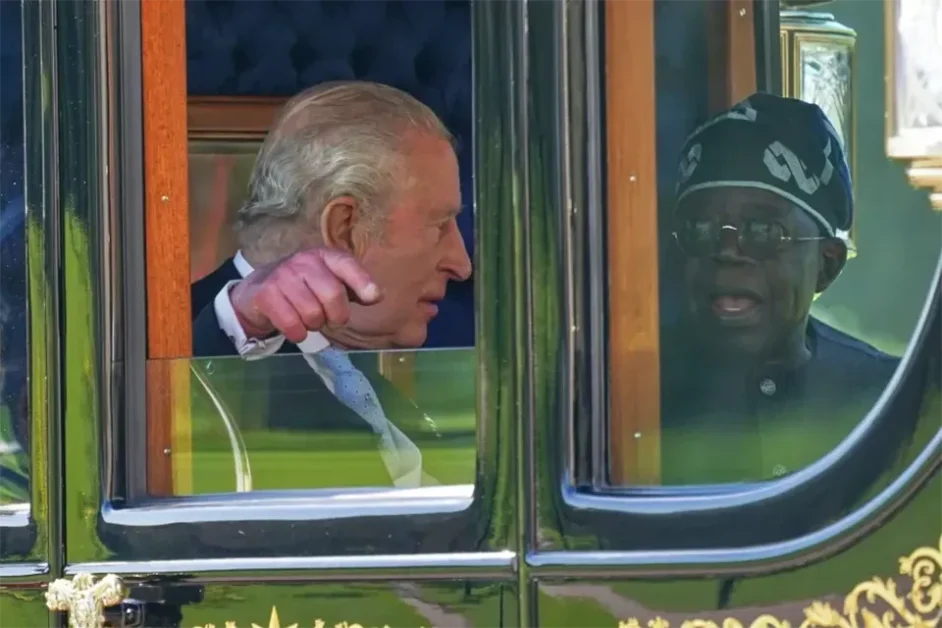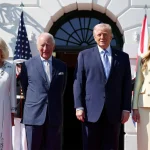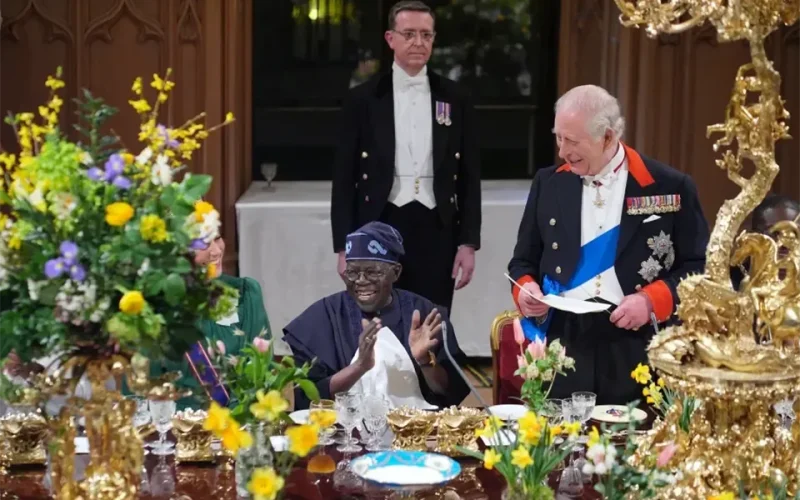
WINDSOR Castle has hosted Emperors, Prime Ministers, and heads of state whose entries into its storied Great Hall have barely raised an eyebrow among the stonework. But on the evening of Wednesday, 18 March 2026, the ancient fortress did something it is not accustomed to doing: it blushed. For the first time in nearly a millennium of royal hospitality, its walls heard a reigning British monarch open a State Banquet in Yoruba.
“Ekabo. Se Daaa Daa Ni,” King Charles III declared, with what palace insiders describe as an admirably straight face, as he welcomed Nigerian President Bola Ahmed Tinubu and First Lady Oluremi Tinubu to the grandest table in the Commonwealth. The room — full of diplomats, lords, captains of industry, and Nigerian-Britons draped in aso-oke that outshone every chandelier — erupted in delighted applause. Yoruba, one of the great linguistic jewels of the African continent, had just been spoken at a State Banquet at Windsor. The ancestors, one imagines, nodded approvingly.
It was the first State Visit by a Nigerian president in thirty years — a gap that felt even longer given the seismic economic, cultural, and geopolitical shifts of those three decades. President Tinubu arrived not as a supplicant seeking an audience, but as the leader of Africa’s most populous nation, the continent’s largest economy, and a country that, as the King himself put it, has not merely changed — it has arrived.
“Nigeria hasn’t merely changed. It has arrived.”
King Charles III
THE POMP, THE PROTOCOL, AND THE NIGERIAN TWIST
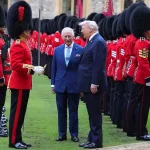
Those who know the Windsor choreography will tell you there is no institution on Earth more precise in its rituals. Every gesture, every timing, every placement of cutlery is the product of centuries of obsessive institutional memory. The King’s Procession. The Household Cavalry. The fanfare. The dazzling array of royal portraits watches from the walls as courses are served with white-gloved exactitude.
But Nigeria, as always, introduced its own programme notes.
President Tinubu, observing the holy month of Ramadan, arrived at a Windsor that had quietly, respectfully, reorganised itself around his faith. A dedicated prayer room was prepared within the castle. Canapés were served before the formal dinner, allowing Muslim guests to observe the fast’s protocol. And in perhaps the most historically significant — and mercifully, most refreshing — adjustment, the traditional pre-dinner drinks were replaced by an exquisitely prepared selection of alcohol-free mocktails. Royal sources confirm it is the first such modification since 1928, when King George V made similar arrangements for King Amanullah Khan of Afghanistan. Only Nigeria could inspire Windsor to dust off a hundred-year-old precedent and make it feel perfectly modern.
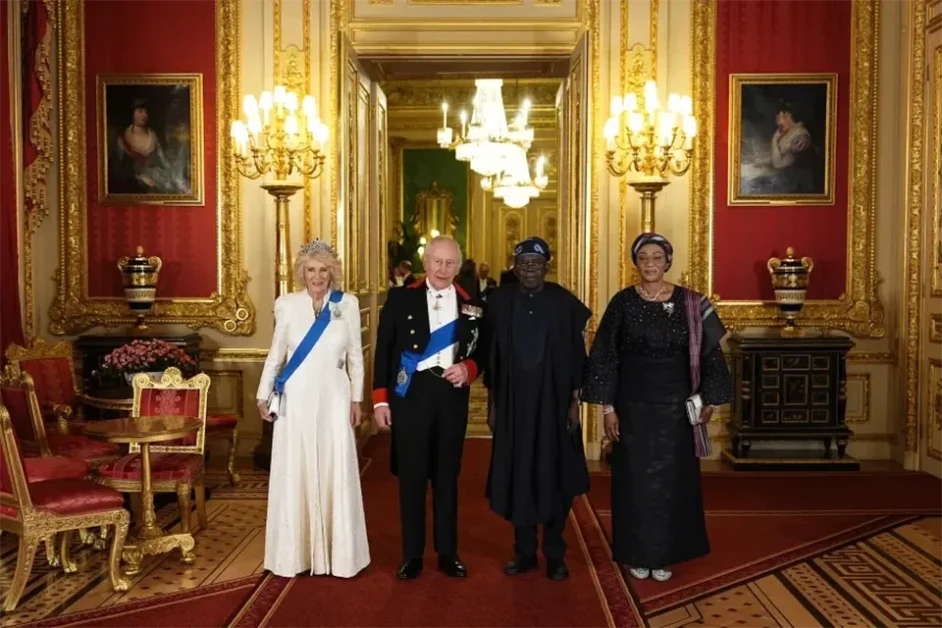
Palace protocol officers, it is understood, were thorough and gracious in every detail. Diplomacy is, after all, a contact sport — and on this evening, Britain played it beautifully.
THE JOLLOF QUESTION (WHICH SHALL NEVER BE RESOLVED)
No account of this evening would be complete without dwelling — at appropriate length — on the Jollof Rice Incident.
King Charles, ever the deft raconteur, recounted with obvious relish how only the week prior he had hosted a ‘Jollof and Tea’ Party at St. James’s Palace for young Nigerians of the diaspora who have flourished through his King’s Trust. The story itself was charming. What elevated it to diplomatic legend was the King’s deliberately evasive punchline.
“I was firmly assured that the Jollof was only the best: Nigerian, of course… or perhaps Ghanaian or Senegalese. Diplomatically, I cannot remember!”
King Charles III
The gasps. The laughter. The Nigerians in the room who felt, viscerally, that the word ‘Ghanaian’ had been said in jest. The Ghanaians — had any been present — would no doubt have had strong opinions. The Senegalese would have quietly felt they had been unfairly dragged into a bilateral dispute. King Charles, who has navigated the complexities of the Commonwealth for decades, clearly understood exactly what he was doing: landing a joke so perfectly calibrated that every camp felt simultaneously seen and gently teased.
It is, one must say, a masterclass in the ancient diplomatic art of saying everything by committing to nothing. If Foreign Office training does not already include a module on The Jollof Gambit, it should.
‘EKABO’ — YORUBA JOINS THE LANGUAGE OF ROYALTY
The opening greeting deserves its own moment of reflection. Yoruba is spoken by over 50 million people across Nigeria, Benin, Togo, and the diaspora. It is a tonal language of remarkable nuance and musical beauty, whose greetings carry layers of inquiry and care. “Ekabo” — welcome, you have arrived safely — is not merely a greeting. It is an affirmation. You are seen. You are valued. You have made it here, and we are glad.
“Se Daaa Daa Ni” — I hope you are well — extends that care further. These are words whose full warmth is carried in the breath and tone of the speaker, and by all accounts, the King delivered them with earnest warmth.
The effect in the banqueting hall was electric. For the Nigerian delegation, it was not a gimmick — it was a gesture. A monarch of one of the world’s most powerful states choosing to open his mouth in your language, on your first visit, is a form of recognition that no treaty text can quite replicate. Yoruba, that night, became — as our headline dares to say — a universal language that everybody in that room understood, regardless of what language they normally speak.
TWO SPEECHES, ONE EXTRAORDINARY MOMENT
King Charles’s address was remarkable for its texture as much as its content. He moved fluently between Hausa wisdom (“when the music changes, so does the dance”), Yoruba proverb (“rain does not fall on one roof alone”), and Igbo philosophy (“knowledge is never complete — two heads are better than one”). He acknowledged, without flinching, that “there are chapters in our shared history that have left some painful marks,” but did not retreat into apology theatre. Instead, he named the forward-looking partnership as the proper legacy of those who bore the weight of history.
He closed with a toast in Pidgin — “Naija No Dey Carry Last!” — which, for the uninitiated, translates roughly as: Nigeria never finishes last. The hall, we are told, responded as one might expect a room full of Nigerians to respond when correctly told their people do not finish last. Enthusiastically.
President Tinubu, for his part, delivered a speech of considerable dignity and political intelligence. He spoke of the Magna Carta and British democratic traditions that have informed Nigeria’s own constitutional journey. He acknowledged the debt owed to Britain for sheltering Nigerian pro-democracy activists during the dark military years — including himself. “My residence was placed under Metropolitan Police surveillance for protection following threats from agents of the junta,” he told the assembled guests, speaking with quiet gravity. “That solidarity remains etched in our collective memory.”
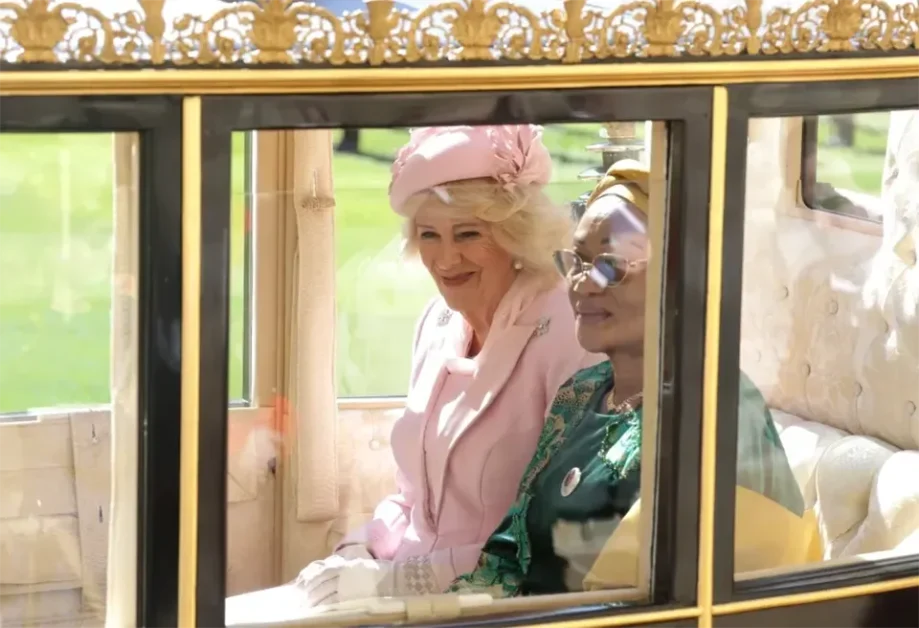
It was a moment that silenced the room. Here was a man who had once needed protection on British soil now standing in Windsor Castle as the president of a democratic nation, raising a glass — a mocktail, naturally — to the partnership between equals that had survived history’s most difficult chapters. If you were not moved, you were not paying attention.
THE LIVING BRIDGE
Beneath the pomp and the pageantry, both speeches returned repeatedly to the same theme: the more than half a million Nigerians who live in Britain are not a political abstraction. They are doctors holding the NHS together. They are Bukayo Saka and Eberechi Eze lighting up Premier League weekends. They are Maro Itoje winning line-outs for England at Twickenham. They are barristers sitting in the highest courts. They are the students and entrepreneurs whose energy has woven itself into the fabric of British life so thoroughly that, as the King observed, much of Britain’s culture is now, in truth, profoundly Nigerian.
The numbers alone tell a compelling story: Nigerian visitors spent £178 million in Britain in 2024. More than 251,000 Britons travelled to Nigeria in the same period. Nigeria is now the United Kingdom’s biggest export market on the African continent. The phrase ‘Made in UK,’ His Majesty noted archly, evidently now comes with “a distinctively Nigerian flavour.”
“From Afrobeats filling our concert halls to Nollywood captivating our screens — so much of Britain’s culture is profoundly enriched by Nigeria.”
King Charles III
AND THEN CAME THE EID BLESSING
King Charles, in closing, wished the millions of Muslims across both countries “Eid Mubarak” in anticipation of Eid El-Fitr — a gesture that, in the current global climate, felt less like a ceremony and more like a statement. He had opened in Yoruba, navigated Hausa, Igbo, and Pidgin, survived the Jollof Question with his neutrality intact, and ended with an Arabic blessing. It was, in the fullest sense of the word, a performance.
Not performance as artifice. Performance as in: an act carried out with full intention and skill, in front of an audience that mattered, on a night that will be remembered.
WHAT WINDSOR LEARNED FROM LAGOS
State Banquets at Windsor have a particular reputation for being immovable — for being precisely what they have always been, in precisely the way they have always been. Tuesday night suggested otherwise. A prayer room appeared. The alcohol did not. Yoruba echoed in halls that once heard only French and Latin. A West African head of state, fasting through a holy month, sat at the top table and was met not with compromise but with celebration.
Nigeria did not come to Windsor to be received. Nigeria came to Windsor, and Windsor — for one glorious evening — became a little bit Nigerian.
As the Hausa saying goes, and as the King himself reminded the table, when the music changes, so does the dance.
Windsor, it seems, has learned some new steps.