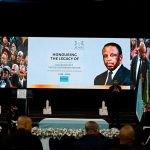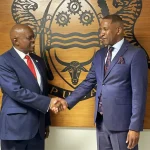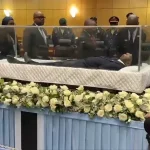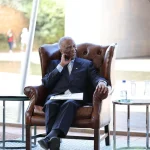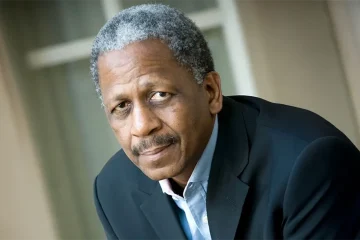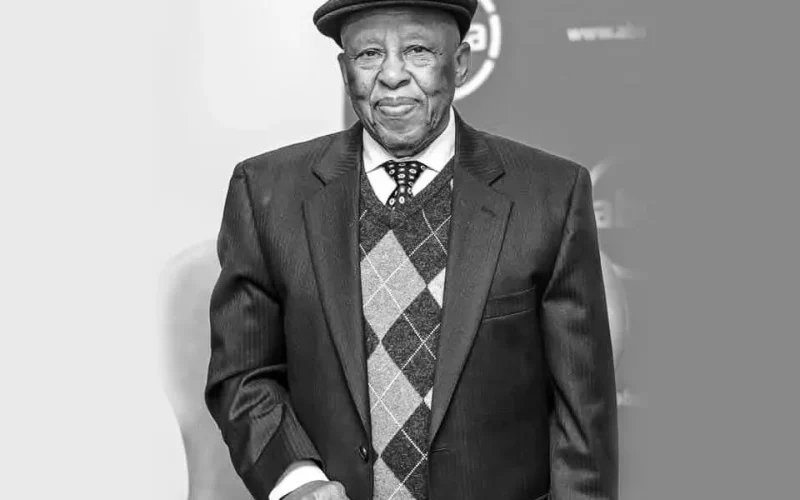
THERE is a particular kind of power that does not announce itself. It does not thunder into rooms or demand the orchestration of applause. It enters quietly, does its work with precision, and leaves the institution stronger than it found it. Festus Gontebanye Mogae, Botswana’s third president, who died in the early hours of Friday morning at the age of 86, possessed exactly that kind of power – and spent a lifetime proving that humility is not the opposite of strength. It is, in fact, its highest expression.
The news of his passing arrived as a quiet shock to a continent that has grown accustomed, in recent decades, to loud leadership. President Duma Boko announced three days of national mourning. Flags across Botswana were lowered to half-mast. And across Africa, those who had watched Mogae govern – his unhurried steadiness, his refusal to mistake high office for personal glory – reached, however imperfectly, for words that might do him justice.
“It is lonely at the top,” Mogae once told a young journalist. He said it not as a complaint, but as a statement of principle: that accountability is indivisible from leadership.
Mogae was born on 21 August 1939, in Serowe – the same storied town that gave Botswana its first president, Seretse Khama. There is something fitting in that coincidence: Serowe seems to produce men of considered consequence. From an early age, Mogae distinguished himself not through aggression or crude ambition, but through the quality of his mind and the seriousness of his purpose.
He was a top student at Moeng College and went on to read Economics at Oxford, then Development Economics at Sussex. Even as a young man far from home, he was already thinking about Botswana’s future. He wrote an influential article in Kutlwano arguing that September 30th – then marked as Protectorate Day – should be retained as a national holiday after independence. The colonial order was ending. Mogae was already thinking about the morning after.
He joined the Ministry of Finance and Development Planning in 1969, three years after independence. He rose steadily – Permanent Secretary by 1975, Executive Director for Anglophone Africa at the IMF, then Governor of the Bank of Botswana. His was a career built not on political theatre but on demonstrable competence and the quiet trust of those who watched him work.
Mogae entered formal politics in 1989, when he retired from the civil service to be specially elected to Parliament and appointed Minister of Finance. He became Vice-President in 1992 and won the Palapye constituency in 1994. By the time he ascended to the presidency in April 1998, he had established himself as something rare in the politics of any era: a technocrat with a conscience.
For Mogae, sound economic management was not merely administrative competence. It was a form of patriotism. He understood that diamond revenues are a gift that can curse a nation if not managed with discipline and foresight, and he spent much of his public life guarding against that fate. He preached fiscal responsibility not as a slogan but as a lived conviction. Botswana’s economy continued to grow steadily under his presidency, even as the country faced its gravest internal crisis.
What a leader does for the least protected among their people is the truest measure of governance — not what they do for the powerful.
If Mogae’s economic stewardship alone had defined his decade in the State House, he would still deserve commemoration. But it is his response to the HIV/AIDS crisis that elevated him into the company of Africa’s most consequential leaders – and revealed, most completely, what his particular form of strength looked like under pressure.
In the late 1990s, Botswana faced one of the highest HIV infection rates in the world. The pandemic was killing adults in the prime of their productive lives, orphaning children, and threatening to unravel the social fabric of the country in a way that no external adversary could have achieved. And across the continent, many leaders chose denial. They called it a foreign disease. They questioned the science. They wrapped their silence in a kind of wounded dignity that was, in the end, a form of cowardice.
Mogae did none of that. He spoke plainly, directly, and repeatedly about HIV/AIDS at a moment when plain speech on the subject carried enormous political and social risk. He adopted one of Africa’s most comprehensive national programmes against the pandemic. He chaired the National AIDS Council from 2000 to 2014. He made antiretroviral treatment a matter of public policy and public commitment. He understood that a leader’s credibility is most tested not when the news is good, but when the truth is frightening.
When he was awarded the Mo Ibrahim Prize for Achievement in African Leadership in October 2008 – as the honour’s first-ever recipient – former UN Secretary-General Kofi Annan offered a summation that cut to the heart of Mogae’s legacy: that his outstanding leadership had ensured Botswana’s continued stability and prosperity in the face of a pandemic which threatened the future of his country and people. It is a sentence worth sitting with. Stability and prosperity, in the face of existential threat. That is governance. That is leadership.
The Man Behind the Portfolio
To know only the statesman is to know only part of the man. Mogae was, by all accounts, genuinely humble and accessible – a quality that is more unusual in former heads of state than it ought to be. His humility has always been on display but was more pronounced a few years back, when, after paying tribute to opposition politician and former Mayor of Gaborone, Paul Rantao, he went home and shared a meal with ordinary citizens – away from trappings normally reserved for VIPs like him.
He remained active after leaving the State House in 2008, engaged in continental mediation efforts, including the crisis in South Sudan, and continued his advocacy against HIV/AIDS on the global stage. He was a patron of Junior Achievement Botswana, president of the Botswana Society, a member of the Lions Club of Palapye, and associated with SADC since its earliest days. The list of civic organisations he served is not a resumé. It is a portrait of a man who understood that public service does not end with the handover of executive power.
And that handover itself was a final act of integrity. In 2008, Mogae ceded the presidency to his vice president, Ian Khama – completing the maximum two terms permitted by the constitution, no more and no less. He did not seek an extension. He did not suggest that only he could manage the transition. He stepped aside, because the constitution said he should, and because he believed in institutions more than he believed in himself.
Khama, paying tribute, called Mogae more than a predecessor – a guiding light, a trusted counsellor, a custodian of wisdom. “We mourn a great statesman,” Khama said, “but also celebrate a life lived in full service to his people.”
He stepped aside, because the constitution said he should — and because he believed in institutions more than he believed in himself.
What Humility Looks Like at the Top
There will be, in the coming days, a great many tributes to Festus Mogae. They will catalogue his honours – the Naledi Ya Botswana, the Ibrahim Prize, the honorary doctorates from Oxford and the University of Botswana, the awards from Harvard, the Congressional Black Caucus, and the African Union. All of it is deserved. None of it is the point.
The point is harder to name, and perhaps more important to try. Mogae governed a small, landlocked, mineral-wealthy country and managed, against the historical odds, to leave it better than he found it. He did so not by manufacturing a cult of personality, not by suppressing opposition or inflating his own mythology, but by doing the quiet, difficult, unglamorous work of competent governance – and by speaking honestly when honesty was the most costly thing a leader could offer.
He was a man who knew, as he told a young journalist, that it is lonely at the top. He said it not as a complaint, but as a statement of principle: that accountability cannot be shared out, delegated, or deferred. Ultimately, the responsibility rests with leadership. It is a lesson that a generation of African leaders – many of whom seem to have drawn precisely the opposite conclusion – would do well to absorb.
Botswana mourns. The continent mourns. And somewhere in that mourning is a question worth sitting with: how many Mogaes do we have left? How many leaders are prepared to wield power without being seduced by it – to speak truth without calculating its political cost, to walk away from office not because they are forced to, but because they always intended to?
Festus Gontebanye Mogae was not a perfect man. No statesman is. But he was, in the most meaningful sense, a principled one. He understood something that escapes many who reach the heights he reached: that the office was never his. He held it in trust for the people of Botswana, and he returned it intact.
That is not a small thing. In the Africa of 2026, it is a rare and luminous example.