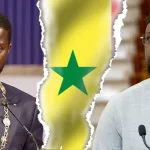
SENEGAL’S President Bassirou Diomaye Faye has refused to sign into law electoral amendments that would have cleared the way for Prime Minister Ousmane Sonko to contest the 2029 presidential election, sending the bill back to parliament in a move widely interpreted as the opening shot in a succession war between Africa’s two most closely watched political allies.
The decision, announced on 8 May 2026, came less than two weeks after the ruling PASTEF party’s dominant National Assembly majority passed the amendments in an emergency sitting, voting 128 to 11 in favour of changes to Articles L29 and L30 of the Electoral Code – provisions that have barred Sonko from the ballot since his defamation conviction in 2023.
President Faye’s office cited a procedural irregularity – the transmission of two different versions of the adopted text – as grounds for the referral back to parliament. The explanation was swiftly dismissed by political analysts and opposition figures in Dakar, where the prevailing reading of the move is unambiguous: the president is asserting his independence from the man who made him.
Sonko, 51, was convicted in May 2023 of defaming a minister he had accused of embezzling public funds and was ordered to pay EUR300,000 in damages. The Supreme Court upheld the conviction in January 2024 and again in July 2025, effectively disqualifying him from the presidential election that his own political vehicle, PASTEF, went on to win – with Faye, then PASTEF’s general secretary, as the candidate. Faye won with 54.28 percent on his first attempt, campaigning from a prison cell.
He assumed the presidency on 2 April 2024 and immediately appointed Sonko prime minister. The arrangement was understood, inside PASTEF and across Dakar’s political class, as transitional: Faye would hold the office while Sonko pursued legal rehabilitation. The electoral amendments, driven through parliament by a PASTEF bloc that holds 130 of 165 seats, were the mechanism for that rehabilitation. Faye has now blocked them.
The president has been direct about where authority lies. ‘If he remains prime minister, it is because he retains my confidence,’ Faye said in remarks directed at questions about Sonko’s tenure. ‘When that is no longer the case, there will be a new prime minister.’ It was language that left little doubt about the direction of travel.
Visible cracks have been forming for months. A ‘Diomaye-President’ coalition – pointedly named for the president rather than the prime minister – emerged earlier this year, drawing support from figures across party lines. Sonko’s allies responded with the APTE coalition, holding a counter-mobilisation in Dakar. The ruling party was fracturing in public, its fault lines mapping directly onto the ambitions of its two leaders.
On the eve of the National Assembly vote on 28 April, the presidency released a sweeping package of draft constitutional and electoral reforms of its own – a move analysts read as an attempt to reframe the Sonko-driven bill as personal legislation, and Faye’s process as the legitimate national alternative.
The opposition has chosen to watch. The main opposition bloc, Takku Wallu, declined to mount any constitutional challenge to the electoral bill, announcing it would not ‘interfere in the internal tensions shaking the ruling party.’ It is a calculation that the wound, left alone, will deepen.
Constitutionally, parliament can re-adopt the original text and return it to Faye, who must then either sign it or refer it to the Constitutional Council. PASTEF’s majority makes re-adoption straightforward. Faye’s manoeuvre may buy only days in legal terms. In political terms, it has already bought considerably more.
Senegal distinguished itself in recent years as a rare democratic anchor in a West African region battered by coups. The country’s 2023-2024 crisis — which left protesters dead in the streets over Sonko’s legal battles — was resolved through elections that produced the very partnership now under strain. Three years before 2029, the battle for what comes next has begun.