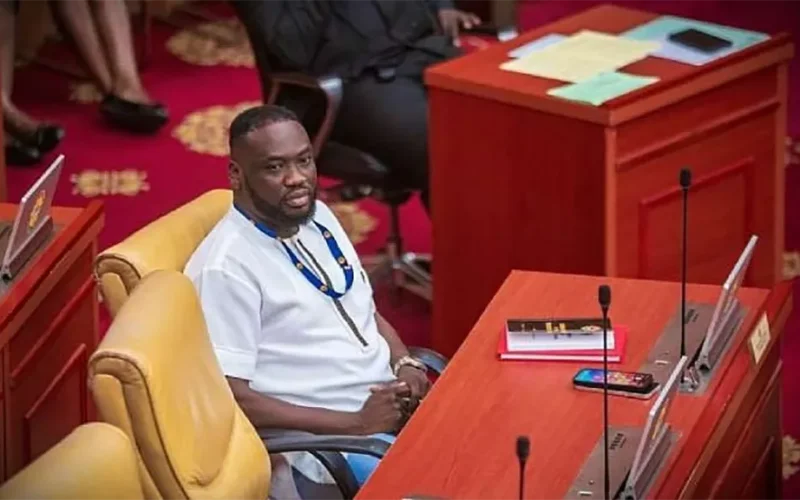
ON the morning of Sunday, 10 May 2026, a Ghanaian Member of Parliament stepped off a KLM flight at Amsterdam’s Schiphol Airport, passport in hand, family in mind – his wife and children waiting for him in London. He never completed the walk-through immigration. Before the day was done, Kwame Ohene Frimpong, the independent legislator for Asante Akyem North and one of Ghana’s most watched political figures, was in Dutch custody, detained on the basis of a US warrant that his own parliament had not seen, could not read, and to this day has not received in authenticated form.
What followed was not merely a legal arrest. It was the opening move in a high-stakes geopolitical chess match – one that pits American prosecutorial reach against West African sovereign dignity, and tests whether the democratic institutions of a proud African nation are prepared to defend one of their own against the long arm of US law enforcement.
Parliament confirmed the detention on 12 May 2026 in a statement signed by the Clerk to Parliament, Ebenezer Ahumah Djietror, noting that the Speaker and leadership were engaging Ghana’s diplomatic mission in The Hague for further details. The language was measured, almost clinical. The reality on the ground was anything but.
Frimpong was detained on Sunday, 10 May 2026, after arriving at Schiphol on a KLM flight from Accra. The MP, who was travelling on a diplomatic passport, was reportedly on a private trip to the United Kingdom, where his family resides, and was arrested while in transit through the Netherlands.
This is the first critical fact that Accra must grapple with: the arrest did not happen on Ghanaian soil. It happened in Amsterdam – in a European transit hub, thousands of kilometres from Ghana’s jurisdiction, beyond the reach of Ghana’s Extradition Act, beyond the protective canopy of parliamentary privilege under Ghanaian domestic law.
A combination of legal, political, and operational factors plausibly explains why a transit-arrest at a European hub may have been preferred over the bilateral extradition route under Ghana’s Extradition Act, 1960 (Act 22). In plain terms: whoever orchestrated this move appears to have deliberately avoided the political complexity of requesting Frimpong’s arrest on Ghanaian soil, where the government would have had to make a public decision and Parliament would have had advance notice. Schiphol was cleaner, faster, and harder to intercept.
Legal practitioner Martin Kpebu noted that because securing the MP through the Ghanaian government had proven politically difficult, authorities waited for him to travel before acting. “Extradition is politics,” he said.
That observation carries enormous implications for every African leader, every minister, every lawmaker who travels abroad under the assumption that a diplomatic passport is armour.
The Majority Chief Whip, Rockson-Nelson Dafeamekpor, revealed that the arrest warrant was issued on 26 April – and that the MP personally contacted him from custody saying: “Boss, I’ve been arrested.” Lawyers were only shown the warrant but were not given a copy, and US authorities told Ghanaian officials they were under no obligation to reveal the grounds for the arrest.
Read that again. A sovereign nation’s parliament — duly elected, internationally recognised, carrying the democratic mandate of the Ghanaian people — was told by US authorities that they had no right to know why one of their members was being held.
The US Department of Justice formally declined to comment on the detention in an email received by JoyNews Research in the early hours of Friday, 15 May 2026. The DOJ’s Senior Communications Advisor for International Law Enforcement simply said the US had nothing to offer. The FBI’s National Press Office, asked six specific questions — including whether an unsealed indictment existed, which US Attorney’s Office was handling the matter, and whether extradition would be sought — did not address any question on its merits and deferred to the DOJ.
Washington’s silence is itself a statement. It says: we act, and we do not explain. Whether that posture is justified by the alleged criminality or constitutes an affront to bilateral diplomatic norms is a question Ghana’s Foreign Affairs Ministry must now put squarely on the table.
The allegations themselves, sourced from anonymous quarters rather than official documentation, are serious. Sources familiar with the case allege that the investigation involves suspected financial crimes, including money laundering and romance scams, with an estimated value of up to $32 million. However, these allegations have not been officially confirmed by Dutch or US authorities. A source also told GhanaWeb that the investigation into the allegations has spanned more than a year. These remain unverified. The integrity of accountability journalism demands that we state that plainly: no charge sheet has been made public, no indictment unsealed, no court record accessed.
Ghana Mobilises – Swiftly and Seriously
Ghana’s institutional response has been, in the circumstances, commendably rapid.
The Majority Chief Whip confirmed that a war room of sorts had been activated: “Since then, we have brought in the Foreign Minister, brought in our Ambassador to The Hague, brought in the Attorney General because he has to deal with some legal issues in terms of travelling on a diplomatic passport. The Speaker himself has been brought in, the Clerk. So we have coordinated this matter very well.”
The Majority Leader, Mahama Ayariga, who was transiting through Heathrow Airport at the time, diverted his journey to Amsterdam’s Schiphol Airport to engage Dutch authorities, holding discussions for about two to three hours. That is not the action of a government caught flat-footed. That is an institution in motion.
Crucially, the Majority Caucus engaged a Ghanaian lawyer qualified to practise in The Hague to represent Frimpong before Dutch prosecutors, with the Attorney-General examining the legal and diplomatic implications of Frimpong’s travel on a diplomatic instrument — an examination expected to feed directly into Ghana’s posture on any extradition request the United States may file.
The MP has since been transferred from Schiphol and is now held at the Penitentiaire Inrichting (PI) Haaglanden in Scheveningen — the same institution that houses detainees before the International Criminal Court, a facility that accommodates those held for proceedings at international tribunals. The symbolism is not lost on observers.
The Diplomatic Passport Question: Ghana’s Potential Knockout Blow
The most consequential legal argument available to Ghana is also the most fragile.
Frimpong was travelling on a diplomatic passport but on a private trip — a distinction that Dafeamekpor acknowledged complicates any claim of diplomatic immunity. The Attorney-General has been asked to provide an opinion on whether diplomatic privileges can apply under those circumstances.
Under international law, specifically the Vienna Convention on Diplomatic Relations of 1961, diplomatic immunity is not automatically conferred by the possession of a diplomatic passport. It depends on the individual’s functional status — whether they hold a diplomatic post recognised by the receiving state. A sitting Member of Parliament travelling privately, even on a diplomatic passport, occupies a contested grey zone.
Article 117 of Ghana’s 1992 Constitution provides that civil or criminal process from any court or place out of Parliament shall not be served on, or executed in relation to, a Member of Parliament. The constitutional immunity, while not absolute, is expected to feature prominently in any submissions Frimpong’s lawyers may make before the Dutch courts and in Ghana’s diplomatic representations.
Whether that constitutional provision has extraterritorial reach — whether it binds a Dutch court — is precisely the question that will determine the trajectory of this case.
A Pattern, Not an Anomaly
Ghana would be wise not to treat this as an isolated incident. It is not.
The Frimpong case evokes the precedent of November 2005, when then-NPP Member of Parliament Eric Amoateng was arrested in the United States for drug trafficking — a case that paralysed Parliament for months. More recently, former Finance Minister Ken Ofori-Atta faced legal scrutiny abroad, with US Immigration and Customs Enforcement describing him as an “illegal alien” who overstayed his visitor visa.
The accumulation of these cases points to something systemic: a new era in which Ghanaian — and more broadly African — political elites face a globalised accountability environment that domestic immunity cannot shield them from. This is both appropriate, where genuine criminality is concerned, and alarming, where the process is opaque, unilateral, and immune to the diplomatic norms that should govern relations between sovereign states.
The question Ghana must now answer publicly is not only whether Kwame Ohene Frimpong is guilty or innocent. That is for courts to determine. The question is whether a nation of 33 million people, with a functioning parliament, an independent judiciary, and its own extradition treaty obligations, is entitled to be treated as a partner in the administration of justice — or merely a jurisdiction to be bypassed when Washington determines the domestic route inconvenient.